The Snapper That Would Not Die
On the negotiable boundary between life and what comes after it.
On the morning I went to market, I had no intention of witnessing anything metaphysical.
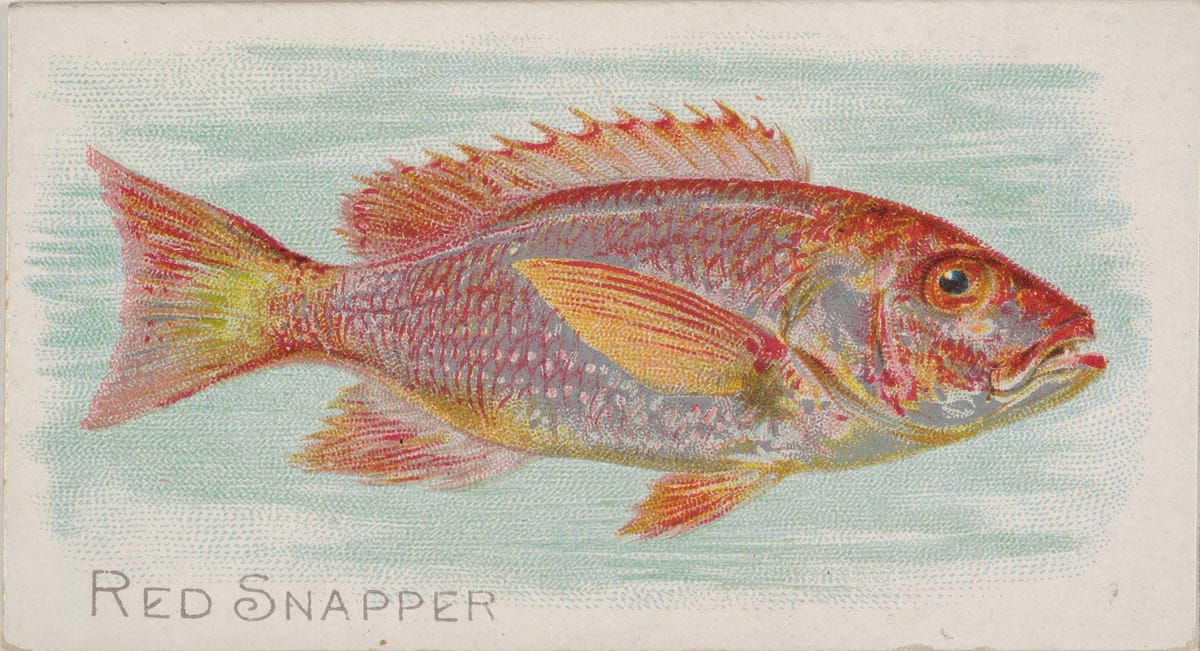
I was living in Northern Italy at the time, a short drive from the Adriatic, and had decided to make zuppa di pesce — fish soup. The market carried only what the local fishermen had brought in the afternoon before: skate, monkfish, cuttlefish, shrimp, and one red snapper that was still, demonstrably, alive — sluggishly twisting on the counter with what I can only describe as inconvenient persistence.
All of it went into a plastic bag with a little water. I trotted home.
The bag went on the kitchen table. I began the soup base — garlic, tomato, olive oil, parsley, salt, hot peppers — then turned to the fish. Dumping the bag into the sink, I found the snapper not merely alive but more active than before. She had rallied. She (and it was a she — more on that shortly) was twisting with a kind of indignant energy, as though the journey had revived rather than depleted her.
I moved her to the other section of the sink and began cleaning the rest of the fish, watching from the corner of my eye as she continued to thrash. I decided to tend the soup base and wait for her to die.
Wait, I did. But she didn't.
I know what needs to be done when you are cleaning fish. I have done it before. Furthermore, I am not a queasy person. But I had never done it to something that was, by any reasonable definition, still living. The snapper was clinging to life with a tenacity I found increasingly difficult to witness — and increasingly impossible to ignore, given that the soup was waiting.
I decided, as an act of mercy for all parties, to end it.
With a cleaver, I cut off her head.
She did not die. She thrashed harder.
I stood at my kitchen counter, cleaver in hand, staring at a headless fish that was moving with more urgency than it had shown all morning. The horror of it was total and immediate. I knew, even then, the scientific explanations — the decentralized autonomic nervous system of fish, the brain governing higher functions while the spinal cord independently manages muscle movement. Severing the head removes the brain; the spinal cord remains. The body doesn't know yet. The body keeps going.
Knowing this did not help.
What I have since learned is that the red snapper is an exceptionally hardy fish — well known among fishermen and fish market workers for precisely this behaviour. She had outlasted everything else in that bag, not by chance but by constitution. She was built for survival in a way that made my kitchen an extended inconvenience rather than a conclusion.
But the knowledge that comes later is always too late for the moment that demands it.
Watching her, I found myself thinking — eventually, not immediately, because immediately I was only horrified — about how many people, across how many centuries, had watched a fish move after it should have been dead and reached for something other than biology to explain it.
In some coastal and island cultures, fish that continued moving after death were understood to carry messages from the spirit world. In Japanese folklore, the persistence of life after apparent death is connected to the idea that the spirit — the tamashii — takes time to leave the body. The practice of ikejime, the swift and respectful dispatch of fish, was not only about meat quality; it was about allowing the spirit a clean departure. My snapper had been afforded no such courtesy, and was perhaps making her position known.
The Japanese concept of mono no aware — that gentle, melancholy awareness of impermanence — would find in her continued movement exactly the kind of poignant, uncomfortable truth it seeks out: the boundary between life and death is not a threshold but a gradient. Not a door that closes, but a light that dims.
Shinto belief holds that every living thing possesses a kami, a spirit, and that the spirit does not vanish at the moment we decide death has occurred. Traditional Japanese fishermen would offer brief prayers over their catch — an acknowledgement of the departing spirit, a thank-you for the life given. I offered no such prayer. I offered a cleaver, and achieved nothing.
Hawaiian tradition goes further still: certain fish are understood as ancestral spirits in animal form. A fish that refused to die was a fish that refused to leave — an ancestor attempting communication. Had anyone from that tradition been with me at the market, the snapper would have gone back into the water before I got anywhere near a bag.
The ancient Greeks, closer to the Adriatic than any of the others, would have read her movement as divine animation — an omen, a sign. My countertop, in other words, was the site of phenomena that humans have been watching with wonder, reverence, and revulsion for tens of thousands of years. I was merely the latest in a very long line of reluctant witnesses.
I had by now waited long enough that she lay still, and I told myself, firmly, that this was over.
Mustering what remained of my composure, I clipped the fins and the tail, scaled her, and inserted my knife into the body — headless, tailless, finless — intending to remove the guts and the eggs I could see she was carrying.
She jumped.
Not a twitch. Not a residual tremor. She jumped, with a vigour that seemed, at the moment, almost personal.
I grabbed her and flung her back into the sink, where she continued to move. And I began to cry — not the dignified, single-tear variety of crying, but the kind where you gulp air, your nose runs, your shoulders heave, and you make sounds you would prefer no one ever hear. The kind of crying that arrives when something has finally exceeded your capacity to manage it with composure.
She had no head, no guts, no tail, and no fins. She had eggs, which I had seen, and which I could not stop seeing.
It was too late to drive her to the Adriatic. There was no version of this that ended well. What had begun as a market purchase, just two hours before, had become something for which I had no adequate conceptual framework.
I told myself, as one does, to stop it. To get on with things. To put the fish in the soup.
So I did. Despite continued movement, I placed her into the boiling soup base. She flapped once, twice, and was finally still.
My husband at the time was a Southern Italian from humble origins — practical, intelligent, and entirely untroubled by the business of fish. His mother, from whom I had learned to make this soup in the first place, was similarly constituted: hard-working, natively wise, and not given to existential crises over dinner. Either of them would have put the snapper in the pot two hours earlier and felt nothing in particular about it. His mother might, at most, have made a quiet sign of the cross over the pot.
He came home from work, sat down, and ate.
Asked why I wasn't having any, I replied that I wasn't very hungry — which was true, in a technical sense, without elaborating on the reason.
He shrugged. He said the soup was delicious, and made particular mention of the cuttlefish.
The snapper, I recall, he did not specifically note. But she was there. She had insisted on being there, at considerable cost to both of us, and I suppose that is the closest thing to a conclusion the story offers.
Nothing is quite as dead as it appears. Nothing contains only that which it seems. The boundary between life and death is, improbably, negotiable — and the moment of crossing it is not a fixed point but a long, gradual, sometimes undignified passage.
She taught me that. I made her into soup.
I’m not sure which of us came out ahead.