The Woman Who Could Taste Everything: A Modern Fairy Tale
All the best stories begin with an ordinary moment that turns out not to be ordinary at all. This one begins with an orange.
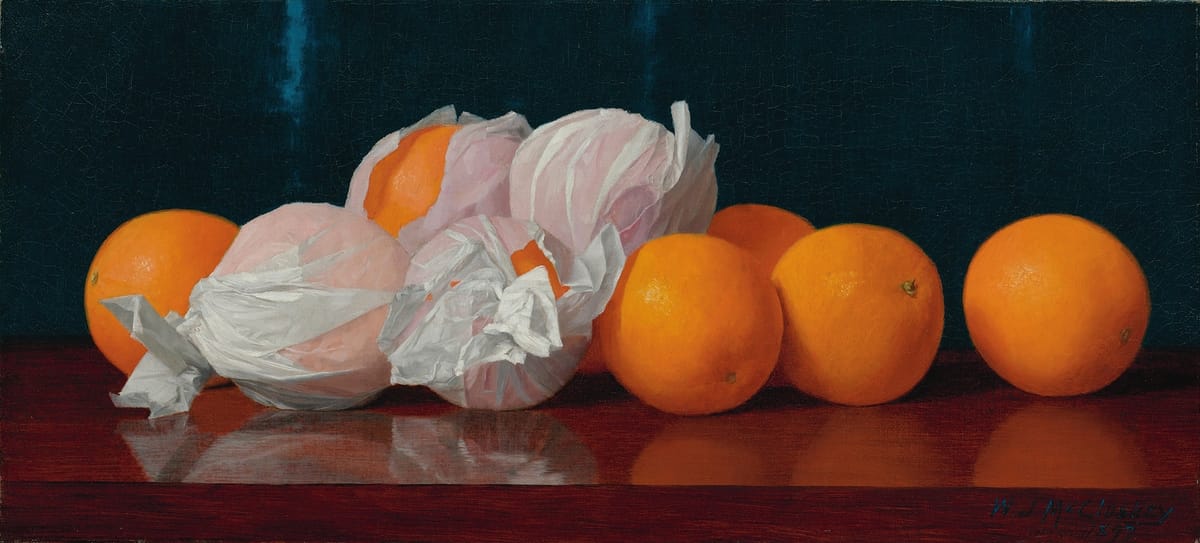
There once was — or there once was not — a woman who woke one Tuesday morning in early February, took a bite of an orange and understood, with a clarity that arrived all at once and without invitation, that she was eating Sicily.
Not the idea of Sicily. Sicily itself. The particular volcanic dark of the soil beneath the grove, the tilt of the winter sun across the Ionian coast, the hands of the man who had picked this orange — a man with a sore shoulder and a daughter who was getting married in the spring, with thoughts about the cost of everything and a specific memory of his own father in this same grove, decades before, and the aroma of the blossoms in April which, if you have never been to a Sicilian orange grove in April, is almost unbearably beautiful.
All of this arrived in the woman through the orange, in the space of a single bite, the way music arrives — not as data, but as experience, full-bodied and simultaneous, there all at once and then still there, resonating.
She sat with the orange half in her hand for a very long time.
Then she ate the rest of it, slowly, with an attention she now understood it deserved.
She was not old, not young — in that particular decade of a life when the world has mostly finished surprising you, and you have settled into your assumptions, until something comes along and removes them all, efficiently and without apology, like a hand sweeping a table clear.
She lived alone, in a city, in the way that many people live alone in cities: with routines which had calcified into comfort, with friends she saw regularly, but perhaps not deeply enough, with a job that was useful and unremarkable, and with a persistent, low-grade sense that something about the way she was moving through the world was slightly off — as though she were reading a book with the light not quite right, able to make out the words but missing something in the register.
Food was something she had always liked in an ordinary way. She had always cooked reasonably well, bought reasonably thoughtfully, eaten with moderate gratitude and no particular ceremony.
Yet, after the orange, none of that was possible anymore.
She did not know what to call what had happened to her. She did not try to explain it. On the following Saturday, she went to the market with the careful attention of someone entering a new country, which is exactly what it was.
She picked up a clementine from Morocco and felt the dry warmth of the Atlas Mountain foothills, the particular quality of light there — harder and more golden than Sicily’s, the thoughts of the people who worked the grove earthier, less complex, a different relationship to time — and beneath it all, beneath the human thoughts, the deeper vegetable thought of the tree itself, which was not thought in any language she knew but was closer to sensation: the long pull of water upward through the root, the slow conversation with the sun, the making of sweetness out of light.
This she had not expected. She stood in the market aisle with a clementine in her palm and tears on her face, and the other shoppers moved around her with the adroit urban indifference of people who have learned not to make eye contact with those who are crying in the produce section.
She bought the clementines. And she bought raspberries from a farm two counties over that she recognized — truly recognized, the smell of her grandmother’s garden arriving in her so completely that she had to grip the shelf. Then kiwi from New Zealand, which gave her a vertiginous green rush, the cold Pacific in it, the clean eucalyptus thoughts of a country at the bottom of the world that is convinced, on some cellular level, of its own great distance from everything else and has made a kind of private peace with this.
She bought maple syrup from Quebec — and this was perhaps the most beautiful, because it came through to her as something between a memory and a dream: the cold of a maple wood in late winter, the particular creak of snow underfoot, and then beneath that the tree’s own understanding of this season, which was not grief at the tapping but something closer to what she could only call generosity — an abundance pressing outward from the heartwood, offered freely, in the way that trees offer things.
She drove home with her bags, pulled over once to allow herself to fully cry, and then continued.
The fermented things were another matter entirely — deeper, stranger, with a quality she hadn't anticipated.
She had always kept yoghurt and sourdough in her kitchen, had always eaten kimchi with a vague awareness that it was good for her. She understood now that good for her was the smallest possible thing to say about it.
The yoghurt opened to her like a conversation in a language she had not known she spoke. The bacteria were not thinking — not in any way she could have described to anyone who asked — but they were not not-thinking either. They were doing, which in the very old understanding of things was always another word for being, and their doing had a quality she could only call intention: the slow, purposeful transformation of milk into something more than milk, a collaboration between the living cultures and the liquid they inhabited, each altering the other over time, each necessary to what the other was becoming.
This, she thought, is what it means to work.
The sourdough was ancient. Not the particular loaf, but the starter — its yeast carried lineages longer than most countries, longer than most languages, longer than any story she had been told about where things came from. It tasted, under its ordinary bread flavours, of time. Real time, not the kind measured in days, but the geological, tidal, patient kind that operates beneath the human scale. She ate it slowly and felt briefly humbled in a way that was not uncomfortable, the way you feel when you stand at the edge of the ocean, and it is very large, and you are very small, and this proportion is an unexpected relief.
The kimchi was the strangest of all. It came to her in layers — the cabbage’s own cool memory of the field it had grown in, the hands that had prepared it, but also the long, dark, fermenting weeks in the jar, during which the bacteria had conducted what she could only describe as a kind of wild, roiling democracy. There was nothing quiet about it. It arrived in her the way a market sounds when everyone is talking at once, and somehow it still makes sense — bright, specific, alive.
She ate her fermented things with enormous gratitude. She began to say thank you when she ate. Not performatively — she did this alone, in her kitchen, in a low voice, aware of how it might look from outside and not particularly caring. The orange from Sicily deserved it. The grandmother-raspberry deserved it. The ancient yeast deserved it in ways she was only beginning to understand.
Then came the meat.
She had eaten meat all her life without question, in the way of her culture and her time, with no more thought than she had given to the orange before Sicily arrived in her mouth. She understood, abstractly, that it had been alive. Before now, she had not understood what that meant.
She ate a piece of venison on an evening in autumn, cooked simply, because she had been given it by a friend who hunted responsibly and who had spoken about the animal with respect. She was not prepared for what came through.
The deer’s life arrived first — the forest, properly tasted, not as a postcard image but as a sensory reality, the network of smells and sounds that constituted a living forest for a creature whose world was almost entirely composed of them. There was a depth to it that she had no framework for: the deer’s knowledge of its own territory, learned over years, lived in the body, the forest as a kind of home that operated through scent and memory and fine-tuned alertness. A beautiful, complicated, lived life.
Then the shot.
It came through clean and sudden — not prolonged, because the hunter had been skilled and careful — but it came through, and she sat with it, and she did not look away from it. This was the contract, she understood. The life given. The death required. The least she could do was witness it with the full attention it deserved, rather than the careful inattention she had practised all her years.
She ate the venison with gratitude that was also grief. She thought this was correct.
The fish was different. Panic in the nets — not the singular, clean shock of the venison, but a collective confusion, a thrashing at something that had no name for it, no framework, no ability to make sense of the sudden arrest of water and movement. Wild-caught fish still carried the sea in them, cold and vast and genuinely ancient, and she was grateful for that — grateful for the ocean’s thoughts, which were the oldest thoughts on earth. But the manner of the dying was harder.
She reduced her fish, and when she ate it, she was very still.
She did not mean to eat the factory meat. It was at a party — a tray passed, she took a piece of something without thinking, and then it was in her mouth.
She set down her drink.
It was not dark, exactly. She had braced for darkness and found something she could not have anticipated and which was, in its way, worse. It was blankness. The blankness of a life lived in a space too small to move through, surrounded by others in the same condition, without grass or light or the smell of real air or any of the sensory richness through which an animal knows that it is living and that the living has some quality, some texture, some content. The animal had thought almost nothing, because there had been almost nothing to think with. And then — at the end — the fear, which was real and sharp and had no context, because there had never been enough life to give fear its proper frame.
She put the piece of meat on a napkin. She excused herself. Outside, in the cold air, she stood for a while and breathed.
She was not angry. Anger felt insufficient. What she felt was something quieter and more serious — a form of sorrow that had the quality of resolution. Something had to change. She simply did not know yet what she had the power to change.
The processed food she discovered by accident, in a moment of road-trip desperation — a service station off the highway, a bag of something brightly coloured, a hunger that felt like a small emergency.
She opened the bag and ate one piece.
The noise was extraordinary.
It came through not as sensation but as cacophony — a Tower of Babel of confused signals, a hundred different substances from a hundred different origins all present simultaneously, none of them with any coherent story to tell because they had been so thoroughly processed away from their origins that no story remained, only the echo of stories, the ghost of the signal, fragments of what had once been a potato and what had once been a wheat field and what had once been something she couldn't identify at all — some synthetic thing that had never had a life to remember, emitting a kind of white noise that was somehow louder than anything she had heard from any living food.
It tasted, underneath the salt and the engineered flavours, of forgetting. Of things that had been made to have no history, because a history would complicate the transaction.
She put the bag in the bin. She drove to the next town and found an apple from an orchard fifty miles north and ate it in the car park with her eyes closed. The orchard arrived in her — specific, rooted, the particular thoughts of an apple tree in late autumn, which are the satisfied thoughts of a thing that has completed its cycle and done so well. Her breathing began to slow.
She thought about what she wanted the world to be, and what it was, and whether there was a path between those two things that a single person could walk.
She began, quietly, to live differently — not dramatically, not in the way of people who make their private resolutions into public performance, but in the accumulated small ways that eventually constitute a life. She bought from those whose methods she could taste-trust. With more attention, she ate less. She was not perfect: she had learned that was not available to anyone who lived in the actual world and needed to eat in it. But she was present in a way she had not been before. She ate with gratitude, and she meant it, specifically, for each particular thing.
And she began to wonder.
She wondered it the way you wonder about something that is probably impossible but that you cannot quite leave alone. She wondered it at her kitchen table with the last of a bottle of Quebec maple syrup, which she ate slowly, from a spoon, while the maple wood in winter came through her in gold and cold and extraordinary generosity.
What if everyone could taste this?
Not as an abstraction, but as a real question, given her full attention. What if the man at the party — hand on the tray, taking the blank meat without thinking — could taste what she tasted? What if the child tearing into the bright bag at the service station could hear the cacophony she had heard, and feel the apple’s orchard-song waiting fifty miles north as a viable alternative? What if every person who ate — which was every person, which was everyone alive — could receive, from their food, the full account of what it was and where it had been and what it had cost?
She did not think it would solve everything. She was not naïve about the world, which is large and complicated and rarely changed by any single thing. But she thought it would change something. She thought it would make the transaction visible, in a way that visibility changes things. She thought that people, given the full truth of what they were eating, would not simply shrug and continue — or not all of them, not forever. If only it could be felt, she thought gratitude might be teachable.
She did not know how to give this gift. She did not know whether she had any power to give it. But she held the question with her, the way you hold on to something you love — not crushing it, not putting it down, just carrying it, carefully, wherever you go.
She asked it of the food she ate. She sent it into the bacteria of her sourdough, into the yeast, into the old living networks of the things she trusted. She whispered it against the skin of fruit. She offered it, in her own wordless way, to the forests and fields and oceans whose gifts arrived daily in her kitchen.
Whether anything heard her, she could not say with certainty.
But she thought the maple syrup, on the last spoonful, tasted briefly of spring. Of things about to open. Of sap rising in the dark through cold wood, patient and certain, toward the light.
She took this as an answer of sorts.
She put the spoon down. Sitting in her kitchen, the early morning light comes in at an angle she never stopped finding worth attention. She thought about Sicily, and the man with the sore shoulder, and his daughter’s wedding in the spring. She thought about the deer in the autumn forest, its long knowledge of its own territory; about the democracy of kimchi, the ancient patience of yeast; and the orchard-satisfaction of the apple in autumn.
She thought: all of this is available. It has always been available. It is waiting in every bite, if you could only be still enough to taste it.
And then she made her breakfast, and she was still enough, and she did.
─── ❖ ── ✦ ── ❖ ───
There was a philosopher — the Daoist Zhuangzi — who once dreamed he was a butterfly, and woke uncertain whether he was a man who had dreamed of being a butterfly, or a butterfly now dreaming of being a man.
The woman who could taste everything had a similar uncertainty, in her quieter way. She was not always sure whether she was eating the orange, or whether the orange, briefly, was eating her — exchanging something, passing something across the membrane between lives, making a gift of itself and receiving, in return, her full attention and her gratitude.
She thought this was a fair trade.
She thought most things would be fair trades, if we could only pay the right currency.
The right currency, she had learned, was attention. Was presence. Was the willingness to taste what you was actually being tasted, to receive what is actually being given, to know — really know, in your body and not just your head — that what arrives at your plate has a history, and the history is real, and it deserves at minimum the courtesy of being known.
This is not a very complicated lesson.
It is, nonetheless, one the world has not yet learned.
She kept hoping. She kept eating.
She kept tasting everything.