The Return of the Ducks
On homecoming — theirs and mine — and the land that holds us all without distinction.
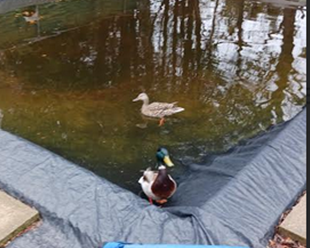
Every spring, toward the end of March or the beginning of April, a mallard couple arrives in my backyard.
They come to swim in the rainwater and snow-melt that has accumulated over winter on the tarp covering our in-ground pool. They have been doing this for decades — not the same couple, of course, but a continuation of duck families, generation folding into generation, returning to the same patch of water on the same traditional grounds. Much like our own human habitation of this particular spot.
I moved to this house in 1961, left in 1974, and returned in 2005 after my parents died. The pool has been here since 1967. We still use the old canvas tarp in winter rather than the rigid modern covers now fashionable among pool owners, and I am glad of it. The rigid covers are sensible — they eliminate the accumulated water, the ice, the ever-present concern of an animal or person falling through — but they would also eliminate the ducks. Some inefficiencies are worth preserving.
In winter, when I was young, the pool was drained to just below the jets and long logs were placed along the sides to prevent the concrete from heaving in the freeze. It made a small, practical skating rink. I never mastered the skill, but I watched my parents move over it — gracefully, with precision — and the memory of that has stayed in my body the way certain things do: not quite thought, not quite feeling, something more like a quality of light. They are gone now. The pool remains. The ducks come back.
I want to speak about the Anishinaabe language before I go further, because this house sits on their traditional lands, and because the words they have for ducks are achingly beautiful in ways that matter to what I am trying to say.
According to the Ojibwe People’s Dictionary — the authoritative scholarly resource for this — the general word for duck is zhiishiib. The female duck, the hen, is noozheshib: the prefix noozhe- denotes female, related to noozhishenh, meaning granddaughter or niece. She is, literally, the female-duck. The mallard, the male, is ininishib: inin- carries the sense of man or person, as in inini, and -shib means duck. He is, in a sense, the man-duck — which maps with quiet elegance onto the English word drake.
The pronunciation of ininishib is approximately in-in-ih-shib — four syllables, light and even, with a soft landing on that final sh.
Noozheshib is something else entirely. Three syllables — NOOZH-ay-shib — with the stress on the first long vowel and the zh opening the word with a sound that doesn't quite exist in English: not a hard zh but the soft, voiced, sliding sound in the middle of the word “measure,” or “vision.” Hushed. Fluid. Almost onomatopoeic of the way a duck moves through water — that particular quality of going through something without disturbing it unduly, leaving only ripples.
I think about this sometimes. The Anishinaabe found, in the sounds of their language, something the English names for things do not always manage: a resemblance between the word and the world it describes. Noozheshib. The female duck. Sliding through reeds.
We have given our ducks other names, of course — less elegant, more personal, equally sincere.
For four seasons or so we were host to Mr. Duck. He was large and battle-scarred, each year arriving with deeper wounds on his chest — marks of a life lived at some risk, written in feather and scar tissue. He always came with his female mate, whom we never named. I am not sure why. Perhaps she seemed to require it less. Perhaps we sensed that she was not ours to name.
Last year a younger male arrived with them — unblemished, unaccompanied, clearly without a mate of his own. We called him Junior. He seemed to irritate Mr. Duck in the particular way that youth irritates the established: through sheer presence, through not yet knowing what he didn't know, through following along with an energy that the older male could not quite justify discouraging. He was tolerated. Barely.
My husband is the duck-whisperer. Or more precisely: the duck-quacker. He speaks duck, or something close enough to duck that the ducks themselves appear convinced. They call to him; he calls back. Neither party has a precise vocabulary, but this has never prevented an understanding between species willing to try. They see him through the back window, hear him speaking human to me, and they call out to him with the specific insistence of those who know their audience and refuse to be ignored.
We have consulted the oracles of the internet on the subject of duck nutrition. The ducks have consulted no one, and their preferences are clear: carbohydrates. Bread. Crackers. They get, we assume, whatever is genuinely nutritious from the still water of the tarp, the vernal pools that form in the darker corners of the yard, the various things that grow and fall in those small temporary worlds. What they want from us is bread. We oblige them with sourdough, home-baked from a starter I tend weekly with more anxiety than I apply to most relationships. They prefer it to the store-bought kind. I take this as a compliment not to be examined it too closely.
There are coywolves in the neighbourhood. I hear them at night sometimes — that sound between a howl and a bark, the hybridized call of a creature that is itself a kind of continuation, a species that didn't exist here a century ago and has now claimed these territories as its own. They move through yards. They are resourceful and patient and hungry.
I worry about the ducks.
Not abstractly — I worry in the specific, low-grade, persistent way that you worry about things you have allowed yourself to care about. Have we lured them into a false sense of security? Made them too comfortable with humans, with easy meals, with a private pool in a suburban backyard? Are we the soft life that softens them for a harder death?
I don't have an answer to this. The essay would be tidier if I did, but the honest position is that I don't know whether our sourdough is kindness or complicity, whether the ducks are thriving or being slowly domesticated into vulnerability. I worry, and I keep baking, and they keep coming back.
Mr. Duck did not return this spring.
The younger male did — the one we called Junior, though that name no longer quite fits. He came with a mate: pretty, alert, new to this particular garden and its particular human arrangements. He is bold and claiming in a way that suggests he has been here before, knows the lay of the pool, knows which window to watch and which door to wait near. She is learning. She watches him, and she watches us, and there is a quality to her attention that is not quite wariness and not quite trust — that middle distance where wildness and familiarity negotiate their terms.
As I watch her watch us, I think about continuity.
The ducks return to this water. I returned to this house. My parents moved over the ice of this pool with a grace I could never quite replicate; and now the ice is gone, they are gone, and the ducks come back anyway, to the same coordinates, drawn by whatever it is that draws creatures back — instinct, memory, the encoded knowledge of where the water is, where the welcome is, and where the bread, improbably, will be waiting.
How does one express the sense of being grounded in a place? The knowledge — not intellectual, something more physical than that — of continuity, of belonging to a web of lives that includes but is not limited to the human?
The ducks are not mine. I understand this. The land is mine — on paper — in the way that land is owned in this particular legal and cultural arrangement, but the Anishinaabe understood something that the legal arrangement has never managed to capture: that no one possesses the land. The land persists. The people come and go. The ducks come back.
Perhaps the more accurate thing to say — the thing that feels truest when the noozheshib slides across the tarp water in the April light, when the ininishib calls to my husband through the window with the specific expectation of the already-known — is not that this land is mine, but that I belong to it. That this small patch of ground, this pool, this spring water, these returning birds, possess me in some way I cannot fully account for and do not wish to surrender.
My parents knew something of this, I think, in their wordless way. They skated over the ice of this pool with precision and ease, and they are in the ground nearby, and the ducks come back.
The land holds all of it. The land holds us.