The Scent-sational Skunk and the Universe in a Drainage Ditch
Skunkiana: From Uranus to Cartoons to Beer and Cannabis to Chicago
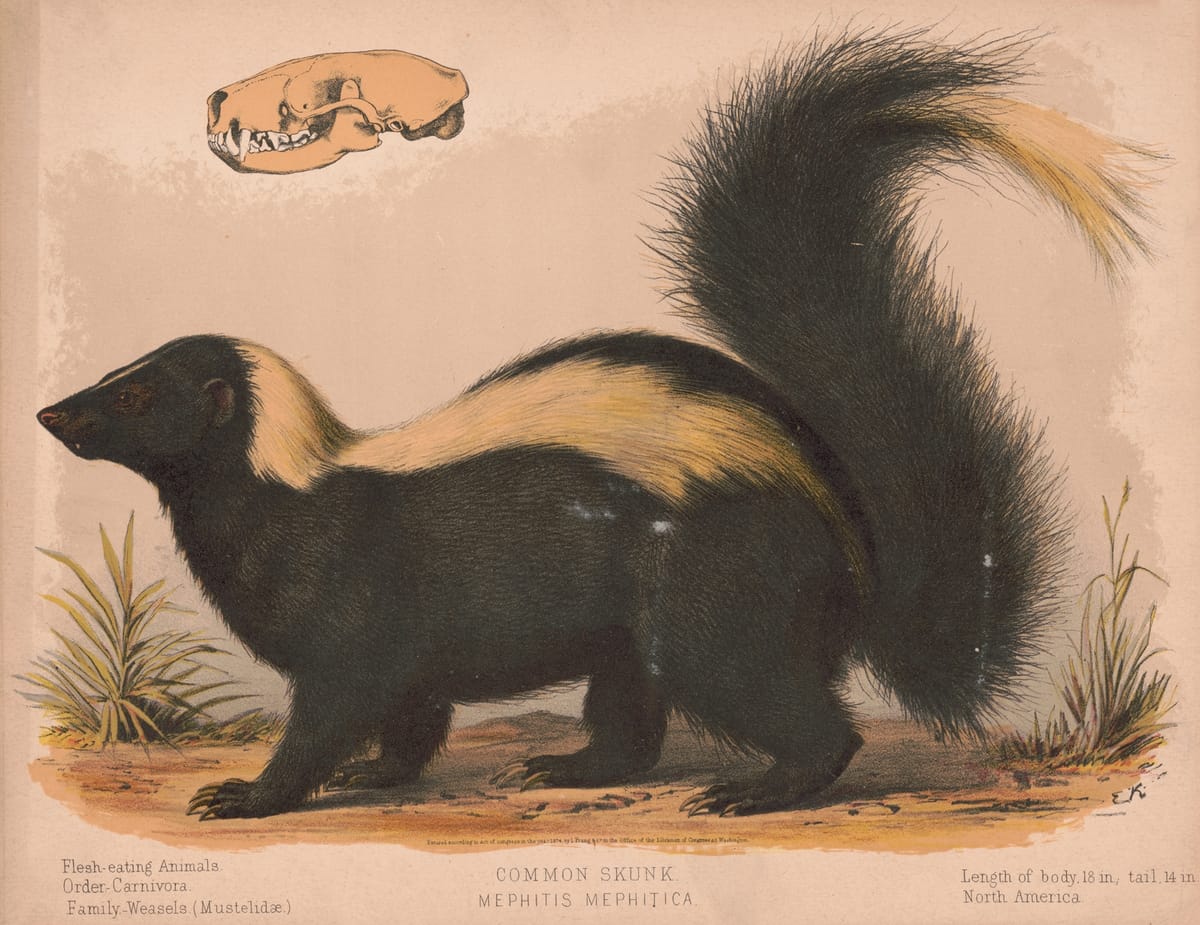
The Ditch
I am angry. Beneath the anger is a grief I haven’t yet let myself feel, but the anger came first and it hasn’t left.
A neighbour has set out poison in the ditch where a skunk lives.
Consider the facts. His property is large, and the ditch lies at its far edge, well away from his house. He never walks there. His car sits nowhere near it. He has no dogs, no cats, nothing that might blunder into a skunk and come home reeking. And the skunk rarely sprays; more on why later. The animal asked nothing of him but to be left alone in a corner of land he does not use.
I have tried to find a reason for what he did.
Fear, perhaps? Southern Ontario lived with rabies for decades, and that fear has outlasted the facts behind it.
Or habit? The old rural reflex that treats every wild thing near a house as vermin.
Or plain indifference?
I can name these, but I can’t forgive them. He didn’t have to understand the skunk. He only had to leave it alone, and he chose poison instead.
Frankly, my thoughts about him are dark indeed.
But before we delve into the history, the benefits and other “skunkiana,” I want to explore the remarkable scent of our neighbourhood skunk.
The Scent
To the human nose, the smell of a skunk is a single thing, instantly known and instantly regretted. To a chemist, it’s an ensemble.
For most of the twentieth century the textbooks got it wrong: an analysis in 1896 named butyl mercaptan as the culprit, and the claim was repeated for decades. In 1975 two American chemists, Andersen and Bernstein, took a closer look with instruments their predecessors lacked. They found that the main ingredient was a close cousin, (E)-2-butene-1-thiol, together with a good deal of 3-methyl-1-butanethiol.
Thiols are the heart of the matter. They are the sulfur twins of alcohols, with the oxygen swapped for sulfur, and the human nose can detect them at concentrations of a few parts per billion. Gas companies add a thiol to natural gas for exactly that reason: we will smell a leak long before we are in danger.
The skunk had the idea first.
In 1990 William Wood, a chemist at Humboldt State University, added to the ensemble. Alongside the thiols he found thioacetates, compounds that smell comparatively mild when first sprayed. Their trick is patience. When they meet water, they slowly break down into thiols again, which is why a dog sprayed on Tuesday seems nearly bearable by Friday and then reeks anew after a walk in the rain. A third group, the quinolines, ring-shaped nitrogen compounds, add to the spray’s staying power.
What comes out of the skunk is a yellowish, oily liquid from two glands beside the tail, aimed through small muscular nozzles. It can travel a few metres, as a fine mist or a focused stream, and it stings the eyes as much as it offends the nose.
Beer and Cannabis, Anyone?
The skunk’s molecules, or their near relations, turn up in surprising places. Beer left in the sun in a clear bottle “skunks” because light breaks down compounds from the hops into 3-methyl-2-butene-1-thiol. That molecule differs from the skunk’s 3-methyl-1-butanethiol by a single double bond. The same compound turns out to be the source of the famously skunky smell of cannabis, a discovery made only in 2021, after decades of blaming terpenes.
And the skunk’s own 3-methyl-1-butanethiol is listed by the World Health Organization’s expert committee as an approved flavouring agent, used in minuscule amounts to lend savoury depth to food.
It is quite possible that you have eaten skunk chemistry without knowing it.
The Smell of Uranus
Nor is the skunk’s chemistry confined to Earth. In 2018 astronomers confirmed that the cloud tops of Uranus contain hydrogen sulfide, the rotten-egg gas. That is a cruder sulfur molecule than the skunk’s, but a relative all the same. Farther out, in the vast cold clouds where stars are born, radio astronomers have detected methanethiol, first found toward the Sagittarius B2 cloud near the centre of our galaxy, and ethanethiol, confirmed in another galactic-centre cloud. These are small thiols, simpler siblings of what the skunk carries in its glands.
A drainage ditch also has, in its humble way, the chemistry of the galaxy.
Strangest of all, our aversion to the smell may not be innate. Critical studies of newborns find that infants do not reliably distinguish odours adults call foul from those they call pleasant. Young children in older experiments were untroubled by smells their parents found revolting, and adult-like aversions appear to settle in only around the age of seven. The eye-stinging burn of a close-range spray needs no teaching; that is irritation, not disgust. But the recoil at a faint whiff drifting across a summer evening is something we probably learn.
My neighbour learned it too.
Here all along
There are stories about skunks, appropriately First Nations tales, as the skunk is truly a North American creature. It did not catch a ride on some immigrant sailing vessel. It was here all along.
Or nearly all along.
For tens of thousands of years, the land beneath my feet lay under ice more than a kilometre thick. Nothing lived here. As the glaciers retreated, beginning roughly 13,000 years ago, life followed them north: spruce and then pine, caribou and then the creatures of the broadleaf forest. The striped skunk came with them. Geneticists who have studied its DNA believe its ancestors originated in the Texas–Mexico region and spread north in several lineages, one of which settled into northeastern North America.
People came north at roughly the same time. The first peoples of this region arrived as the glacial ice withdrew, and the skunk arrived alongside them. They have shared this country ever since. The skunk has no more been imported than the Credit River has.
It has not always been as common as it is now. The dense forests that once covered much of southern Ontario suited it less well than the open land that came later. A Canadian Wildlife Service publication notes that the skunk has adapted well to people, and that its range has grown far beyond what it was in pre-settlement times. Cleared fields, woodlots, hedgerows and, eventually, suburbs gave it the edges and open ground it prefers, along with a steady supply of grubs, fallen fruit, and our garbage. Today a Toronto skunk may spend its whole life within a single square kilometre.
The one in our ditch is almost certainly a local, born within walking distance of where it now lives.
Pepé
I promised you a First Nations tale, but first let’s have a lighter look at Pepé Le Pew. Or a darker look upon further pondering.
The world’s most famous skunk made his debut in 1945, in a Warner Bros. Cartoon called Odor-able Kitty, directed by Chuck Jones. He was not yet the character we know. In that first outing he is revealed, in the final gag, to be an American skunk named Henry, with a wife and children, merely putting on a French act (so, an adulterer). By 1947 he had become Pepé Le Pew, a name that puns on the English exclamation for a bad smell. In 1949 For Scent-imental Reasons won him an Academy Award.
The formula never changed. A female black cat, Penélope, accidentally acquires a white stripe down her back, usually by brushing against a freshly painted fence. Pepé mistakes her for a skunk and pursues her with florid pseudo-French declarations of love. He is oblivious to her frantic efforts to escape, and oblivious, too, to his own smell, which empties every room he enters. There is a zoological joke buried in all this: a French skunk is an impossibility. Skunks are creatures of the Americas. Pepé is drawn as a striped skunk, the same species that lives in our ditch, and he would have had a very long swim to Paris.
Jones said later that Pepé was a kind of inverted self-portrait. In his autobiography, Chuck Amuck, he wrote that the character embodied a romantic self-assurance Jones knew he lacked. The joke was always on Pepé, on his vanity and his deafness to refusal. In 2021 that reading was put to the test. A New York Times columnist, Charles M. Blow, argued that the cartoons had taught audiences that “no” was just the opening move in a chase. Around the same time, it emerged that a scene featuring Pepé had been cut from Space Jam: A New Legacy. The two events looked like cause and effect, but they weren’t. The scene had been dropped months earlier, after a change of director. Warner Bros. nonetheless indicated it had no plans to bring him back. The most famous skunk in the world has been quietly retired, not for his smell but for his manners.
It is worth pausing here, because the problem with Pepé is not a matter of changing fashion. The cartoons never asked us to find him charming. The joke was on him, on his vanity and his conviction that every refusal was a coquettish invitation. Penélope runs, struggles and flees, and we were meant to laugh because her unwillingness was so obvious. Audiences assumed that ridicule was protection enough. Repeated for decades in front of children, it was not. The chase became the pattern, and the refusal became part of the game. What was tolerated was never acceptable. We should recoil at it now, and it’s fair to ask why so many of us took so long.
There is an irony in the casting, too. Of all animals, the skunk is the one that says no most clearly. It stamps, it hisses, it lifts its tail and turns to show its stripes, well before it resorts to anything more drastic. Its whole existence is a lesson in reading refusal. The most famous skunk in the world is the one who never learned it.
The Windy City
The older skunk of this continent is far more formidable. In the Ojibwe word zhigaag, the skunk has a name that belongs to a whole family of Algonquian languages, a family that also gave English its word “skunk.” One relative, the Miami-Illinois šikaakwa, means both “skunk” and “wild leek,” and French explorers wrote it down as Chécagou. A city of nearly three million people – Chicago – is named, in part, for the smell.
The Great Skunk – Coexistence not Conquest
The great skunk story of the Anishinaabe is the story of Aniwye, also called Mishi-zhigaag, the Giant Skunk. In the versions recorded among the Ojibwe, Algonquin and Cree, Aniwye was a monstrous skunk, or in some tellings a man-eating giant, whose spray did not merely offend but killed. People sickened and died from it. The animals united against the monster, and it was brought down, by Great Fisher in some versions and by Wolverine in Cree tellings. Then came the part that matters most. The monster was not simply erased. Either Fisher or Nanabozho, the great teacher and trickster, transformed it into the ordinary skunk we know: smaller, less deadly, still carrying its weapon, but now able to live among the other animals.
In some versions the monster is killed before it is changed, and in others it is simply diminished. Either way, the story does not end in eradication. The danger is not abolished; it is brought down to a size the world can live with. The skunk keeps its spray and its warning stripes, and everyone else learns to give it room.
It is a story about coexistence, not conquest.
There is a lovely piece of natural history hidden inside it, too. The fisher, ojiig in Ojibwe, is one of the few real animals that will prey on a skunk. The hero of the story is also one of its actual enemies, which suggests these stories were told by people who knew the forest very well.
The skunk has other uses in Anishinaabe life as well. One Anishinaabe woman told a journalist of her ancestors travelling each fall from Lake Superior to the mouth of the Chicago River, trapping young skunks for their musk. Ojibwe medicine people used it as a treatment for pneumonia.
The creature my neighbour chose to poison was, for others, a source of healing.
The Fellow Earthing in the Ditch
And the living skunk more than earns its keep. It is a true omnivore; in summer it eats mainly insects: grasshoppers, crickets, beetles, and the white grubs, cutworms, and armyworms that gardeners and farmers spend money to destroy. It will even dig out wasps’ nests and kill the wasps with its front feet. In autumn and winter it eats plant and animal food in about equal measure: berries, black cherries, fallen fruit, mice, the occasional carrion. The seeds of the fruit it eats pass through it and are scattered across the landscape, and its digging turns and loosens the soil.
It is not a saint. The same appetite that clears a lawn of grubs also sends it digging in the sand for turtle eggs, and in southern Ontario, where most of our turtles are in trouble, that is no small thing. The skunk is not a hero of the story. It is a fellow earthling, with mixed effects upon the place it lives. But it was my neighbour long before my other neighbour.
An Expensive Aroma
As for why our skunk so rarely sprays: the answer is economics. A skunk carries only enough spray for a handful of discharges, and refilling its glands takes a week or more. Spraying is expensive, so the skunk does everything it can to avoid it. The stamping, the hissing, the raised tail, the black-and-white coat that can be read from a distance: all of it is the same offer, made to almost every creature it meets. I would rather not. The spray is the last word, not the first.
Only one predator reliably ignores that offer. The great horned owl hunts at night, as the skunk forages at night, and its poor sense of smell leaves the skunk’s defence all but useless against it. Great horned owls take skunks regularly, even though a skunk may weigh three times as much as the owl that kills it.
No Longer Anger, but Grief
That is where my grief finally overtakes my anger. Poison does not stay where it is put. If the thing in the ditch is the kind that kills slowly, as many of these poisons do, a sickened skunk will wander, weaken, and become easy prey. The owl that takes it will take the poison too. A man who could not bear a skunk at the far edge of his land may end up killing the owl that would have taken care of the skunk in its own way, as nature always has.
The Anishinaabe told of a monster that was brought down to a size the world could live with. My neighbour has done the opposite. He has taken a small creature, one that asked nothing of him, and made it a monster in his own mind. The skunk in the ditch is made of the same chemistry as the clouds of Uranus and the nurseries of stars. It came north with the retreating ice and has lived beside the peoples of this place for thousands of years. It deserved better than to die in a ditch for being what it is.
Sources
- Skunk spray, Molecule of the Month (University of Bristol)
- Prenylated volatile sulfur compounds in cannabis (ACS Omega, 2021)
- 3-Methylbutanethiol (WHO JECFA database)
- Uranus cloud tops and hydrogen sulfide (NASA)
- Dimethyl sulfide and ethanethiol in interstellar ices (PCCP, 2026)
- Children's hedonic response to odour (Stevenson & Repacholi, 2003)
- Infants' hedonic responsiveness to food odours (Flavour)
- Striped skunk (Government of Canada Publications)
- Striped skunk genetic structure (PLOS ONE)
- Home range of striped skunks in Scarborough (Canadian Field-Naturalist)
- Odor-able Kitty (Wikipedia)
- Pepé Le Pew cut from Space Jam sequel (Cartoon Brew)
- Pepé Le Pew and Space Jam (Deadline)
- zhigaag (Ojibwe People's Dictionary)
- Proto-Algonquian *šeka·kwa (Wiktionary)
- Aniwye, the Giant Skunk (Native Languages of the Americas)
- Skunks in the history of Chicago (Atlas Obscura)
- Striped Skunk (Hinterland Who's Who)
- Skunk (Ontario Fur Managers Federation)
- Great horned owls and striped skunks (Naturally Curious)