The Bellington Family History
The Ancestors of John Noel Bellington
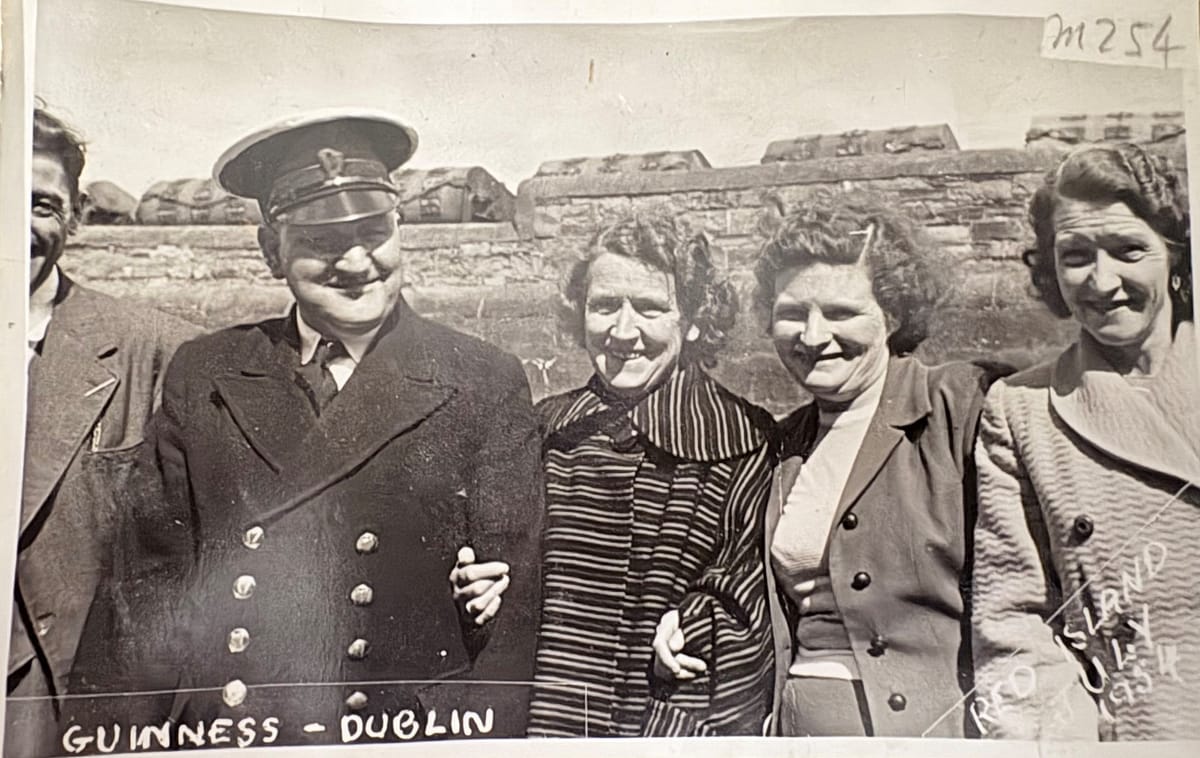
Here is another family history I have been commissioned to compile. There is additional information on this family, including charts and various lists — all of which the family is happy to share should anyone inquire. Meanwhile, here is a bit of their story to enjoy as it was presented to the family in Ontario, Canada, who have authorized this publication.
Ancestors of John Noel Bellington
Every family tree eventually runs out of ink and into weather — a name with no birthdate, a place with no fixed spelling, a person who exists only because someone else’s marriage record needed a witness. This one runs out at Thomas Roe, who left nothing behind but a son, sometime before 1665, somewhere in the low, wind-flattened country around Poulton-le-Fylde and Kirkham in Lancashire, England. Everything that follows is built on thin paper, all the way down to a departure from Liverpool in 1952 and a death in Toronto in 1996. I’ve tried to walk it the way it happened — oldest to newest — while being honest about the places where the ink itself gives out.
The Fylde, in Roes and Whitesides
John Roe, born about 1665, married Jennet Towers at Kirkham in 1690; their daughter Jennet Roe married a Whiteside, whose son George married a Briers, whose daughter Mary married a Waterworth, whose daughter Mary married an Edward Billington of Kirkham in 1823. Say it quick enough, it sounds like a nursery rhyme, which is more or less what parish-register genealogy always threatens to become once you get past the point where anyone had an opinion worth recording. What we’re left with, generation after generation, is essentially weather and occupation: labourers, a power-loom weaver at 7 Lawsons Street in the 1851 census, a daughter tentatively down as an “examining tenter” — someone who checked the woven cloth on the frames, if I’m reading that faded trade term correctly, though I’ll say plainly I’m not fully certain of the exact wording. The mills of Preston and Kirkham were in this family’s bones before anyone thought to write down why.
By 1892, a William Billington was born to John Billington (the name originated as Billington and much later switched to Bellington) and Mary Langton, in a household eventually settled at 63 Gorst Street, Preston, with nine children scattered across it like buttons off a coat — Gerry, Mabel, William, Edward Lancaster, Lillian, Mary, Florence, Charles, and Cicely. William was the third; he would be the one to leave Lancashire, and Lancashire’s flat weaving-town rhythms, behind.
Drumcondra, and the ridge that may or may not belong to someone named Conra
The Irish side of this story settles, generation after generation, into a few square miles of north Dublin — Drumcondra, Clonturk, Puckstown, Beaumont, Santry — and it seems worth pausing on what those names are actually carrying, since the people who lived under them clearly weren’t going anywhere.
Drumcondra’s Irish name is usually given as Droim Conrach — Conra’s Ridge — though there’s a rival, older reading that would make it “the ridge of the contract,” which I find almost unbearably apt for a family whose own paper trail is one long sequence of legal instruments: marriage contracts, court orders, workhouse admissions, pension deeds. The Tolka runs through it; so did one of the ancient roads said to converge, at least in legend, on Tara. By the time your people were living there, Drumcondra had already absorbed its older name, Clonturk, and was well on its way to being the unglamorous, church-and-hospital-dense suburb it is today — the Church of the Holy Family on Aughrim Street, the old Drumcondra Hospital (built as the Whitworth), the North Circular Road running past it all toward Mountjoy.
Puckstown, where Patrick and Mary Kelch’s family lived at least twice over — the 1901 census, the 1926 census, the run of petty-sessions entries in between — is the better story, and I want to tell it carefully, because it very nearly isn’t the story you’d expect. In Irish folklore, Púca is the shape-shifting, mischief-making sprite — the root behind Puck in Shakespeare, James Stewart’s invisible 6 ft (1.83 m) white rabbit friend in the film Harvey (1950), and behind a whole scatter of Irish townlands with names like Poll an Phúca, “the hollow of the púca,” usually attached to some suitably lonely bog-hole or sea-cave. There is a Puckstown in County Louth that’s exactly this: an English mistranslation of Poll an Phúca. It would be a wonderful thing to tell you that your Puckstown, north of Dublin near Artane, carries the same pixie under its floorboards.
But the place-name scholarship is fairly clear that it doesn’t. This Puckstown — logainm.ie lists it under what’s now Grace Park Heights, Collins Avenue, and Thorndale — is flagged specifically as being of English-language origin: most likely the ordinary English surname Puck, or Pook, attached to a townland the way Grace’s family gave their name to the road beside it. No fairy, just somebody named Puck, who once held or worked that land.
I’ll admit I’m a bit disappointed on your family’s behalf, and also a little delighted — because the coincidence of it is almost better than the folklore would have been. A family repeatedly summoned before the Drumcondra petty sessions for drunkenness, for threatening language, for a nighttime scrap that ends in “dismissed on the merits,” made their home — without knowing it, and possibly by nothing more than an accident of an English landholder’s surname — on a townland that sounds exactly like the address a mischief-spirit would give if a magistrate asked him for one.
Grangegorman, three times over
If Drumcondra is this family’s home ground, Grangegorman is its recurring appointment — and I don’t think that’s overstating it. It is worth knowing (if you don’t already), that “Grangegorman” isn’t one building. It’s a single sprawling complex on the north side of the city that has, over roughly two hundred and fifty years, been a fever hospital, an asylum, a workhouse, and two entirely different prisons — one for men, run alongside the North Dublin Union workhouse itself, and, separately, the Richmond Penitentiary, which in 1836 became the Grangegorman Female Penitentiary: the first prison in Britain or Ireland built to hold women exclusively. For half a century it doubled as a transportation depot — something like three thousand two hundred women and children passed through it on their way to convict ships bound for Van Diemen’s Land, before the practice ended. Women there were set to scutching and cloving flax by hand, work considered heavy enough that a doctor had to sign off on assigning it to anyone judged too weak.
Your family touches this one patch of ground at least three times, for three unrelated reasons, across nearly a century.
The earliest, and the shakiest, is the prison record for an eighteen-year-old “Maria Tyrrell,” admitted to the Grangegorman Female Prison in October 1888 on a soliciting charge, with a birth year that lines up — loosely — with your Mary Tyrrell. I want to be honest that this is may not be a match; the name is close but not identical, and the researcher who first flagged it was careful to call it a possibility rather than a fact, which is the only responsible way to hold it.
The second is Patrick Kelch — Mary’s husband, Elizabeth’s father — who was admitted to the North Dublin Union Workhouse twice in September 1900, at Grangegorman, once described as “sickly,” once not, each time giving Puckstown as his home and, oddly, a half-legible birthplace the clerk seems to have rendered as “Yellow, Lancs.” (I couldn’t run that place-name to ground with any confidence — it may be a mishearing of a small Lancashire village, possibly Yealand, but that’s just speculation.) The North Dublin workhouse at Grangegorman had, by the 1890s, been the subject of a British Medical Journal inspection that found the female “lunatic” wards housed in conditions the inspectors said were fitter for animals than people — not evidence of anything about Patrick’s particular experience there, but the general air the institution was breathing at the time he walked, or was carried, through its gate.
The third is William Billington himself — Elizabeth’s husband, your great-grandfather — who ended up not in Grangegorman the institution but Grangegorman the military cemetery, in Cabra, where he’s buried under a stone recording R.A.S.C. service from 1909 to 1921, with Elizabeth laid beside him. Between a workhouse admission and a soldier’s grave, “Grangegorman” in this family’s records manages to mean almost every register a working-class Dublin life could be filed under — poverty, punishment, and, at the very end, official honour.
Patrick Kelch the younger, and Mountjoy
Patrick and Mary’s son, also Patrick, born at Puckstown in May 1898, was committed to Mountjoy Prison in July of that year, on a charge that the surviving register renders, as best as it can be made out, as an attempt to steal a motor car. Two years’ hard labour, inferred from the abbreviation “2 years H.L.,” though the surrounding notation is genuinely too faint to expand with confidence.
It’s worth knowing what kind of building he was walking into. “The Joy,” on the North Circular Road in Phibsborough, opened in 1850 and already, by 1923, one of the most politically loaded buildings in the new Irish state; the great republican hunger strikes of that autumn saw some five hundred men refusing food inside its walls. One of them, Andy O’Sullivan, dying of it that November. Patrick’s offence had nothing to do with any of that; he was, as far as the record shows, an ordinary young man convicted of an ordinary crime in an extraordinary building at an extraordinary moment, which is its own kind of dissonance worth noting. By 1926 he was back in Puckstown, twenty-seven years old, still unmarried, working as a builder’s labourer and living with his widowed mother and a young relative named John Redmond — the record noting, almost in passing, that Mary claimed to have borne five or six children (the clerk himself wasn’t sure which) and that none of them, John Redmond and Patrick excepted, were living with her by then.
The marriage that stitched the two counties together
On 9 January 1916, at the Church of the Visitation in Fairview — a few minutes’ walk from the Drumcondra ridge whose name may or may not honour a man called Conra — Elizabeth Kelch married William Billington, the Lancashire weaver’s grandson who’d become a non-commissioned officer out of Islandbridge Barracks. He’d go on to more than three decades at Guinness, in Traffic and then Administration, at a starting wage that history hasn’t bothered to record; she raised six children in a family whose addresses shift, document to document, the way working Dublin addresses tend — 42 Arklow Street, 8 Beaumont Avenue, both a short walk from Drumcondra and from the ground at Puckstown, where her own family had lived for at least two censuses running.
Their eldest, Mabel, died at St Patrick’s Hospital in August 1940, twenty-three years old, nicknamed “Bebe” — the family’s grief notice, that August, extended to Irish Textiles, Shell Manufacturing, and the whole of the Guinness Traffic Department, which tells you something about how thoroughly this was a family embedded in the working institutions of the city. Edward, or Edmund, married in 1949. Annie lived on past 1970. Patrick (“Paddy”) worked at Guinness like his father, from 1947 until his death in 1992, remembered in his obituary alongside a sister, Connie, and a brother, Noel. And Connie herself appears only by name, one more life the record didn’t stop to fill in.
Crossing over
And then there was John Noel — youngest, or near enough — who in June 1952 walked up the gangway of the Franconia at Liverpool with an occupation of “layer” against his name and an Irish address of 28 May Street, and sailed, alone, for Quebec.
By 1954 he’d married Florence Manger in Toronto — her own family Channel Island stock on her father William’s side, arrived in Canada in 1921, settled by 1931 into a four-room brick flat on Vine Avenue in High Park, a five-month-old Florence just barely caught by the census sheet before it was cut off. John Noel and Florence built a life in Toronto that, according to the 1974 voters’ list, had already folded in another generation under one roof — a John Jr. Working as a press worker alongside his filler father and packer mother, at an address family memory insists was 25 Royal even though the official record says Runnymede, which is its own small, ordinary example of how a family’s spoken history and its paper history can simply disagree.
John Noel Bellington died in Toronto on 21 January 1996. Florence followed him on 21 October 2003 — closing out, in a Canadian winter and a Canadian autumn a world and two centuries away, a story that started with a nameless ridge in Lancashire and a townland that only sounds like it was named for a sprite.