The Boxer in the Cupboard
A Deep History of an Everyday Keepsake
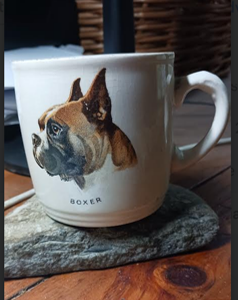
Amy has had the mug for more than sixty years. It has a boxer on it: a fawn dog with cropped ears and a black mask, the word BOXER printed beneath him in small capitals. No one in her family was especially fond of dogs. The mug came to Amy around the turn of the 1960s, and for most of her childhood her mother set it at her place every morning, filled with milk.
As a child, it had been her favourite breakfast mug. Now it serves a new function, standing on her kitchen table in Ontario, holding pens, pencils and paper clips.
It is not a valuable piece, at least not in terms of market value.
Mugs from the same series turn up online for about fifteen dollars, and this one was never kept for display: the inside is crazed and stained from years of use, and there are rust-coloured flecks around the foot.
When Amy left home in her twenties, the mug stayed behind with her mother. It went into the kitchen cupboard and stayed there, and it never came out when Amy visited, not even for a cup of tea. After her parents died, Amy inherited the house and everything in it, and the mug was still in the cupboard, where it had waited for fifty years.
The family didn’t dislike dogs; they simply weren’t a dog household, or much of a household for pets at all. And yet Amy loved that mug, and the boxer on it. And yet her mother kept it, through all the years after Amy left, in a cupboard she opened every day. Why a child chose that dog, and why a mother held on to his mug, are small mysteries of motive that will never be solved.
This humble object, now repurposed as a pen holder, carries its own history. But, as we will see, the mug does not give up its origins easily. Here is what we can surmise.
Who in the World and Where in the World?
Turned over, the mug shows its only direct testimony: a crown printed in black, with the initials W.L.E. Ltd arched above it and MADE IN ENGLAND curving below. The initials belong to no maker in the standard lists of British pottery marks. Whoever W.L.E. was, the firm has left almost no trace beyond its own backstamp.
The mug was not made alone. Others like it turn up in online listings: a French poodle, a beagle, and a shaggy Old English Sheepdog confidently labelled “English Shepherd,” which is a different breed. Each has a breed portrait on the side and the name printed underneath in the same lettering, on what appears to be the same straight-sided body with three rings at the foot. This was a series, one plain shape dressed in interchangeable dogs, sold to whomever liked, or happened to buy, a particular breed.
Both the boxer and the mark sit on top of the glaze; a fingertip can feel the difference. That suggests they were applied at the same stage, after the plain mug had already been made and fired. W.L.E. may not have made the mug at all, but only decorated and marked it: a finisher, or a trading firm that bought plain wares from one of the many potteries of Staffordshire, added its dogs and its crown, and sent them out into the world.
Where they went may be inferred from the dog itself. The boxer’s ears are cropped to tall points, a style long discouraged in Britain but common in North America. The mug was probably made with buyers on this side of the Atlantic in mind.
As for when: dealers list these mugs as 1930s, but they give no evidence. The firmest date is the one Amy supplies herself. The mug was in her hands around the turn of the 1960s, so it was made before then, most likely in the decade or two after the war. Who made it, who decorated it, and who first brought it home are still unknown.
How in the World?
What the mug cannot tell us about its makers, it can tell us about its making.
It is earthenware, the ordinary material of English kitchens, not bone china or porcelain. Held against a bright light, it lets none through. Its clay was probably a blend that the potteries of Staffordshire had refined over two centuries: ball clay from Dorset and Devon to make it workable, china clay from Cornwall for whiteness, ground flint or quartz for strength, and Cornish stone, a feldspar-rich rock that helps the mixture fuse in the kiln. None of these ingredients was rare or expensive. Brought together in the right proportions, they made the everyday white crockery that filled kitchen cupboards across the English-speaking world.
The mug was not thrown on a wheel by a potter at work. Its straight sides and the three neat rings around its foot suggest it was shaped by machine or cast in a plaster mould, one of thousands identical to it. The handle was made separately and attached while the clay was still firm but not yet dry. The mug then went into the kiln for its first firing, at more than a thousand degrees, which hardened the clay into what potters call biscuit.
Next came a clear glaze and a second firing, giving the mug its smooth, white shine. Whether that glaze contained lead, as British earthenware glazes long did, or was one of the lead-free glazes that were becoming common by mid-century, cannot be determined by eye.
Here Comes the Boxer
Only then did the boxer arrive. He was printed as a transfer in ceramic enamels, coloured glass ground fine and tinted with metal oxides: iron for the browns of his coat and darker mixtures for his mask. The transfer was laid on top of the glaze and fixed in a third, cooler firing. The crown and the letters W.L.E. Ltd on the base were almost certainly added the same way, at the same stage, which is why both the dog and the mark can still be felt as a faint ridge under a fingertip.
Decades of use have left their own record. Around the foot, where the glaze has worn away, the clay has darkened from white to brown, a record of the mug being set down and picked up thousands of times.
Truly Deep Time
But what about the truly deep history, the time-travelling of this humble object?
There is much we don’t know, but one thing is clear: there is gilding on the lip. It is chipped, but some remains. It is a very small amount of gold, probably applied as “liquid gold,” a solution painted on and fired until only a thin film of metal was left.
Where that gold was mined can only be guessed. In the years after the war, most of the gold traded in London came from South Africa, from the reefs of the Witwatersrand, which then produced more gold than any other region on earth. That is the likeliest source. But gold is almost never used up. It is melted down, refined and reused again and again: coins become jewellery, jewellery becomes bullion, bullion becomes the film around a mug’s rim.
Some gold on Amy’s mug may have been dug from the ground a few years before it was fired. Some of it may have been in a ring, a coin, or a cup centuries earlier.
And before any of that, the gold was not made on earth at all.
The universe began with almost nothing but hydrogen and helium. Stars, burning across billions of years, built heavier elements in their cores, but they cannot make gold. Gold forms only in the most violent events the universe knows, above all the collision of two neutron stars, the dense remains of dead stars, which spiral together and break apart in a burst of newly made elements. The gold scattered by such collisions drifted through space, became part of the cloud that coalesced into our solar system about four and a half billion years ago, and was gathered into the young earth. Most of it sank to the planet’s core; what we mine today may have reached the surface later, carried by meteorites that struck the early earth.
So the thin gold line that a child’s lips touched every morning, above a mug of milk, was made in the collision of dead stars long before our sun existed.
Not such an ordinary keepsake after all.
References
On the mark and the series
Birks, Steve. "Initials used as Pottery Trade Marks – W." The Potteries. https://www.thepotteries.org/mark/w/index.html. Accessed 29 September 2026.
Godden, Geoffrey A. Encyclopaedia of British Pottery and Porcelain Marks. London: Herbert Jenkins, 1964.
TheGoslingCollective. "Vintage 1930s French Poodle Mug: W.L.E. Ltd, Gold Rim." Etsy listing. https://www.etsy.com/listing/1456192785/vintage-1930s-french-poodle-mug-wle-ltd. Accessed 29 September 2026.
Rex's Tresures [sic]. W.L.E. Ltd "English Shepherd" item. eBay listing no. 167049085016. https://www.ebay.com/itm/167049085016. Accessed 29 September 2026.
On materials and manufacture
Hamer, Frank, and Janet Hamer. The Potter's Dictionary of Materials and Techniques. London: A & C Black, various editions.
On the origins of gold
Abbott, B. P., et al. (LIGO Scientific Collaboration and Virgo Collaboration). "GW170817: Observation of Gravitational Waves from a Binary Neutron Star Inspiral." Physical Review Letters 119 (2017): 161101.
Kasen, Daniel, et al. "Origin of the Heavy Elements in Binary Neutron-Star Mergers from a Gravitational-Wave Event." Nature 551 (2017): 80–84.
Willbold, Matthias, Tim Elliott, and Stephen Moorbath. "The Tungsten Isotopic Composition of the Earth's Mantle before the Terminal Bombardment." Nature 477 (2011): 195–198.