Once Upon a Perfume: The Story Chanel Didn't Mean to Tell
Mind the Gap or the Importance of Noticing
Perfume advertisements are almost always highly sexualized — for both genders. Often creative, even artistic, they range from the evocative to the elegant to occasionally the rather absurd. There is, however, a new commercial airing for a new fragrance — Coco Mademoiselle Crush Absolu — that strikes me as one of the most disturbing I’ve seen in years. I will explain why later in this essay, but first I will tell the story of the advertisement as though it were a fairy tale.
Karina in the Tavern
Once upon a time, not so long ago, there was a beautiful young woman who was so attractive that people followed her everywhere, just to glimpse at her loveliness. One day, her attendants — for she was a special woman with many servants — were busy grooming her: applying make-up, helping her dress in an elegant white ensemble, and combing a hairpiece of long brown tresses that Karina (for this is the name we will call her) would often wear in public. Once she had been suitably groomed and attired, she was whisked away in a beautifully appointed carriage, where she removed her wig, revealing her true hair, and then took a moment to apply a light spray of a magical perfume. It was then that the very handsome driver of the carriage looked seductively and with desire upon her, as almost everyone tended to do.
No matter, they had arrived at their destination, where a throng of male admirers pressed against the side of the carriage, hoping to catch a glimpse of Karina, and perhaps capture an image of her to keep and share with others. Karina closed the curtains of her carriage, and then, to everyone’s surprise, when the door was opened, she was nowhere to be found, having quickly escaped through the door on the other side of her conveyance. She had begun to run, casting off her outer clothing and her lovely dress, quickly running on fashionable white and black shoes, now wearing only a thin gossamer white chemise. The admirers spotted her in the distance, and attempted to run after her, but she was too swift, turning a corner and evading her pursuers.
Karina found herself just outside an elegant tavern, filled with many men and a few conservatively clad women. Music was playing inside. Intrigued, she opened the door, and in that very moment, a bright light surrounded her, eclipsing everything else. The music stopped, and everyone turned to stare appreciatively at her loveliness. By comparison, all the other women were drab, but Karina was a vision in abbreviated white. She walked through the tavern, pausing at each table, the heels of her beautiful shoes tapping audibly on the stone floor. She was enchanting.
As she walked among the tables, Karina began to imagine herself dancing.
She reached the bar, tended by a sombre woman dressed in formal black clothing. She leaned into it and noticed a handsome man registering her image on a photographic device. This pleased her, and she smiled. There was a golden pinball machine nearby, with three men around it, and Katherine joined their play, subtly thrusting at the machine as pinball players often do. She reached high scores on the golden machine and was delighted.
She began to dance then, taking a black hat off the head of one admirer. Several men joined her dance, and she began to energetically shake her hips in rhythm with the lively dance music that had begun to play once the pinball game started. Another man now knelt behind her, following her suggestively gyrating hips. Two men lifted her up, twirled her around, and placed her on top of the bar. Karina was delighted and began to dance there, high above everyone else. Then, with complete abandon, she fell backward into the waiting arms of a crowd of men. The crowd now included the admiring chefs, who had left the kitchens to enjoy the spectacle and the cheers of the crowd. Again she was raised aloft by several men and set down again to dance with many partners. Some other, more drab and conservatively clad women were dancing as well, but no one really had eyes for them — it was all about Karina.
Then, something changed.
There was now a gap in Karina’s world.
She next found herself outside the tavern, running in her tiny white chemise, having lost her shoes, running away barefoot in the rain which had begun sometime during her time at the tavern. She was soaking wet and alone. Despite a rueful smile that some claim to have seen on her face through the rain, no one could say what had ultimately happened in those final moments — or hours — in the tavern, and what ultimately became of the lovely Karina.
Not Really A Fairy Tale — A Commercial
What I have just described is not, of course, a fairy tale at all. It is the advance publicity film — an “extended cut,” in industry parlance — for a new Chanel fragrance: Coco Mademoiselle Crush Absolu, a flanker to the house’s 2001 Coco Mademoiselle, itself a descendant of the original 1984 Coco. The film was directed by Joe Wright, a filmmaker whose earlier work — adaptations of Pride & Prejudice, Atonement, Anna Karenina — has made a career of women constrained by social systems, longing rendered as spectacle, the camera lingering on the body as the site of meaning. That sensibility, applied here to roughly 120 seconds of perfume advertising, is not an accident. It is a skilled hand doing exactly what it has always done, in a shorter form.
What’s In A Name?
Chanel’s own language for the fragrance leaves little room for alternate readings. The official copy describes it as embodying “the power of attraction at its most potent, whose pull is impossible to resist” — a scent “magnetic in its intensity.” Read plainly, this is not language about a woman choosing to wear something. It is language about a force acting upon her, and upon everyone near her: power, pull, magnetism, resistance rendered futile. The vocabulary is borrowed wholesale from coercion and applied, without apparent hesitation, to romance.
The name itself repays a closer look. “Crush”, in its everyday romantic sense — an intense, often youthful infatuation — is not, etymologically, a separate word from its violent twin. Both descend from the same root: force applied until something gives way, the sensation of being flattened by an effect one cannot control. A “crush” of people is a crowd pressed dangerously together. To be “crushed” is to be destroyed. Chanel has not invented an ambiguity here; they have simply selected, from a word that has always meant both desire and destruction, the half they wish the customer to hear — while leaving the other half fully intact, doing its work beneath the surface.
No One Seems to Notice
As far as I can tell, there has been no push-back whatsoever on the commercial, an absence I find utterly remarkable. The feedback online is largely positive, and leaning — surprisingly, or perhaps unsurprisingly — toward “empowerment”.
Empowerment… of all things.
To me there is an ocean of distance between what we, collectively, notice and what we do not. Before I delve into the darkest heart of the commercial, let’s look at a glaring example of what appears to have gone unnoticed and unremarked: The choice of soundtrack.
The Darkness in the Soundtrack – Pimps and Coercion
The soundtrack chosen for the film is “Young Hearts Run Free,” recorded by Candi Staton in 1976. It is, on its surface, a clever choice — a buoyant, dance-able classic, instantly recognizable, evocative of exactly the joy the fragrance house wishes to invoke.
It is also, on any closer listening, a warning.
The song was written and produced by David Crawford, but not from imagination. In a 2010 interview, Staton described its origin plainly: she had been involved with a man named Jimmy James — a pimp, by her own description — a relationship she called “very difficult to leave,” one that was “very threatening and abusive.” Crawford, listening to her describe it over lunch, began taking notes. “I’m gonna write you a song,” he told her. “I’m gonna write you a song that’s gonna last forever.” He did.
What he wrote, from her testimony, is not a love song. It is a song about the impossibility of leaving. The chorus does not celebrate romance; it envies its absence, mourning young hearts still free, still unhung-up, in a way she and her man never quite managed. Beneath the pre-chorus’s determination — self-preservation is what’s really going on — sits its honest, unresolved counterpart: the admission that turning loose, wanting to, trying to, is not the same as being able to.
This is the song now playing beneath a young woman’s ecstatic surrender to a crowd of men — lifted, twirled, passed hand to hand, set atop a bar to dance above them all. A song born from one woman’s real account of a coercive, threatening relationship has become, decades later, wallpaper for a scene it would, on any honest reading, warn her against.
Whether the choice was made in ignorance of the song’s history or in full knowledge of it and a calculated indifference to the dissonance, the effect is the same: Staton’s testimony, offered once at lunch to a man taking notes, has been stripped of everything but its rhythm and repurposed to sell the very entrapment she was trying to name.
The choice of soundtrack was likely closely pondered. I cannot imagine otherwise, given the magnitude of the company behind it and the prestige of the director. And here is where I question another choice made in this advertisement. I wonder if anyone else watching this small piece of film advertising has noticed the disturbing parallels with the movie The Accused, and the real-life case that inspired it?
A Disturbing Parallel – The Gang Rape
Cheryl Araujo was twenty-one, the mother of two young daughters, when she stopped at Big Dan’s Tavern in New Bedford, Massachusetts, on the night of March 6, 1983, to buy a pack of cigarettes. She played the jukebox. She watched some men shooting pool. When the other woman she’d been talking to left, one of the men locked the front door, and Araujo found herself the only woman in the bar. What followed was a gang rape on the barroom pool table, carried out while other patrons reportedly watched, some cheering. She escaped, and was found by passing college students wearing only a coat — accounts differ on the particulars, some describing a single remaining sock, others a torn sweater, but converging on the same essential image: a woman who had fled with her shoes gone, her clothing destroyed.
The case became the basis for the 1988 film The Accused, starring Jodie Foster. In dramatizing the assault, the film made a choice the real case did not offer: it staged its own version of the bar scene around a pinball machine, the woman surrounded by admiring, then predatory, men, her attire scant, one of only a few women present, the others dressed conservatively by comparison.
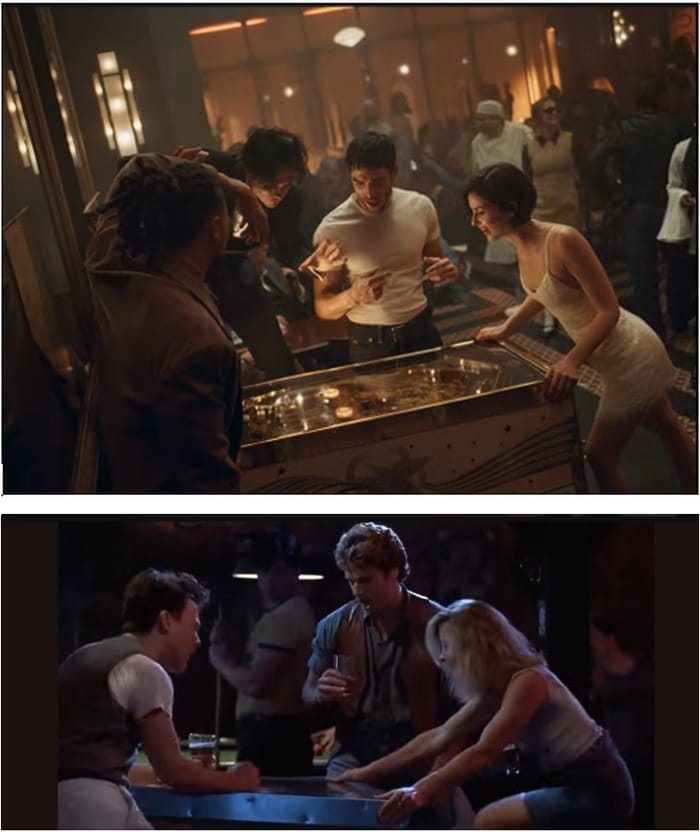
Watching the Chanel film closely, the echo is not vague. It is architectural: the pinball machine, the crowd of men, the woman as the only spectacle in the room, the conservative women rendered invisible beside her, the eventual flight.
This is Not Victim Blaming
I want to be precise about what I am, and am not, arguing. A woman should be able to walk naked down a street and not be assaulted. A man should be able to fling hundred-dollar bills across a crowded bar and not be robbed. That neither is safe to do is not a failure of the woman or the man — it is a failure of the world around them, and the moral weight of what might happen belongs entirely to whoever chooses to do harm, not to whoever was visible.
I do not believe Karina, or anyone she stands in for, invited anything by wearing very little in a room full of men. But I do think an advertisement that stages precisely that scenario — a woman alone among strangers, elevated, passed hand-to-hand, ecstatic and unguarded — and offers it back to its audience as pure glamour, without the faintest shadow of the risk such a scene would actually carry in the world as it exists, is doing something quietly irresponsible. Not because she should have known better. Because the advertisement does, or ought, but chooses not to say so.
And there is a second thing worth separating out, because the film and the copy writing do not agree with each other. Chanel’s own language sells power: potency, pull, magnetism, a force she wields. But the visuals sell something else entirely — desirability. Karina does not act upon the room; the room acts upon her. She is lifted, not lifting. Carried, not carrying. Set atop the bar by other hands, not climbing up there herself. To be desired and to hold power are not the same thing, and the advertisement quietly trades on the confusion between them, letting the copy claim the one while the camera delivers the other. A woman whose value depends on her youth, her beauty, and how little she is wearing has not been given power. She has been given a currency — one for which she did not set the exchange rate, spent in a room where everyone else decides it’s worth.
Mind the Gap
Does any of this matter?
Mattering is not the first concern; noticing precedes it. Nothing can matter that has not first been seen — really seen, turned over, questioned rather than simply absorbed and enjoyed.
An advertisement is built, with tremendous skill and enormous budget, precisely to be felt and not examined: 120 seconds of music, light, and motion, engineered to bypass the part of the mind that asks what is it actually looking at. Most of what passes in front of us passes exactly as intended. This one did not pass by me quite so easily.
I do not know whether this small act of noticing changes anything. One essay does not unmake an image that has circulated, relabelled and reused, for as long as advertising has existed. The next campaign will likely do something very similar, and most of its audience will feel, correctly by the ad’s own design, delighted rather than uneasy.
But I am watching.
I noticed the pinball machine, and the golden light, and the borrowed song, and the woman running barefoot through the rain while the crowd that adored her, moments before, simply vanishes from the story, unaccountable, unquestioned. I noticed what the copy claimed and what the camera actually showed, and that the two did not agree.
I cannot make anyone else notice. I can only report what I saw, and ask, gently, that the next time something this carefully made asks for nothing more than your delight, you look a little closer before you give it.
And consider that fairy tales, like our Karina story, almost always have an underlying reason — a wolf, a warning, a door that should not be opened. Ours had one. I wonder if Chanel’s does.
Here are links to both the Chanel advertisement and The Accused movie scenes:
References and Primary sources:
The campaign itself
- Chanel. "Coco Mademoiselle." Official product page. https://www.chanel.com/ca-en/fragrance/coco-mademoiselle/
- Chanel Coco Mademoiselle Crush Absolu — extended campaign film. YouTube. https://www.youtube.com/watch?v=snr7XqNweMQ
The song
- Staton, Candi. "Young Hearts Run Free." Written and produced by David Crawford. 1976. Lyrics: Genius. https://genius.com/Candi-staton-young-hearts-run-free-lyrics
- Enzinna, Wes. "Featured Alabamian: Candi Staton." Interview. Oxford American, 2010. Archived version: https://web.archive.org/web/20101211180429/http://www.oxfordamerican.org/interviews/2010/dec/02/featured-alabamian-month/
The Accused / Cheryl Araujo
- "Cheryl Araujo." Wikipedia. https://en.wikipedia.org/wiki/Cheryl_Araujo
- The Accused (1988), directed by Jonathan Kaplan, starring Jodie Foster.
Word origin
- "Crush." Cambridge Dictionary. https://dictionary.cambridge.org/dictionary/english/crush