An Amanuensis' Fountain Pen: The DNA of a Working Collectable
Sometimes objects enable us to become more
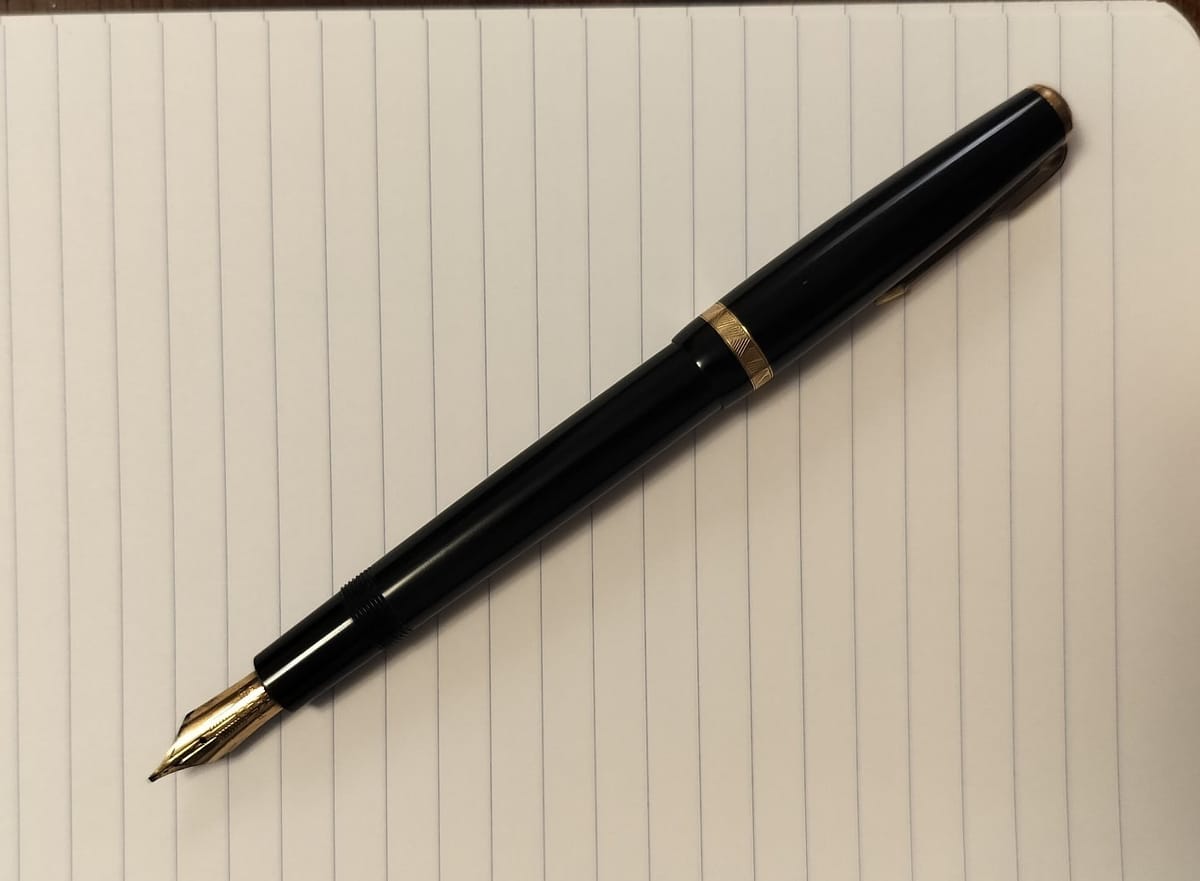
It is an ordinary Wednesday afternoon, and Robert is talking about a fountain pen.
In speaking with Robert, one senses that he is usually a reserved individual, not prone to exuberance — but this item is clearly a source of enthusiasm. Some might look at Robert’s pen and blandly comment that “yes, it’s certainly a nice pen,” but they would be missing the point.
This pen is meaningful. It has its own story, that has over time become part of Robert’s story too.
An English Made Fountain Pen
Here is the moment to be precise. Robert’s pen is an English-made Parker Duofold Maxima fountain pen. It has survived seven decades and still serves its intended purpose. It is considered a collectable, and there is a market of specialists who would wish to acquire this particular pen — which makes this a fitting occasion to say plainly that this is not an appraisal, not an assessment of market worth. This is a much deeper, and arguably more meaningful, look at a seemingly everyday object. Better defined, perhaps, as a working collectable.
Robert and the pen are roughly the same age, with both coming into being in the 1950s. They — Robert and his pen — now live in Texas, but the pen has only lived there since Robert acquired it, sometime between 2015 and 2020. Robert cannot place the acquisition more precisely than that five-year window; the memory of exactly when has not survived as clearly as the pen itself has.
And this would seem a good place to write more precisely about the pen and its life before Robert.
The nib tells you most of what is knowable before you even turn the pen over: Parker England 50, the “50” not a whim but a code — the largest nib Parker’s Newhaven factory made for this range, reserved for the Maxima, the flagship of a lineup that ran up through Slimfold, Junior, Demi, and Senior before arriving at this.
The wide chevron band at the base of the cap says the same thing in a different register: it marks the pen as the top of the line, not merely a Duofold but the largest and most deliberately made of them. Parker’s own nib-marking convention of the period typically stamped these nibs “14K Parker England 50” — Robert’s pen reads “Parker England 50” without a visible 14K mark, though the nib is understood to be 14-karat gold. Whether the mark is present but unnoticed, worn away, or genuinely absent is not something that can be settled without closer examination.
Going Back to Newhaven
The pen was almost certainly made at Parker’s factory in Newhaven, England — the plant responsible for the entire postwar British Duofold line, Maxima included, and the source of the “England” stamped into the nib.
The factory that made this pen sat in Newhaven, a small port town on the Sussex coast at the mouth of the River Ouse, England — a working harbour town, not a manufacturing hub in the way Birmingham or the Midlands were, which makes the presence of a fountain-pen works there something of a historical accident.
The site had begun life not as a factory at all, but as a First World War army transit camp used to move troops and materials across the Channel to France. The camp was abandoned in 1921 and a pen manufacturer named Felix Macauley built a factory there. In 1930 the facility was sold to Valentine & Sons; then finally acquired outright by the Parker Pen Company in stages through the 1940s. By the time Robert’s pen would have been made in the mid-1950s, pen manufacturing had already been on that site for roughly three decades.
The 1950s themselves were a period of active expansion at the Newhaven works — new factory bays were raised in 1951, and a large brick office block, still known internally as “H Block,” went up in 1955 to house a rapidly growing administrative staff. How many people were on the factory floor specifically in the middle years of that decade is not a figure that turned up in the sources available — the clearest workforce numbers on record are around a hundred employees under Valentine & Sons, and over a thousand by the 1970s, once Newhaven had become a major regional employer. The true number for 1955 or so almost certainly sits somewhere between those two points.
When in the World?
A precise year of manufacture is harder to claim with confidence. Collectors and dealers who specialize in these pens regularly assign individual Maximas to specific years — the mid-1950s, or 1956, or 1958 — but the model’s exact production run and the year the Maxima itself was introduced remain points of open discussion even among dealers, and no single date can be stated here as settled fact. What can be said with more confidence is the decade: this is a 1950s pen, likely the middle years of that decade, made in the same stretch of years in which Robert himself was born.
Inside the barrel is a filling mechanism built for use with an ink well or bottle of ink, rather than a cartridge: a rubber sac compressed by a metal pressure bar, the two working together so that a squeeze of the barrel expels air from the sac, and its release in the ink draws the fluid back in.
This was Parker’s aerometric filling system, which replaced the older button-filler mechanism used in Parker’s British pens into the early 1950s. What the design achieves, whatever its exact materials, is repairability — the sac can be replaced, the bar reset — which is no small part of why a pen built for a desk in the 1950s can still be filled, and written with, on a desk in Texas seven decades later.
The First Owner
Not much is known of the pen’s early life. Robert found it offered on eBay in the UK, where the seller was auctioning off the possessions of a deceased family member — an online estate sale, of sorts. There was no history of the pen included in the original listing, just pictures and features and talking points of interest to particular fountain pen enthusiasts. Perhaps the deceased uncle bought it new, nestled in the original and subsequently lost box. Perhaps it had changed hands between its inception and the eBay auction. We will never know. Things can only be traced from eBay forward, the pen travelling through the mail from the Old World to the New.
Why Acquire a Fountain Pen?
When Robert was asked why he chose to purchase this particular pen, he had a short but interesting response. He had become a “fountain pen enthusiast,” for no precise reason other than he was experiencing, at that particular point in time, some turbulence in life. He chanced upon the notion that he might find some solace, or some distraction, by means of what he now terms “the pointless exercise of being a collector”. He termed it “buying gifts for myself” and in this case by acquiring the “best” fountain pen of its type for that time.
And yet, despite the “pointless” exercise, the pen has remained with him and gained weight — in meaning — as we shall explore later. But before we call up the present, this is a good place to explore the deep genealogy of the pen itself.
The DNA of a Fountain Pen — Out of Africa
Of the pen’s materials, gold is the one worth pausing on longest, because its journey to the nib is traceable in outline even though its exact origin is not.
In the 1950s, the overwhelming majority of the world’s newly mined gold came from South Africa, and by long-standing arrangement — one that had defined the trade since the nineteenth century and was freshly reestablished when the London gold market reopened in 1954 — South African mining houses shipped the bulk of their production to London to be sold and refined. It arrived unrefined, was assayed and refined by relatively few London firms working to strict purity standards, and was then sold on through the London bullion market to manufacturers who needed it, jewellers and dentists and instrument-makers among them, pen companies too.
Parker’s Newhaven factory did not buy finished gold sheet from outside; it ran its own in-house “melts” operation, where gold was weighed, alloyed to the correct karat, and rolled into the sheet from which nibs were stamped — a detail confirmed by former Newhaven staff who recalled the melts book as the literal control ledger for the department.
Gold entering Britain in the 1950s came overwhelmingly by way of South African mines and the London bullion market, refined by one of a handful of London houses, before reaching a manufacturer’s own workshop. What it cannot do is name the mine. No document survives — or at least none that this research has found — connecting a specific bar of gold to a specific nib stamped “Parker England 50” on a specific day in Newhaven. The most honest claim available is a systemic one, not a particular one: this gold almost certainly passed through that South African-to-London pipeline, but its deeper origin, the specific seam it came out of the ground from, is unrecoverable.
The tiny fused ball at the very tip of the nib — the actual point that meets the paper, separate from the gold body around it — sits in a similarly uncertain place, though for a different reason. Pen nibs of this era were conventionally described as “iridium-tipped,” and iridium is itself one of the platinum-group metals, historically sourced primarily from South Africa’s Bushveld region alongside a smaller supply from the Ural Mountains in Russia — so, geographically, a story that echoes that of the gold.
But the word “iridium” on a mid-1950s nib carries a genuine asterisk: industry accounts consistently note that tipping alloys largely stopped containing actual iridium by the mid-1950s, priced out by its rarity, and were increasingly replaced with alloys of the more available sister metals — osmium, ruthenium, ruthenium-tungsten blends, and similar mixtures loosely grouped under the same “iridium” label out of habit rather than accuracy. Robert’s pen was made right at that pivot point. Whether its tip is old-style true iridium or one of the substitute platinum-group alloys already coming into use by then is not something that can be determined by looking at it, and is left here, deliberately, unresolved.
The black material of the barrel and cap is the section where the sources actually disagree with one another, which is worth stating plainly rather than smoothing over. Some dealer and collector descriptions of mid-1950s aerometric Duofolds — including pens of this same general type and era — describe the material as black celluloid. Other accounts place Newhaven’s shift to injection-moulded polystyrene barrels specifically in the late 1950s, and specifically in connection with Parker’s cheaper Duofold models rather than the flagship Maxima.
Robert’s pen, as a mid-decade Maxima, sits close to that dividing line without falling clearly on either side of it based on the sources available. It may be celluloid; it may be an early use of the injection-moulded plastic that would come to define Parker’s later, cheaper British pens. Both are plausible.
The pressure bar and the spring inside the aerometric mechanism are almost certainly some grade of steel — a metal chosen for its ability to flex thousands of times over decades without fatiguing, which is exactly what the mechanism has, apparently, been doing for seventy years. Whether it is specifically stainless steel, as it visually appears to be, is not something this research can confirm beyond the visual impression already noted, and no further claim is made about its alloy.
How the Pen is Used Today
Robert uses this pen regularly, and it does more than mark words and numbers on a page. He is an IT professional, which means — like many of us — he types and uses keyboards and devices all day.
His Maxima came to have special uses, not related to his “pay the bills” life.
The pen enables him to truly write, or better put, to scribe. He can act as his own personal amanuensis — at once the one composing the words and the one setting them down, the pen forcing a small distance between the two that a keyboard doesn’t.
He cites the physicality of the object first: its heft, its size, the feel of it in the hand. This, he finds, helps create focus — writing that is legible and deliberate, rather than merely fast. The touch on the page is more delicate than that of a regular ballpoint pen; there is no need to “grind” it onto the page, only to let the ink (and his thoughts) flow.
The nib’s own form makes the writing itself more visibly elegant — downstrokes wider, cross-strokes narrower — so that the motion of writing becomes more conducive to the pondering and choosing of meaning. The pen’s mechanical demands, in other words, impose a discipline on his thinking that a keyboard does not.
The ink is a further, deliberate choice. He seeks inks from England when he wants a deep, saturated black, and others from France when he wants something closer to earthy tones.
A Working Collectable with a New Purpose
Just a fountain pen? Just a collectable? Clearly, this is not the case.
For an appraiser, it might carry a modest market value; for the collector, a certain cachet. But for Robert, this humble object — part of his life for a decade or less — is something more. It is the embodiment of an emotional period, one that culminated in the ability to create words of worth and meaning.
Not a bad purchase.
A “keepsake,” in the truest sense of the word.
Sources consulted
NB: several sources are dealer listings, enthusiast blogs, and collector forums rather than peer-reviewed or archival sources.
On the Duofold Maxima and the Parker UK Duofold range
- Nishimura, David. "English & Danish Aerometric Duofolds." Vintagepens.com. https://www.vintagepens.com/Parker_UK_Duofolds.shtml
- "Parker Duofold Maxima, No. 50 14ct Gold Nib." The Old Pen Shop. https://theoldpenshop.co.uk/products/parker-duofold-maxima-blue-with-no-50-14ct-gold-nib-p0428
- "Vintage Parker Duofold Maxima." Worthpoint archive. https://www.worthpoint.com/worthopedia/vintage-parker-duofold-maxima-465798670
- "1957 Parker Duofold Maxima" (forum thread). Fountain Pen Network. https://www.fountainpennetwork.com/forum/topic/323750-1957-parker-duofold-maxima/
- "Parker Duofold." Wikipedia. https://en.wikipedia.org/wiki/Parker_Duofold
- "Parker Duofold UK — New Standard, Blue, Aerometric" (two listings). Peyton Street Pens. https://www.peytonstreetpens.com/
- "Parker New Duofold UK Senior (1950s)." Peyton Street Pens. https://www.peytonstreetpens.com/
- "1950s Parker Duofold Senior Aerometric — Black Celluloid." Protopens. https://www.protopens.com/1950s-parker-duofold-senior-aerometric-made-in-england-14k-gold-f-size-nib-black-celluloid-fountain-pen.html
- Goodwriterspens's Blog. "Newhaven Parker Duofold Demi." https://goodwriterspens.com/2012/10/23/newhaven-parker-duofold-demi/
- Goodwriterspens's Blog. "English Parker Duofold Aerometric." https://goodwriterspens.com/2018/07/19/english-parker-duofold-aerometric/
- Fountain Pen Chronicles and More. "Parker 17 Duofold." https://fountainpenchronicles.blog/2024/07/08/parker-17-duofold/
- Parkercollector.com. "Parker 17." https://www.parkercollector.com/parker17.shtml
- Parkercollector.com. "Parker Centennial." https://www.parkercollector.com/centennial.shtml
On the Newhaven factory and its history
- Walton, Carol. "Parker Pen Company." Our Newhaven. https://www.ournewhaven.org.uk/topics/businesses/parker_pen_company
- "Former Parker Pen Factory." Geograph Britain and Ireland. https://www.geograph.org.uk/photo/3103949
- "Newhaven project on the history of the Parker Pen Factory receives national funding." Sussex Express. https://www.sussexexpress.co.uk/heritage-and-retro/heritage/newhaven-project-on-the-history-of-the-parker-pen-factory-receives-national-funding-4528931
- "Did you or someone you know work at the Parker Pen factory in Newhaven?" Sussex Express. https://www.sussexexpress.co.uk/news/people/did-you-or-someone-you-know-work-at-the-parker-pen-factory-in-newhaven-4500260
- "Parker Pens: Stories from Newhaven Town, East Sussex." Press Play Films. https://pressplayfilms.co.uk/parkerpens/
- "A Brief History." Penshop.co.uk blog. https://www.penshop.co.uk/blog/a-brief-history-parker
- "Parker Pen Company." Wikipedia. https://en.wikipedia.org/wiki/Parker_Pen_Company
- "The history of penmaking around Britain." Heritage Hunter. https://heritagehunter.co.uk/the-history-of-penmaking-around-britain/
- Rupert Arzeian, Fountain pen blog. "Nine years with the Parker Frontier fountain pen." https://rupertarzeian.com/2020/04/23/nine-years-with-the-parker-frontier-fountain-pen/
On gold sourcing and the London bullion market, 1950s
- "After the War is Over, The London Gold Market Reopens: 1954–1968." Alchemist, LBMA. https://www.lbma.org.uk/alchemist/issue-95/after-the-war-is-over-the-london-gold-market-reopens-1954-1968
- "Learn About the London Gold Market." BullionStar. https://www.bullionstar.com/gold-university/london-gold-market-trading
- "Origins of the London Bullion Market." LBMA. https://lbma.org.uk/origins-of-the-london-bullion-market
- Blagg, Michele. "The Royal Mint Refinery." Alchemist, LBMA. https://www.lbma.org.uk/alchemist/issue-71/the-royal-mint-refinery
- "1. Introduction." LBMA OTC Guide. https://www.lbma.org.uk/publications/the-otc-guide/introduction
- "The First Gold Fixing." LBMA. https://www.lbma.org.uk/wonders-of-gold/items/the-first-gold-fixing
- "The Daily London Gold Fix." The Tontine Coffee-House. https://tontinecoffeehouse.com/2021/08/09/the-daily-london-gold-fix/
- "The Reopening of the London Gold Market in 1954." An Exchange Rate History of the United Kingdom (Cambridge University Press). https://www.cambridge.org/core/books/an-exchange-rate-history-of-the-united-kingdom/reopening-of-the-london-gold-market-in-1954/9EC83D5D143E4E1C298BE35056D70182
- "The London banking house." Guide to the Rothschild Archive. https://guide-to-the-archive.rothschildarchive.org/the-london-banking-house/depts/the-daily-gold-price-fixing/history-of-the-gold-price-fixing
- "Rand Refinery." Wikipedia. https://en.wikipedia.org/wiki/Rand_Refinery
On nib manufacture and tipping materials
- "The Art of Pen-Making." Parkerpen.com. https://www.parkerpen.com/parker-pen-making.html
- "Vintage Pen Catalog: Parker, 1945 to the present." Vintagepens.com. https://www.vintagepens.com/catill_Parker_2.shtml
- "Parker Fountain Pen Nibs." The Online Pen Company. https://www.theonlinepencompany.com/fountain-pen-nibs/parker-nibs
- "Nibs." Parker75.com. https://parker75.com//Reference/Nibs/Nibs.htm
- "Nibs." Parker45Pens.com. https://parker45pens.com/nibs/
- "Retipping." Wikipedia. https://en.wikipedia.org/wiki/Retipping
- Nishimura, David. "What is iridium?" Vintagepens.com FAQ. https://vintagepens.com/FAQbasics/iridium.shtml
- "Nibs, Then and Now." Fountain Pen Chronicles and More. https://fountainpenchronicles.blog/2022/02/22/nibs-then-and-now/
- "Pelikan's Wolfram-Iridium Alloy." The Pelikan's Perch. https://thepelikansperch.com/2023/09/13/pelikan-wolfram-iridium-nib-tipping/
- "Precision in Nib Crafting: Iridium Tipping Techniques." Fountain Pen Revolution. https://fprevolutionusa.com/blogs/news/precision-nib-crafting-iridium-tipping-techniques
- "Fountain Pen Nib and Tipping Materials Explained." Bottle and Plume. https://www.bottleandplume.com/blogs/learn/fountain-pen-nib-and-tipping-materials-explained-and-gold-vs-steel-myths-busted
- "Fountain Pen – Nibs." Technology Trends / Primidi. https://www.primidi.com/fountain_pen/nibs
- "4.4 Nib Materials." Fountain Pen Design. https://fountainpendesign.wordpress.com/fountain-pen-nib-design-function/fountain-pen-nib-materials-composition/
- Minerals Yearbook, 1954 and platinum-group metals data tables (1955–56). University of Wisconsin Digital Library. https://search.library.wisc.edu/digital/