What's In the Bone: The Deep History of a Domino Set
The Curious Story of a Simple Antique Game
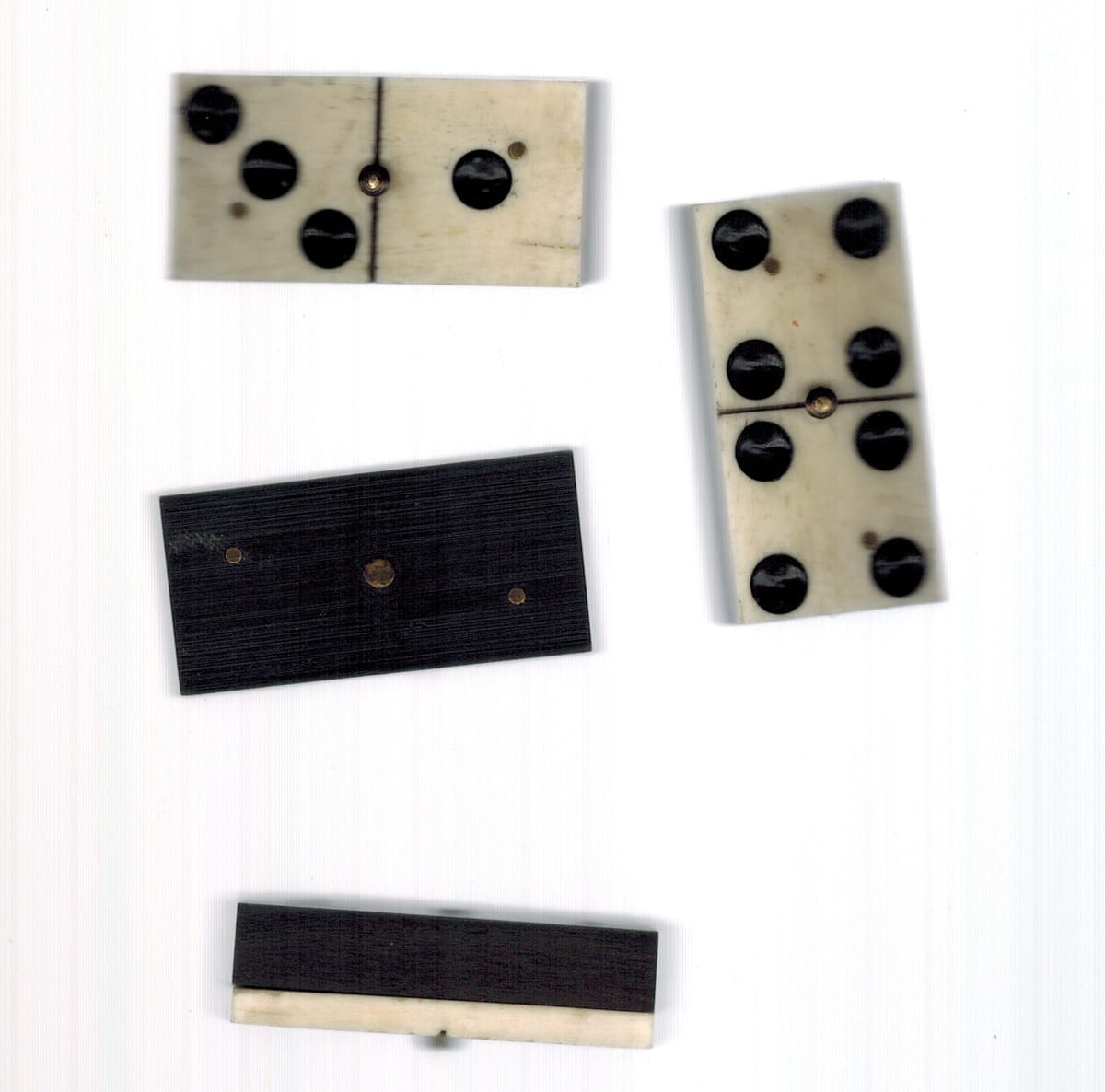
It all started, for me, while babysitting my ten-year-old granddaughter. We were thinking about playing a new game, and I recalled an old set of dominoes I had stashed away in the basement. We began to play, and I began to ponder.
I knew the set had been owned by my father, kept in the basement of the house I inherited, along with all its contents, upon his death. He and I had never played dominoes together. I suspect the set had remained, if not untouched, unplayed for decades.
Who may have possessed the set before it was my father’s is, itself, an inference rather than a fact. My father was born in 1920, and would not, in any meaningful sense, have “owned” anything as a child — so if the set predates him, as I believe it does, it must have belonged first to his father, my grandfather, Frederick Choppin. This is an assumption, not a documented certainty. It rests on timing, and on something harder to defend: the set simply feels like the kind of thing my grandfather would have owned, based on what I know of his other possessions.
My grandmother Jessie, by contrast, was no player of games — she was outdoorsy, a reader, not a gamer — and I find it hard to picture her ever taking a turn with these tiles. Much less slamming them in victory on a tabletop.
When my grandfather died in the 1930s, everything he owned stayed with her; only upon her own death were those possessions divided between my father and his sister. My father, it seems, came away with the smaller, more “manly” objects among the household’s effects — pocketknives, tools, a set of dominoes — while my aunt inherited other things entirely. So what I actually know is this: the set was in my father’s keeping, and before that, somewhere in a household shared by Frederick and Jessie. Which of them — or whether either of them — ever set a tile down on a table, I cannot say.
The dominoes are snugly housed in a fitted box. The lid slides open through bevelled edges, and the joints are beautifully dovetailed. The wood appears to be beech. The tiles — or bones, as they are often called — have a marked heft and substantive feel to them. They don’t feel modern in any sense. Their physicality is notable.
And so, I began turning the tiles over and over in my hand, inspecting them more closely, and wondering what story they might have to tell.
A Deeper History
I want to give some history to the Rennicks of New Brunswick, the original — or certainly early — owners of the game. But first, let’s take a look at the history of the game itself, some reasonably deduced information about what this set was made from and how truly ancient these components are, and some speculation on when and where the set may have been made.
The Game
Dominoes is a game of matching tiles, tracing back to twelfth- and thirteenth-century China. The version played today — the double-six set, with its familiar twenty-eight tiles running from blank-blank through six-six — emerged in Italy in the early eighteenth century, and spread from there across Europe over the following decades. By the time my set was made, dominoes was already an old game, its rules and standard form well settled, its manufacture a well-established trade rather than a novelty.
The name itself carries a bit of disputed folklore. One theory ties “domino” to the black hooded cloak, lined in white, once worn by priests in winter and later adopted as a masquerade costume — the white tile with its black pips echoing the garment’s contrast. I offer this as a charming and oft-repeated story rather than a settled fact; other sources trace the word more plainly to the Latin dominus, “master.” I don’t know which is true, but I am fine with that.
Of What the Set Is Made
Under a strong, raking light, the white material of the tiles shows faint striations, running more or less in the same direction across every piece. This is a meaningful detail. Ivory, the material one might first assume, has a distinctive signature — Schreger lines, a fine crosshatch pattern where two sets of lines cross one another. What I found instead was a simple parallel striation, with no crosshatching at all.
That absence points toward bone rather than ivory — specifically, in all likelihood, cattle bone, and more specifically still, the cannon bone, or shin-bone: long, dense, and straight, and for centuries the standard, unremarkable material for exactly this kind of small turned or cut goods.
Bone was a byproduct: The animal that gave up its shin-bone had certainly been raised and slaughtered for beef, or culled at the end of a working or dairy life, its bone recovered afterward by butchers and sold on, in bulk, to the bone-workers and turners who supplied trades like this one. We can’t know the particular animal’s age, but a beef animal of the period would most plausibly have been somewhere between two and four years old at slaughter; a dairy cow or working ox, considerably older.
The dark material presented its own small puzzle. My first assumption was ebony, but I wondered whether it might instead be ebonite — vulcanized rubber, patented in the mid 1800s and widely used through the second half of the nineteenth century as a cheaper, moldable stand-in for true ebony. A simple test settled it, or came as close to settling it as I could manage at home. When I rubbed the dark material and brought it close, I found no odour at all — no trace of the faint sulfurous smell that vulcanized rubber tends to retain, even after a century, when warmed by friction. That absence, together with the wood-like irregularity of the streaking under light, points toward genuine ebony.
Ebony does not grow in Europe or North America. Wherever this set was made, the wood had already crossed an ocean before it reached a workbench. The nineteenth-century trade in ebony ran chiefly through West Africa — Gabon, in particular — and through Ceylon and southern India, both moving through British colonial and mercantile channels; or Madagascar, via the French.
Only the heartwood of the tree is usable — dense, jet black, and slow to form — while the pale outer sapwood is cut away and discarded. Because of this, an ebony tree needed real time before it was worth harvesting at all; a reasonable estimate puts that at sixty to a hundred years or more of growth, though I hold that figure loosely. A tree that began growing in some West African or Ceylonese forest a century before Canada’s Confederation might easily be the very wood held in my granddaughter’s fingers now.
And then there are the pins — small, dulled, brownish-gold, holding bone to wood these many decades. I ran a magnet across the pine – no pull. So, likely brass, an alloy of copper and zinc, and both metals, however plain they may seem set into a domino, carry a history longer than either the tree or the animal ever could.
Neither copper nor zinc formed in the Big Bang; both were built, atom by atom, inside stars — through slow neutron capture in aging red giants, and in the more violent processes of supernovae — long before our own sun existed. When those ancient stars shed their outer layers, the elements scattered into the interstellar dust and gas from which our solar system eventually formed, some 4.6 billion years ago. From there, the story turns geological rather than stellar: copper concentrated into mineable veins in places like Cornwall, through granite intrusions some 280 million years ago; zinc, in deposits like those worked around Liège in Belgium, through mineral-laden groundwater moving through limestone over a vast stretch of time.
If, as seems likely, these pins were cast in Birmingham — England’s great centre of brass founding and small-metal manufacture in this period — then the copper and zinc within them had already travelled an almost unfathomable distance before they ever became something as modest as a pin holding a domino together: forged in the deaths of stars, scattered across a forming solar system, locked into rock for hundreds of millions of years, mined, smelted, alloyed, and finally shaped into something small enough to hold between two fingers.
I find something quietly staggering in that. The set in my hands is, by any ordinary reckoning, old — older than my grandfather, older than the Rennicks, older by a wide margin than the city of Saint John itself. And yet every material in it is, in its own way, almost incomprehensibly older still.
When and Where Was It Made
Taken together — the pinned bone-and-ebony construction, the fitted and dovetailed box, the standard should-be twenty-eight-tile count (mine has just twenty-six; more on that later) — the set most plausibly dates to somewhere in the second half of the nineteenth century, likely the 1860s through the 1890s.
Where, exactly, it was made, I cannot say with any confidence. England and France were the two leading centres of this kind of fine-ish games manufacture in the period, and the materials — West African or Ceylonese ebony, cattle bone, Birmingham brass — would all comfortably fit an English origin, moving through the same colonial and mercantile trade networks that, eventually, brought the finished object across the Atlantic to a modest tradesman’s household in Saint John, New Brunswick. But a locally or regionally made set, produced somewhere within the Maritime provinces themselves using imported raw materials, remains entirely possible too.
I don’t have a maker’s mark, a label, or anything else that would let me say for certain. What I have is a set of reasonable inferences, built from the object itself — and, as I was about to discover, a family’s name, written in an adult’s hand, on the underside of the lid.
─── ❖ ── ✦ ── ❖ ───
The Rennicks
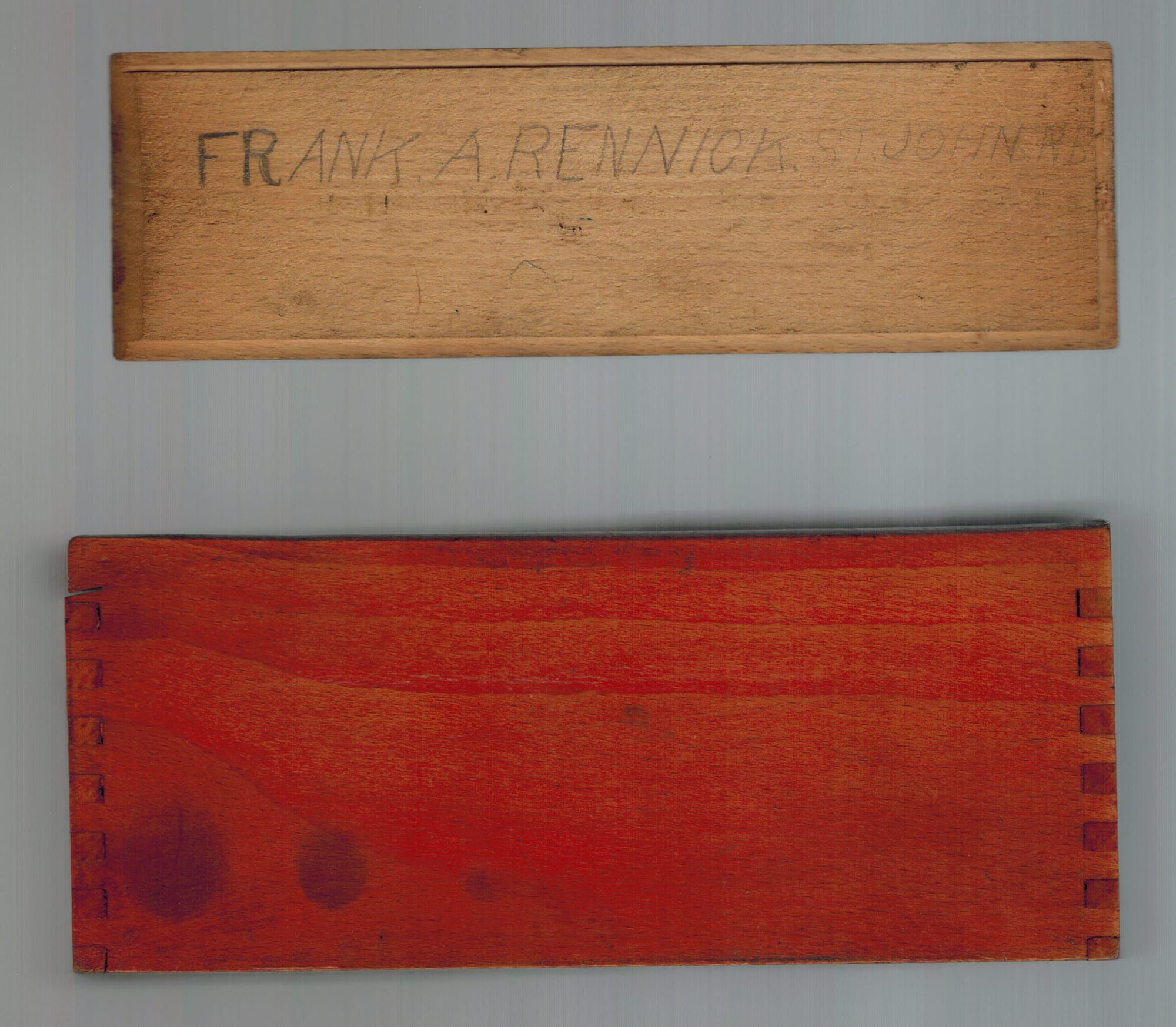
The box itself presented a clue. Beneath the lid, etched in what appears to have been an adult’s handwriting, is “Frank A. Rennick, St. John, New Brunswick.” This made perfect sense.
My grandfather had lived in Saint John between 1920 (or perhaps 1923) and 1931. Frank and his family lived in the city during these same years — and they were neighbours, certainly by March 1925, living just a few doors down from one another on Wright Street. How, exactly, my grandfather came to own a set that had once belonged to the Rennicks, I don’t know for certain. But the closeness of the two households — not merely the same city, but the same street, for at least a few years — was enough to send me looking in earnest.
Frank Adams Rennick was born in Saint John on January 11, 1878, the son of Hugh Rennick and his wife Anna (sometimes recorded as Annie). Hugh, born September 30, 1846, worked most of his adult life as a shoemaker — cordonnier, in the bilingual language of the 1901 census — and by that year was earning a modest $300 annually, the same figure recorded for his twenty-three-year-old son Frank, then just beginning what would become a fifty-year career as a clerk, and eventually cashier, with the Canadian Express Company (later Canadian National Express). Father and son lived together in Duke’s Ward, and would go on living together for most of the next two decades.
Both Hugh and Anna were, in the language of the period, “deaf and dumb” — Hugh’s deafness attributed on the census to a childhood fever, Anna’s to an unspecified “sickness.” The record isn’t a passing detail; in 1891, a decade earlier, both were already recorded as deaf — as was Hugh’s brother Thomas, who died that same year at thirty-seven. Whether some hereditary thread ran through the wider Rennick family, or whether each case had its own separate cause, I can’t say with any confidence — the record merely states the fact of shared deafness among at least two siblings and a spouse, not its cause or origin.
What the record shows plainly, though, is a couple who built a real and active life around that shared circumstance. In May 1907, some twenty of Saint John’s deaf citizens organized themselves into an association, securing a room in the Stockton Building for weekly religious services — conducted, as the newspaper put it, by “preachers of their own kind,” since the deaf congregants found themselves otherwise dependent on hearing clergy they couldn’t follow. Hugh was named to the room committee. Anna was named, alongside a Mrs. Samuel Stanton, to a ladies’ committee formed to assist the new association. This was not incidental membership; it was two people well established in a hearing city, giving real time and effort to building a fuller communal and spiritual life for themselves and others who shared their circumstance, in an era that offered almost no institutional accommodation for it otherwise.
Hugh died on March 27, 1921, at the General Public Hospital, following an operation, at the family home at 82 Spring Street. He was seventy-three, a lifelong resident of the city, survived by Anna, by Frank, and by a sister, Mrs. Joseph Taylor. Sometime in the four years that followed, Anna and Frank — Frank still unmarried — left Spring Street and settled at 68 Wright Street. It was there that Anna died, on March 31, 1925, of what her death record describes as a malignant growth of the neck, with Frank at her side.
Frank remained at 68 Wright Street, alone, for four more years. In June 1929 he married Elizabeth Maude Dunbrack, in Vancouver, and by the time of the 1931 census the couple had settled into their own home at 33 Cedar Grove Crescent, in the Dufferin Ward of Saint John — Frank by then a cashier for an express company, his income risen to $1,425 a year, the house a modest six-room rented row dwelling with, the census noted with a certain period charm, a radio. He died on March 9, 1953, “the last surviving member of his family” — a phrase, as I understand it, means the last of his own household, Hugh and Anna and Frank, rather than the last Rennick anywhere (at least one aunt had outlived Hugh by decades). He was a Freemason, made an honorary member of Albion Lodge No. 1 not long before his death, and also a member of the Knights of Pythias. He was buried from Brenan’s Funeral Home, entombed at Fernhill Cemetery.
My grandfather’s family — Frederick Choppin, his wife Jessie, and their children, including my father, born in 1920 — lived at 96 Wright Street continuously from at least June 1923 (the birthdate of my father’s younger brother James) through October 1927 (James’s death date, at 96 Wright Street, “all his life,” per his death certificate). Ninety-six and sixty-eight Wright Street, by my counting, sit some three or four houses apart — not a long walk at all. My grandfather’s family, in other words, were already living on that street when Anna Rennick died a few doors down in the spring of 1925, and remained there for at least two years afterward, through the years Frank lived on alone before his 1929 marriage and move across the city.
I want to resist the temptation to close this gap more tightly than the evidence allows. I don’t know that Frederick and Frank ever spoke to one another. I don’t know that the set passed directly between them, rather than through some intermediary — a shop, an estate sale, a mutual acquaintance helping Frank settle his mother’s affairs. What I can say is that a game once belonging to a household built, in real part, around silence — a household that fought, deliberately and communally, to be heard in its own way — came to rest, a few doors down, in a household that would go on to play it, generations later, with a ten-year-old girl who has never known any of these names.
Dominoes asks nothing of the ear or the tongue. It can be played, perfectly, in total silence. I find myself unable to shake the thought that Frank, or Hugh, or Anna, might have known that better than most of us ever will — though whether that thought is discovery or simply my own imagination reaching for a meaning the record doesn’t offer, I leave for the reader to decide.
─── ❖ ── ✦ ── ❖ ───
Two Missing Tiles
A complete double-six set holds twenty-eight tiles. Mine holds just twenty-six.
I don’t know which two are gone, or when, or how. I’ve thought about the plain, unglamorous ways a domino tile disappears from a set: swept up with the crumbs after a long-ago game and thrown out without a second look; dropped and rolled beneath a floorboard or a piece of furniture, still there, for all I know, in some Saint John house I’ll never enter; carried off by someone’s child, put in a pocket and forgotten, or simply lost the way small, hard, pleasing objects are always getting lost from a child’s hand.
There is no record for this kind of disappearance. No census taker, no obituary writer, no death certificate marks the moment a domino tile leaves a set for good. It simply isn’t there one day, and by the time anyone thinks to count, no one can say when.
I think, more often than I expected to, of some lines from the 1995 film Restoration1, in which the character Katherine describes a place called The Land of Mar:
Across the sea,
in the Land of Mar...
there is a valley where are kept
all the things lost on earth.
Lost kingdoms,
lost riches,
lost hours,
lost loves.
I won’t pretend I believe in such a place, not literally. But I’ve spent these past weeks in something like it all the same — turning over a bone tile in my hand and trying to call back a lost afternoon, a lost conversation, a lost pair of feet walking three or four doors down a Saint John street on some ordinary day in 1925, for some ordinary reason, that no one thought worth writing down.
Most of what I set out to find, I found. The animal the bone came from, if not the animal itself. The forest the ebony came from, if not the tree. The stars the copper and zinc came from, if not which star, or when. A family — the Rennicks — recovered in fuller and more human detail than I had any right to expect from a name pencilled under a lid. A street, a distance of three or four houses, close enough to call the word neighbours without stretching it.
But not everything.
Not the moment the set changed hands. Not the two tiles that are simply gone. Not whether my grandfather and Frank Rennick ever stood on the same stretch of sidewalk and said good morning to one another, the way neighbours do, without either of them imagining that a hundred years on, someone would go looking for the proof of it.
Some things, it seems, stay in the Land of Mar. I’ve decided I don’t mind. A story with every gap filled in wouldn’t have sent me looking in the first place — and it certainly wouldn’t have been half as much fun to tell my granddaughter, the next time we sit down, twenty-six bones between us, to play.
- Restoration, screenplay by Rupert Walters (1995), spoken by the character Katharine. Quoted via Scripts.com, STANDS4 LTD, accessed September 5, 2026, https://www.scripts.com/script/restoration_16827/5
References and Additional Reading:
Stellar nucleosynthesis (copper, zinc origins)
- Burbidge, Burbidge, Fowler & Hoyle, "Synthesis of the Elements in Stars," Reviews of Modern Physics, 1957 (the foundational paper on s-process/r-process nucleosynthesis)
- NASA's Jet Propulsion Laboratory or NASA Science education pages on stellar nucleosynthesis (nasa.gov)
Copper and zinc geology
- British Geological Survey (bgs.ac.uk) has publications specifically on Cornish copper/tin mining history and geology
- For Belgian zinc/Liège: geological literature on "Mississippi Valley-type" (MVT) ore deposits
Ebony — botany and trade history
- CITES (cites.org) documentation on Diospyros species, since several ebony species are now trade-restricted — useful for both botanical and trade-history detail
- Wood identification/trade references such as the Wood Database (wood-database.com), which covers ebony species, growth characteristics, and historical trade regions in accessible detail
Bone as a craft material
- General decorative-arts or antiques reference works on Victorian-era bone and horn working would cover cattle cannon-bone use directly; museum decorative arts departments (V&A, Smithsonian)
Brass manufacture and Birmingham
- Birmingham's historical role in brass founding and small-metal trades is well covered in local/industrial history sources — Birmingham City Archives or the Library of Birmingham
Domino history
- General game-history references (e.g., The Oxford History of Board Games by David Parlett) cover dominoes' Chinese origins and 18th-century Italian/European spread reliably
Genealogical/documentary sources
- 1901 and 1931 Canada Census records
- Find a Grave memorial
- Telegraph-Journal obituary and death notices, via Newspapers.com
- Saint John Globe, 1891 (Thomas Rennick)
- Restoration screenplay, via Scripts.com