Don't Burn Your Hands: The History of a Potholder
A Work-a-Day Object with a Rich History
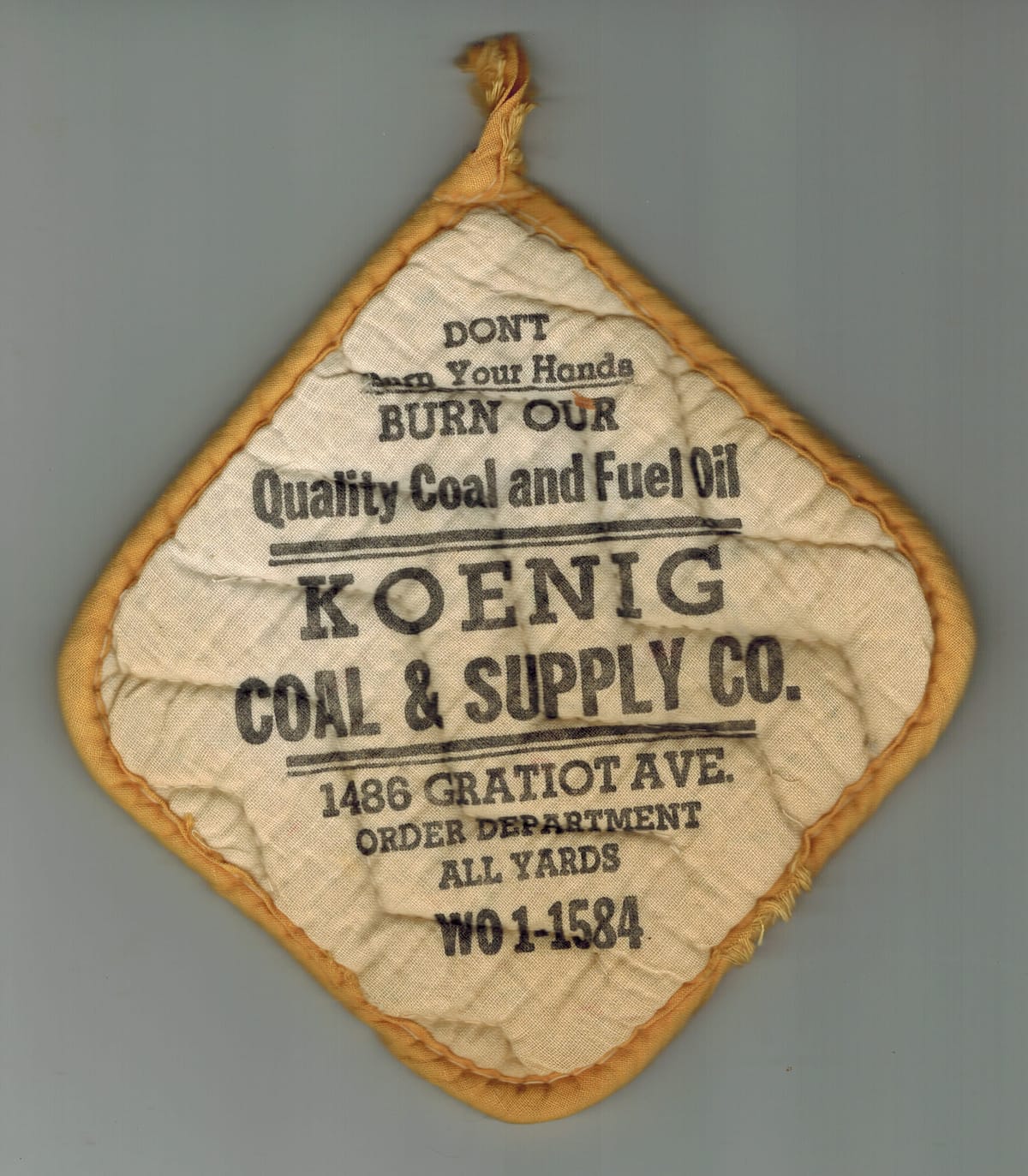
Some objects announce themselves. They arrive with hallmarks, with maker’s stamps pressed into brass, with palette-shaped labels that promise, however falsely, a name.
This is not one of those objects.
It is “just” a potholder.
The Potholder
It is a square of quilted cotton, a scant 5-1/2 inches on a side, bound in gold bias interfacing gone soft with age, with a small barely frayed loop at one corner for hanging. Gray letters, stamped in a diagonal band across its face, still declare, faintly but legibly:
|
Don’t burn your hands. BURN OUR Quality Coal and Fuel Oil. KOENIG COAL & SUPPLY CO. 1486 Gratiot Ave. Order Department. All Yards. WO 1-1584 |
No museum will ever accession this object. It is not old enough to be a proper antique, not distinctive enough to be delightfully quaint — barely, if judged scrupulously, old enough to be called a collectible at all. It occupies a strange, unglamorous middle ground: too young for reverence, too ordinary for nostalgia, and yet somehow still here.
It was never bought. It was given away — a small commercial gesture, free with a delivery, the kind of object that existed by the thousands and was meant to be used until it wore through and was thrown out.
This one was not thrown out.
It has survived for something on the order of seventy years, and it is worth asking why an object built for so little permanence has managed so much of it.
Koenig Coal & Supply Co. Detroit, Michigan
The company on the label was real, and it was not small.
Koenig Coal & Supply Co. Traced its origins to 1870, when Peter Koenig began selling firewood in Detroit — a modest enough start for a business that would, over the following decades, expand into hard coal, then fuel oil, then building supplies and concrete, growing into one of the city’s most substantial independent fuel and materials firms.
By 1932, the company was established at 1486 Gratiot Avenue, the address printed on the potholder, in a building given a striking black-glass Art Deco face as part of a broader modernization of that stretch of the street. By the mid-1960s, near its own centennial, Koenig was being described as the largest independent firm of its kind in the region, combining coal, fuel oil, building supplies, and concrete under one name.
The building still stands. It has since become, at various points, a bar and a venue — a small, ordinary irony, that a company built on heating strangers’ homes should end its working life as a place where strangers gather to be warm in a different sense entirely.
What’s In A Number?
The telephone number does something the company’s own history cannot: it dates the object with real precision.
“WO 1-1584” is not a modern phone number missing a few digits — it is a complete one, in the format the Bell System adopted as a national standard in the years following 1947: two letters representing a named exchange (here, almost certainly Woodward), followed by five numerals.
This format had a surprisingly short reign in the United States. It became the settled national convention only in the postwar years, and the telephone industry began actively phasing it out in favour of all-digit dialing starting in 1961, a transition largely complete within the decade that followed. A potholder printed with a two-letter, five-number Detroit exchange, then, could not have been made much before the early 1950s, and almost certainly not much after the early 1960s.
The object dates itself, independent of any story its owners might tell about it.
Detroit and St. Clair Shores – late 1950s to early 1960s
And there is a story, though not one the potholder can confirm on its own.
It belonged to a woman who will be called Marie here, and subsequently to her daughter who will be called Jackie — their real names kept out of this account, in keeping with the practice of these essays generally — who lived in Detroit and, for a handful of years in the later 1950s, in the newly incorporated suburb of St. Clair Shores, some fourteen miles up the lake from downtown.
St. Clair Shores had become a city only in 1951. When Marie arrived, it was still becoming itself. Locals of the period remembered parts of it, only half-affectionately, as “Muddy Acres,” for the unpaved roads and unfinished storm sewers that left the ground as swampy as it had been when French settlers called the place L’anse Creuse (meaning Little Bay or Shallow Bay) two centuries before.
It was, during Marie’s residency, the fastest-growing suburb of Detroit — a young family’s landscape of half-built streets and lakefront promise. The Jefferson Beach Amusement Park, with what had once been the longest roller coaster in the country, closed its gates in 1959, somewhere in the middle of Marie’s years there — a landmark she would have known either as a going concern or as a thing newly and locally mourned, depending on exactly when she came and went.
She would have read, in whatever paper came to the house, that a Soviet satellite called Sputnik had gone up in October 1957, and felt — as most of the country did — the particular unease of a technological argument being won, for the moment, by another side. She would, if she were still in the area come November 1960, have read about John F. Kennedy’s election, one of the narrowest in the nation’s history. And sometime around these moments, Kern’s, a long-loved downtown Detroit department store, closed its doors for good in 1959, one small local grief folded into a decade of larger ones.
The Oilman, the Milkman and the Breadman
Somewhere in this window, an oilman handed Marie a potholder at her door.
For precision, it was an oilman, not a coal man, despite what the potholder itself advertises; Marie’s household burned fuel oil rather than coal, a detail confirmed by her daughter, Jackie.
This is the detail, the physical contact, is worth sitting with longest, because it is not really about the object at all. It describes a mode of commerce that has almost entirely vanished: a company representative, in person, at the door, handing something directly to the person whose house he had just filled with coal or fuel oil — an ordinary transaction with an ordinary human gesture built into it, unremarkable at the time, now nearly unrecoverable.
The oilman himself has vanished as completely as two other once-familiar callers of the era, the milkman and the breadman — figures who arrived at the door as routinely as the mail and now survive mostly as figures of speech, evidence of just how thoroughly that whole mode of personal commercial contact has disappeared from ordinary life.
‘Tis the Season
Detroit’s oil-heating season ran roughly from autumn through February or March; whatever else was or was not true of Marie’s household in a given year, the delivery itself would have come in the cold months, carried in by a stranger she likely knew by sight, if not by name.
Whether anything else was true of that particular winter is practically unknowable, and it would be dishonest to pretend otherwise.
What is certain is that Marie was pregnant in 1957 and 1958. A household expecting a child in early spring might have known, in those same winter months, a particular kind of restlessness — sore feet, a sore back, the low hum of apprehension and anticipation that attends any coming change. It is tempting to fold that possibility into the object’s story, to imagine Marie’s hand closing around a still-warm potholder while some other, larger warmth was building in the house alongside it.
But nothing in the object itself, and nothing in what survives of the household’s account, fixes whether such a thing was happening in that particular winter, or a different one, or not at all in any way connected to this potholder’s arrival. The two facts — a coal company’s seasonal delivery, and whatever else was unfolding in Marie’s life across these few years — sit beside each other without ever quite touching. What can be said, and said with certainty, is smaller and stranger for its smallness: her hand touched it.
The History of the Object
The object’s own materials tell a story with a different kind of confidence — strong in its middle, honestly uncertain at both ends.
The cotton was almost certainly American-grown; there was no economic reason, for an object this ordinary, to look further afield than the country’s own Cotton Belt — the Mississippi Delta; the Texas and Oklahoma plains; the fields of Georgia, Arkansas, and the Carolinas.
Where that raw fibre went next can be said with more confidence still. By the 1950s, American cotton textile manufacturing had all but completed its long migration out of New England and into the Piedmont region of the Carolinas and Georgia, consolidating around a handful of large, vertically integrated firms — Cone Mills, Burlington Industries, Dan River, J.P. Stevens, Deering Milliken among them.
It is entirely plausible, though not provable for this specific piece of cloth, that both the plain backing and the printed face of this potholder began as yardage from a mill in exactly that region, at almost exactly the moment of its greatest concentration and output.
Where the story goes soft again is at the very last step: the cutting, quilting, printing, and stitching that turned plain cloth into a finished, branded object.
Some larger Southern mills operated their own finishing divisions capable of carrying goods all the way to this point. Equally plausible, a separate premium or “advertising specialty” manufacturer, a genuine mid-century industry built specifically to produce branded giveaways for companies like Koenig, might have been located anywhere from the same Southern mill towns to the Midwest, closer to its client.
The potholder carries no manufacturer’s mark — these giveaway pieces essentially never did — and so this last leg of the journey is a gap that cannot honestly be closed. Somewhere between a Carolina loom and a Detroit doorstep, cloth became a gift, and no record of exactly how survived the transaction.
The ink follows a similar pattern of confidence and honest limit.
A single-colour design on a short run like this was, by every reasonable expectation of the period, produced by screen printing — a method that had its origins in advertising and display work near the turn of the century, decades before it found its way into fine art. The grey-black pigment is consistent with carbon black, the default colourant of the era, very likely bound in the kind of synthetic resin system that had become standard in commercial textile printing by the 1930s.
Why the lettering reads as grey rather than a truer black today is a question with two equally plausible answers: it may simply have been printed that way from the start, a cost-conscious choice for an object made by the hundreds and given away for nothing; or it may have faded, decade by decade, through sun and laundering and the slow oxidation of the binder itself. The object does not tell you which, and there is no easy way to make it do so.
Why did Marie keep it?
This is the question that matters most and can be answered least.
She died more than twenty years ago and cannot, obviously, be asked. What survives is not an explanation but a fact of placement: among the things she left behind — some with real market value, some still in daily use, all of them, in one way or another, explicable as things worth keeping — this potholder sat quietly in a linen drawer, tucked in among the good tablecloths and the guest towels it did not remotely resemble in quality or purpose. It is not fine. It has no resale value worth mentioning. It does nothing that a newer, prettier potholder could not do better. Yet it stayed.
The object’s own condition offers a modest clue toward one possible answer. Its hanging loop is only lightly frayed, and the potholder itself is notably clean — free of the scorching, staining, and heavy wear that decades of real stove-top use would be expected to leave on quilted cotton. Jackie, asked directly, reported that her mother was not especially fond of cooking, that it was for Marie simply another household task to be managed rather than lingered over. That temperament may explain the object’s pristine state more plausibly than any theory of careful, deliberate preservation: a potholder rarely used has correspondingly little chance to wear out.
It is fair, too, to ask whether this survival reflects something more concerning than ordinary sentiment — whether Marie was, in the clinical sense the word has since acquired, a hoarder. Jackie’s answer is a clear no. Marie kept a great many things over her lifetime, by her daughter’s account, but not at any level that would raise real concern; she was an accumulator in the unremarkable way that most people are, not someone for whom keeping had become a compulsion.
Perhaps it meant nothing in particular to her, and was simply too small and too little trouble to discard — the kind of object that survives not through reverence but through sheer inertia, the drawer never quite emptied, the thing never quite in anyone’s way.
Or perhaps it was kept precisely because it had been given, not bought — a small unearned gift from a stranger at the door, in an era when that kind of encounter was still ordinary yet quietly pleasing.
Neither explanation can be confirmed against the other, and it may be that both were true in different years, or neither, or that the question would have struck Marie herself as a strange one to be asked about a potholder.
What can be said is only this: whatever quiet, unexamined status it held during her lifetime has shifted, now that she is gone. Before her death, it was merely another object among many — unremarkable, indistinguishable from a dozen other small things a household accumulates without thinking. Since then, it has taken on something closer to pathos, not because the object itself changed in any way, but because it was touched by a hand no longer here. An object she touched, that survived her, that outlasted several better and more expensive things — that status is not something the object earned by being kept. It is something death conferred on it, after the fact.
A Time Traveller
It did not travel far, in the end — Michigan to Ontario is no great geographical distance, a lake crossed rather than an ocean. But measured in years rather than miles, it travelled a great deal further than that: Call it, without much exaggeration, a time traveller: an object built to last a single heating season, that instead crossed seven decades intact, arriving here essentially unchanged.
From a Detroit doorstep in the last years of a two-letter phone exchange, through a linen drawer that outlived its keeper by decades, it has been quietly waiting, as objects so often do, patient in a way no person can be. And here, now, it has its brief moment to come into the light and declare whatever meaning can still be discerned — an accounting, a small declaration of whatever meaning a workaday object can still be made to yield, before it goes quiet again.
Notes and Caveats
Established as fact: Koenig Coal & Supply Co.’s founding date (1870) and its occupancy of 1486 Gratiot Ave. From 1932; the two-letter, five-number telephone exchange format as the U.S. national standard from the late 1940s through the start of its phase-out in 1961; St. Clair Shores’ incorporation as a city in 1951 and its documented status as Detroit’s fastest-growing suburb through the 1950s; the closures of Jefferson Beach Amusement Park (1959) and Kern’s department store (1959); the launch of Sputnik (October 1957) and the election of John F. Kennedy (November 1960); that Marie’s household heated with fuel oil rather than coal, and that Marie was not fond of cooking — both reported directly by Jackie.
Probable, not confirmed: that the potholder’s cotton was grown in the American South and woven in a Piedmont Carolina or Georgia mill, consistent with the overwhelming concentration of that industry in the region by mid-century; that the printing method was screen printing using a carbon-black, resin-bound pigment; that the object’s clean, lightly worn condition reflects infrequent use rather than deliberate preservation.
Speculative but grounded: any connection between the potholder’s arrival in the household and a pregnancy, a particular season of physical or emotional change, or any specific year within Marie’s known residence in St. Clair Shores; the specific manufacturer or location responsible for cutting, quilting, and finishing the object into its final form; whether the grey tone of the lettering reflects original formulation or decades of fading; Marie’s own reasons for keeping the object.
Unknowable, and treated as such throughout: why, specifically, this object was kept for more than seventy years when so many identical ones were not.
References
- "Koenig Coal & Supply Co. Building," Historic Detroit, https://historicdetroit.org/buildings/koenig-coal-supply-building
- "The Coal King," nailhed (blog), May 2015, https://www.nailhed.com/2015/05/the-coal-king.html
- "Your Evolving Phone Number," Invention & Technology Magazine, https://www.inventionandtech.com/content/your-evolving-phone-number-1
- "All-number calling," Wikipedia, https://en.wikipedia.org/wiki/All-number_calling
- "Textile Industry," South Carolina Encyclopedia, https://www.scencyclopedia.org/sce/entries/textile-industry/
- "Cotton mills move upcountry," Appalachian History, https://www.appalachianhistory.net/2018/04/cotton-mills-move-upcountry.html
- "Screen printing," Encyclopædia Britannica, https://www.britannica.com/technology/screen-printing
- "Evolution of Textile Printing Technologies and Innovative Sustainable Solutions," The Textile Magazine, https://www.indiantextilemagazine.in/evolution-of-textile-printing-technologies-and-innovative-sustainable-solutions/
- "Gallery: 150 historic Detroit News front pages from 150 years," The Detroit News, https://www.detroitnews.com/picture-gallery/news/local/michigan-history/2023/03/26/gallery-150-historic-detroit-news-front-pages-150-years/11547534002/
- "St. Clair Shores, Michigan facts for kids," Kiddle, https://kids.kiddle.co/St._Clair_Shores,_Michigan
- "Looking Back: St. Clair Shores may not be an old city, but it honors its past," Metromode, https://metromodemedia.com/looking-back-series-scs/
- "City History," St. Clair Shores, MI Official Website, https://www.scsmi.net/98/City-History