The Duck Call
On humble objects, deep time, and the breath of the people we have loved.
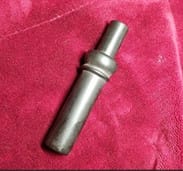
It is odd to think that a humble duck call is, technically, a woodwind instrument. You will not find one in an orchestra, nor is there sheet music composed for it — no Song of the Duck Call, no Duck Call Symphony, Opus 10. And yet it has music, poetry, history, and in the case of my duck call, considerably more.
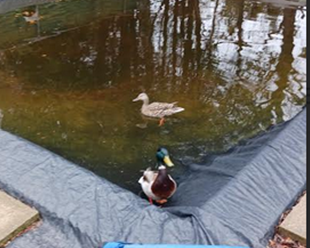
I own a duck call. A modest object, hardly a museum quality item worthy of velvet cushion reverence. It is about five inches (13 cm) long and close to three-quarters of an inch (2 cm) in diameter. It is black, has a reed inside, and has been in this house for as long as I can remember. I have written elsewhere about the ducks that return to our backyard each spring, and about my husband, who is what I can only describe as a duck-whisperer — a man who speaks something close enough to duck-speak that the ducks themselves appear convinced. He uses the call to talk to them. They answer. Neither party requires a shared vocabulary to sustain the relationship.
While watching him do this one April morning, I began to think about the instrument itself. About what it is, and where it came from, and how far it had travelled to end up here, near a creek in Port Credit, calling mallards to a suburban backyard.
As it turns out: very far indeed. In several senses of the word.
If My Duck Call Could Talk
If my duck call could tell me its own particular history, it would speak of the Illinois River valley and its journey to Mississauga, Ontario. But if we were to probe more deeply — and probe we shall — we would need to begin somewhere much older than Illinois, much older than Ontario, much older, in fact, than even the idea of a duck call.
There is research suggesting that instruments made specifically to attract or repel birds and fowl date back twelve thousand years. These instruments were fashioned from bone, both mammal and human. Similar in principle to whistles, they are scientifically classified as aerophones. It is a fine word for a humble object, meaning a voice made of air. Which is, when you consider it, precisely what a duck call is.
My duck call, however, has a rather more specific and recent origin. It was made in 1904 — which makes it, as of this writing, one hundred and twenty-two years old. I know this not through family records, but through forensics. On its side, it reads “P.S. Olt.” It also reads “Patent Applied” — not “Patent Pending” or “Patent Granted.” Philip Sanford Olt received his patent in 1905. He had only switched from wood to hard rubber in 1904. In other words, my duck call was made during a very narrow window of time: after the material changed, but before the patent came through. It is, by any measure, a first-year model.
The Material
My duck call is made of ebonite, which is the name given to hard rubber in contexts where the material earns a more distinguished title. What identifies it is a combination of physical qualities and simple tests that any curious person can perform at the kitchen table. Ebonite is black or very dark brown. It is smooth and slightly warm to the touch — warmer than plastic, which is one of the things that distinguishes it. It is hard but not brittle, and develops a brownish oxidation over time. When rubbed vigorously on the palm of the hand, it emits a faint and unmistakable smell of sulphur, and becomes slightly glossier. When tapped, it sounds duller than plastic — a deeper, more considered sound, as though it has more to say and is in no hurry to say it.
The name ebonite was chosen to reflect the material’s resemblance to ebony wood: the same density of colour, the same quality of darkness. It is used still — in high-end fountain pens, musical instrument mouthpieces (the clarinet’s, in particular), specialty industrial parts, and vintage bowling balls. These are objects that share with the duck call a certain requirement: that the material be warm in the hand, precise in the machining, and in no way brittle. Objects that are meant to last, and do.
The clarinet mouthpiece connection is one I find especially pleasing. My duck call is a woodwind instrument made of the same material as other woodwind instruments. One is played in concert halls; the other is played in marshes. The material makes no such distinctions.
Where the Rubber Meets the Road
To understand where ebonite comes from, one must begin with natural rubber, which begins — in the case of my duck call, almost certainly — in the Amazon.
Ebonite starts as latex, the sap of Hevea brasiliensis, the rubber tree. These trees grow in tropical regions: Southeast Asia, parts of Africa, South America. By 1904, plantation cultivation of rubber was underway in Southeast Asia; the British had smuggled seeds out of Brazil in 1876, germinated them at Kew Gardens, and shipped the seedlings to Ceylon and Malaya. But those plantations only became significant sources of supply in the late 1880s and 1890s. The rubber in my duck call almost certainly predates them, which means it almost certainly came from the Amazon — from the great Brazilian rubber boom that ran from roughly the 1850s to the early 1900s, when wild Amazonian trees were tapped by seringueiros, who travelled deep into the rainforest following established routes between trees they had learned to find.
Those trees were not young. Wild Hevea brasiliensis can live well over a century. The trees tapped in the 1880s and 1890s could easily have been saplings in the 1700s. It is well within the reach of possibility that the tree whose latex became my duck call was quietly growing in the Amazon rainforest while Mozart was composing, while the American Revolution was being fought, while the world that would eventually produce Philip Olt and his chicken coop in Pekin, Illinois was still a long way from existing.
I find this worth sitting with for a moment.
The rubber boom of the Amazon was not, it should be noted, a benign or innocent enterprise. It was built on exploitation, brutality, and the enslavement of indigenous peoples — a dark history that is very much part of my duck call’s story, even if its full telling lies beyond the scope of this essay. It would be dishonest not to say so.
From the Amazon, the raw latex — coagulated into balls or slabs of crude rubber by smoking over fires — would have made its way by canoe along the river’s vast network of tributaries to the great export port of Belém do Pará at the mouth of the Amazon. From Belém, by cargo ship across the Atlantic to the eastern seaboard of the United States. Then, by rail, on to Akron, Ohio — which, by 1898, had established itself as the rubber capital of the world. The Goodyear Tire and Rubber Company had been founded there that year, named in honour of Charles Goodyear, who had discovered the process of vulcanization in 1839: the treatment of rubber with sulphur under heat that transforms soft, unstable latex into a durable material. When the sulphur content is pushed very high (from 25 up to 80%) and the curing time extended, the result is ebonite.
Akron, in other words, is where the rubber hits the road. Quite literally, in the case of a company whose name would become synonymous with tires. And in the case of my duck call — where the raw material arrived from one Ohio-adjacent city and made its way to a craftsman’s workshop in another — it was in every practical sense an Ohio product from the moment it reached American soil.
Mitochondrial DNA
Ebonite requires two ingredients beyond rubber: sulphur and linseed oil. These are, in a sense, the mitochondrial DNA of my duck call — ancient, invisible, and largely unremarked upon, yet carrying within them histories that dwarf everything else in its biography.
The sulphur in an early twentieth-century American rubber product almost certainly came from the Gulf Coast — from Louisiana or Texas, where the Frasch process, first successfully deployed in 1894, allowed vast underground deposits to be extracted by pumping super-heated water down to melt the sulphur and force it to the surface. Prior to this, Sicily had been the world’s primary supplier. The American deposits displaced Sicilian sulphur for American manufacturers almost overnight.
Those Gulf Coast sulphur deposits formed long ago in the porous rock just above vast underground salt domes. The salt domes themselves were created over 100-150 million years ago, when the Gulf Coast region was a shallow, repeatedly evaporating sea. As the seawater evaporated in cycles, it left behind deposits of rock salt. Over millions of years buried under sediment, the salt slowly pushed upward through the denser layers of rock above, forming domes. The sulphur came later: as petroleum and gas migrated through the rock and encountered these domes, sulphate-reducing bacteria deposited pure elemental sulphur in the surrounding rock. An ancient sea. Ancient microbes. Tens of millions of years of unhurried geological time, stored in the walls of a five-inch black tube.
There is a thread here that runs through the entire essay and I do not think it is accidental: the sulphur comes from vanished seas. The rubber came down Amazonian rivers. The duck call ends its life near a creek. It is, from first geological origin to final purpose, a creature of water.
The linseed oil implicates a different geography. Linseed oil is pressed from flaxseed, and flax — Linum usitatissimum — is not native to North America. It is one of the oldest cultivated plants in human history, originating in the Fertile Crescent of ancient Mesopotamia in present-day Iraq, and the surrounding region, including Syria and Türkiye. There is archaeological evidence of flax cultivation dating back thirty thousand years; it was certainly being deliberately grown and harvested in the tenth to eighth centuries BCE. The ancient Egyptians cultivated it extensively. European colonists — British, Irish, Dutch — brought it to North America in the early 1600s, and it migrated west with settlement until it found the deep rich soils of the Midwest ideally suited to large-scale production. By 1904, the linseed oil Goodyear needed was being produced nearby in Ohio, Indiana, and Illinois.
A tree from the 1700s Amazon. A sea that vanished 100 million years ago. A crop first grown in the ancient Fertile Crescent. All of it converging in an Akron factory, and from there to a workshop in Pekin, Illinois, and from there to a small black object sitting on a shelf in Port Credit, Ontario.
A Man in a Chicken Coop
Philip Sanford Olt was born in 1870 in Illinois, of German descent, and spent his early years farming in the Illinois River valley near Pekin. Olt was well known locally as a wing shot of considerable skill. His old Lefever Damascus double-barrel with the pistol grip wrapped in copper wire still hung in the factory long after his death.
The Illinois River was one of the richest waterfowl hunting regions in North America, sitting squarely in the heart of the great Mississippi River flyway. This whole ecosystem of river, floodplain lakes, prairie marshes, ponds, and backwater sloughs, stretches from near Lake Michigan to the Mississippi at Grafton in southern Illinois.
Olt was not, by any available evidence, a formally trained engineer. He fits instead what might be called a classic archetype: self-taught, hands-on, focused entirely on what works. He first started making duck calls in the late 1800s, working from a converted chicken coop on the family farm, where he incrementally refined his hand-made instrument, solving problems he encountered each morning in the marsh.
The first duck calls available to him were rough copies of a design by the mysterious Frenchman Vit Glodo, made in southern Illinois around 1860. Olt didn’t think much of them. The brass reed material varied wildly in temper and hardness — a reed bent even slightly more than it should was useless. And wooden calls quickly became soaked with moisture from condensed breath and saliva, swelling and warping, sliding out of tune at the worst possible moments. Olt came up with the opposite of the Glodo design — a straight reed and curved reed base, which meant that once the contour was ground into the base, a straight reed would be easy to keep in tune, and simple to replace in the field. And he chose a different material entirely for the barrel and the tonal plug: hard rubber.
Hard rubber, he understood, had remarkable dimensional stability in cold weather and an almost complete lack of moisture absorption. A hard rubber call submerged in water for a year absorbs less than one percent moisture. There are recorded instances of Olt duck calls recovered from lakes and swamps after twenty-five years underwater, cleaned out, and found to be in working condition. Whether or not this was Olt’s intention when he made the switch, it is a kind of immortality.
The original reed in the D-2 and other early Olt calls was spring sheet hard rubber — approximately 0.012 inches (0.3 mm) thick. Not brass, as I had initially assumed: ebonite, vibrating against ebonite. My duck call is, in its essentials, a single material: ancient Amazonian rubber tree, transformed.
The first model he produced for sale was the D-2 Regular, in 1904. He sold six hundred that year.
A legend began — though it would not have looked like one from the chicken coop.
The Journey
I do not know how my grandfather came to own this particular duck call. What I know is that the gap between Pekin, Illinois in 1904, and my grandfather’s hands is — like many gaps in family history — filled with plausible inference and honest uncertainty.
My grandfather, Frederick Choppin, was born in Germany, in 1886. He is, in this respect, a quiet echo of Philip Olt: both men of German descent, one making the call, one eventually owning it, neither aware of the other’s existence. Frederick immigrated to Canada from England in 1905 — one year after the call was made — and appears in the 1906 Nominal Rolls and Paylists for the Volunteer Militia, 24th Regiment, Kent, Ontario, and then in London, Ontario. The 1911 census shows him at Wolseley Barracks in London, occupation: soldier. From London, he moved to Winnipeg Manitoba, from there to Ottawa Ontario, and then transferred between 1920 and 1923 to Saint John, New Brunswick. From Saint John, the family eventually moved to Pembroke, Ontario, where Frederick died in the 1930s.
The duck call was most likely acquired by an Ohio hunter — perhaps with military associations — who brought it across the border into Canada, where it passed, by some route I cannot reconstruct, into my grandfather’s possession. As much as I want, not every thread can be tied. The call existed before Frederick came to own it; it outlasted him, and that will have to be enough.
When Frederick died, the call passed to my father, Harold, who was born in Ottawa in 1920, and had grown up with the object, likely without thinking much about it. Harold brought it with him to Ottawa in the 1950s. Then to Detroit, from about 1956 to 1960. Then to Etobicoke in 1960, and Mississauga in 1961. In 1974, he moved to Italy — first to Castelfranco Veneto, then to Treviso, then to Novellara in Reggio Emilia — and the duck call, I know, went with him. I saw it sitting on a shelf in the Veneto, far from any duck marsh, waiting with the particular patience of objects that have learned to outlast things.
In the mid-1980s, Harold and the duck call returned to Mississauga — to the same house in Port Credit, beside Cooksville Creek, where he had lived in 1961. When he died in 2005, I inherited the call and brought it to my home in Clarkson, and in 2006 moved back to the Port Credit house, beside the creek, where it has been ever since.
All these places, the duck call has been. Ohio, London, Kent, Winnipeg, Ottawa, St. John, Port Credit, Clarkson, Treviso, Castelfrano, Novellara… I know without any doubt, that its two-note song was heard in all those places.
Three continents: South America, in the Amazon where the rubber tree grew. Europe, in the Fertile Crescent where the flax was first cultivated, and in the Italy where Harold carried it for a decade. North America, where all the threads converged — in Akron, in Pekin, and at military postings, and family migrations that finally brought it here. Harold himself crossed all three, and the call crossed them with him, as though it had always been his to carry.
Our Breath
There is a thought experiment sometimes called Caesar’s Last Breath: the argument that the atmosphere is so thoroughly mixed over time that any breath you take likely contains at least one molecule exhaled by Julius Caesar, or Cleopatra, or any figure from history you care to name. The molecules are still here, circulating, redistributed across the centuries.
The interior of a duck call is a more intimate version of this.
My duck call has been blown by, to my knowledge, only ten people across one hundred and twenty-two years: my grandfather Frederick; my grandmother Jessie; my father Harold; his sister, my aunt; my mother; my first husband; myself; my second husband; and my two children. A small circle; a known circle — some of them, no longer living — and whose breath, by the logic of Caesar’s last breath, is still here, still circulating, still present in some molecular sense inside that five-inch black tube.
None of them were hunters. I want to be clear about this. Every person in my family who ever blew into this call did so to watch the ducks, or to speak to them, or out of simple curiosity about the sound it made. It has never, in this family, been used to kill anything. It has only ever been used to call.
This seems right to me. It seems in keeping with what the object has become, over the course of its long and improbable life.
A duck call is, technically, a woodwind instrument. It will not be found in an orchestra. There is no sheet music composed for it. But it carries, in its small black body, the compressed history of an Amazon tree that may have been a sapling in the 1700s, of seas that vanished more than 100 million years ago, of a crop first grown in the ancient Fertile Crescent, of a self-taught craftsman in a chicken coop in Illinois, of a German-born soldier navigating the institutions of a new country, of a man who carried it across three continents and back, and of the breath of everyone who ever raised it to their lips and called out across the water, not to kill, but to be answered.
My husband stands at the back window. The ducks are on the pool tarp. He calls to them; they call back. Neither party requires anything more than this — the sound, crossing the water, with a fellow earthling on the other side hearing it.
This essay is the companion piece to The Return of the Ducks and was written in part while remembering my father, who, on this day, May 2nd, 1920, was born.
 Denise Choppin