Notes Under a Victorian Parlour Table
A story before it moves on
In addition to this website's collection of writing, I also compose pieces on people's objects, their heirlooms, their keepsakes. For other object histories, please visit:
It’s About to Start a New Journey
At this moment, it stands in an apartment in downtown Toronto, beside a sofa, holding a lamp. Its owner, James, is about to move, and he has decided to let it go.
But before it leaves the family that has kept it for well over a century, James began to look at it properly, and felt the pull that inherited things sometimes have. He will part with the table, but not without its story. These pages are that story, and they will travel with it, tucked beneath its top, for whoever owns it next.
Before we come to the specifics of this particular table, let us take a moment to conjure a scene.
The First Home
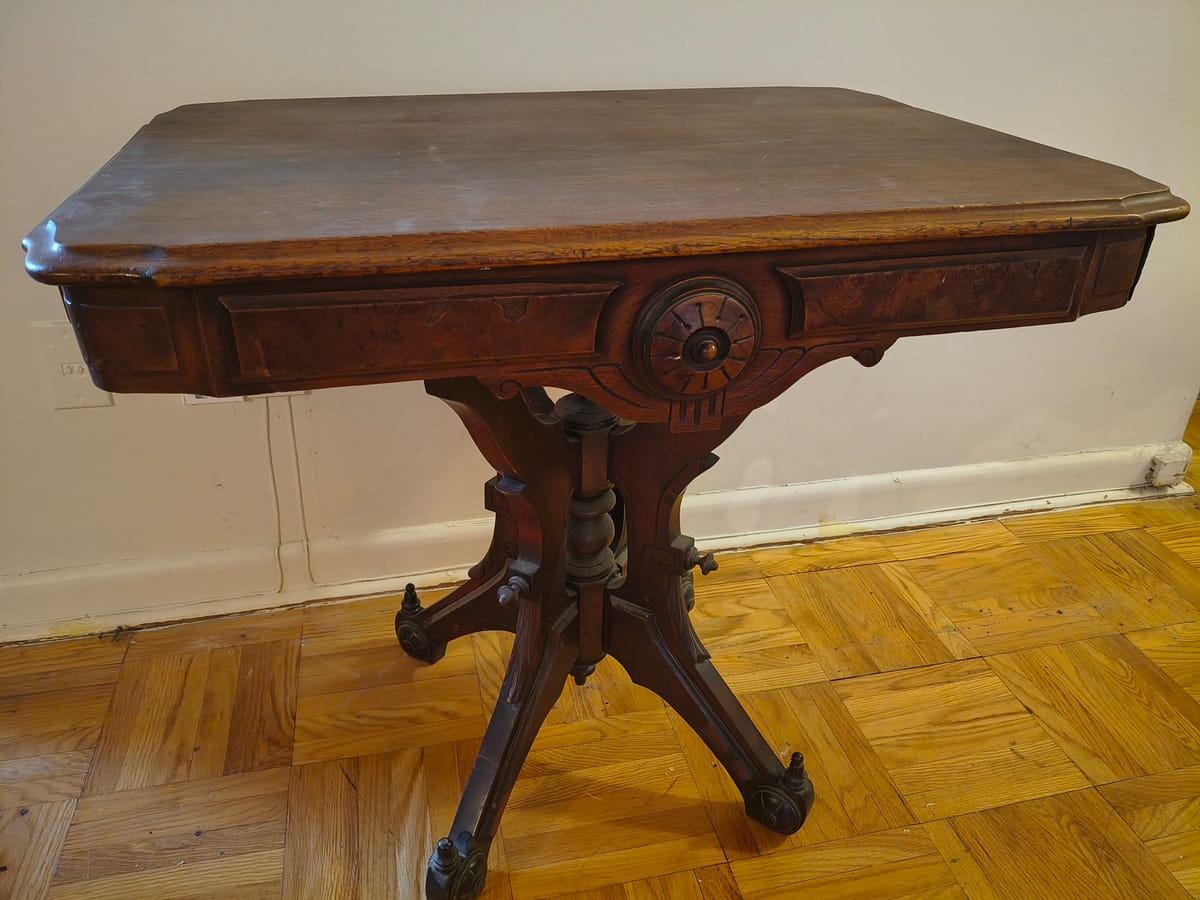
The table was made sometime between about 1870 and 1890. Its first home was probably in or near Hamilton, Ontario, with James’s maternal family. Perhaps it came to the house by wagon; perhaps it was a wedding gift.
We cannot know, we can only imagine.
Imagine, then, that its arrival was met by the family: a corseted wife in a long dress, her husband in the dark suit of the period. They would likely have been pleased as the table was carried into the parlour. The wife ran her fingers across the surface of the wood, chose a place for it at the centre of the room, and set something on it: a lamp, a vase, perhaps the family Bible.
From that moment, the table’s life in the family began. But it had already lived a long life before it ever reached that parlour.
The Walnut Tree
It began as a tree.
The table is walnut, almost certainly the American black walnut that is native to the warm southern edge of Ontario and to much of the eastern United States.
Walnut is a solitary, slightly forbidding tree: its roots, leaves, and husks release a compound called juglone that discourages many other plants from growing near it. The walnut used by furniture factories in the 1870s and 1880s was rarely planted. It was cut from old forests and farm woodlots, from trees that were often a century old or more. The tree that became this table may well have been growing before Upper Canada existed.
The Burl
Look at the panels on the front of the table, on either side of the carved medallion. Their swirling, rippled figure comes from a burl, a rounded growth that forms on a tree’s trunk or at its root crown, often in response to injury, insects, infection or some other stress. The tree cannot undo the disturbance; it can only grow around it, and the twisted grain is the record of that growing.
What began as an accident becomes something rare and beautiful.
It is hard not to think of people who have been through difficult things and carry the pattern of them in whom they become. But there is a sharper thought here too: a burl shows its beauty only after the tree is felled, and the growth is sliced thin and laid across a parlour table to be admired.
Shellac, Glue, and Iron
Other materials came from much farther away. If the table was finished as such tables usually were, its surface was coated in shellac or varnish. Shellac is made from a resin secreted by tiny lac insects on trees in India and Southeast Asia, gathered by villagers, processed, and shipped halfway around the world. The veneer was laid with hide glue, boiled down from the leftovers of tanneries and slaughterhouses. The screws that hold the table together were most likely iron, and in the 1870s and 1880s much North American iron came from the ore ranges around Lake Superior.
That iron has the longest story of all. Iron is forged inside stars and scattered when they explode. The Lake Superior ores were laid down nearly two billion years ago, on the floor of an ancient sea. Microbes were then releasing oxygen into a world that had almost none, and as that oxygen met the iron dissolved in seawater, the iron rusted and settled to the bottom in layers.
It is quite possible that the screws beneath this tabletop hold metal that settled out of an ocean when the air itself was first being made breathable.
Those Who Touched It
And then there were the hands. Fallers felled the tree in winter, and teamsters hauled it out. Sawyers cut it into boards that dried for months, perhaps years. In the factory, men ran the planers, band saws and lathes that shaped the legs and turned the central column. Others laid the veneer, assembled the parts, filled and stained and finished the wood, and crated the table for the railway. Then came a dealer, a salesman, and a delivery man. By a conservative count, dozens of people touched this table before the family ever saw it.
What came out of all that work is a walnut parlour or centre table in a style that blends two Victorian fashions.
From the Renaissance Revival come the framed burl panels, the bold carved medallion at the centre of the apron, the small turned finials where the legs meet the column, and the turned drop beneath it.
Eastlake and Renaissance Revival
From the style named after the English writer Charles Locke Eastlake come the flat-cut, angular legs and brackets and the shallow lines incised into them. Eastlake had argued for honest, restrained design. American and Canadian factories borrowed his name and his flat ornament largely because both were cheap to produce by machine.
So the table carries a small irony: its Eastlake features are what made it affordable, and its Renaissance features are what made it look expensive.
When new, a table of this kind was neither a luxury nor a trifle. A similar walnut table with a marble top sold in the 1870s for about thirty or forty dollars, at a time when a labourer earned roughly a dollar and a half a day. A wood-topped table like this one would have cost somewhat less. It was furniture for the respectable middle class: shopkeepers, clerks, tradesmen and prosperous farmers, families with a parlour to furnish.
The Shrine in the Parlour
The parlour was the front room, kept for visitors, Sundays and family occasions, and the centre table was its heart. On it stood the household’s brightest lamp, the family Bible, the photograph album, a vase of flowers. In the evenings the family gathered around it to read, sew and play games. One museum curator has called the Victorian centre table a shrine to the ideal of the close-knit family. It was where a household showed visitors, and itself, who it hoped to be.
The Decline of the Parlour and the Walnut
Fashions change, and the parlour did not last. In the 1890s a new term, the “living room,” began to appear in writing about home decoration. Edward Bok, the influential editor of the Ladies’ Home Journal, campaigned against the parlour, which he thought a useless room, and the house plans his magazine sold replaced it with a living room or a library. Walnut fell from favour at about the same time, partly because so much of it had been cut that good timber grew scarce, and lighter oak took its place. Heavy, dark Victorian furniture began to look old-fashioned, then simply old.
Many pieces like this one were sold, broken up or burned. Others were moved out of the way, into back bedrooms, attics, and cellars. Those are often the ones that survive. A table in daily use is scratched, knocked and eventually replaced. A table nobody much thinks about is left alone.
This one owes its survival, in part, to having gone out of fashion.
The Family and its Table
James’s mother’s family traces its roots to Loyalist settlers at the Head-of-the-Lake, as the Hamilton area was once known. No one now remembers who first owned the table, only that it belonged to the Hamilton side of the family. It passed to James’s maternal grandparents, then to his mother’s sister, and in the 1960s to his mother.
She lived first in Cooksville and later in Port Credit, both now part of Mississauga, Ontario. She liked older things and kept several family pieces: delicate Victorian chairs, a love seat, an ornate desk and an elaborate coat rack. The table was never one of the featured pieces. It lived in the basement recreation room, the informal family room of postwar suburban houses.
It had followed the parlour’s own decline quite literally, from the front room of a Victorian house to the basement of a suburban one. There, largely overlooked, it was kept safe.
Around 2010, as her health began to fail, James’ mother moved to Cambridge to be closer to her granddaughter, and the table went to James in Mississauga, and later moved with him to Toronto. The rest of the Victorian furniture is gone now, some to family, some to friends. The magnificent desk, now the property of a granddaughter, awaits with family while she resides on another continent. The coat rack is with James. Of the parlour furniture that once surrounded it, only the table remains.
In James’s apartment, it has found its way back to its old work. It stands beside the sofa and holds up a lamp: the same job it was made to do some 140 years ago.
These Notes are for You
If you are reading this (“you” being the next owner of this object), you have probably turned the table over, and you are not the first to leave or find something here.
On the wooden crosspiece someone long ago scratched a set of numbers, which seem to read “30” and “10” on either side of a long slash, with “80” beside them. It is tempting to read them as a date, 30 October 1880, and that would suit the table’s style perfectly. More likely they are a workman’s note: an order number, a batch, a way of keeping track of parts. On the underside of the top is a large looping mark in blue-grey crayon, of the kind factory hands used to keep a top matched to its own base as it moved through the shop. No one can now read it.
These are the only words the makers left us, written where no owner was meant to look. No one now remembers who first owned this table.
Only the table remembers, and it has kept its own notes underneath.
This essay is the newest of those notes. It was written at the request of the last family owner, so that the table would not leave the family empty-handed, without its history.
Whoever you are, it is yours now, to use, to enjoy, and one day to pass on. Look after it. It has come a very long way.
Written for James, Toronto, October 2026.
Sources and further reading
The identification of the table rests on examination of the owner's photographs. Where the essay speaks of what is likely or possible, it is drawing on the general histories below, not on documents about this particular table.
The parlour, the centre table and its cost
- Illinois State Museum, "Center table," in At Home in the Heartland. Source for the uses of the centre table, the "shrine" to family life, and the 1870s price of about $30 to $40.
- Richard H. Thornton, An American Glossary (1912), "Centre-table", World English Historical Dictionary.
- Federal Reserve Bank of St. Louis, FRED, Laborers' Average Daily Rate of Wages for United States, 1860–1880 (NBER Macrohistory data).
- True West Magazine, "Shopping from Home in 1897 with Sears Roebuck".
From parlour to living room
- Edward Bok, The Americanization of Edward Bok (New York: Scribner's, 1920), Chapter XXI, "A Signal Piece of Constructive Work".
- Karen Halttunen, "From Parlor to Living Room: Domestic Space, Interior Decoration, and the Culture of Personality," in Simon J. Bronner, ed., Consuming Visions: Accumulation and Display of Goods in America, 1880–1920 (New York: Norton, for the Winterthur Museum, 1989). Catalogue record. Cited here through the summaries below; not consulted directly.
- Wikipedia, "Living room" and "Edward Bok".
- Rancho Los Cerritos, "Status, Style, and Culture: Interpretation of the 1870s Parlor and the 1931 Living Room".
Style
- Charles Locke Eastlake, Hints on Household Taste in Furniture, Upholstery, and Other Details (London, 1868; first American edition, Boston, 1872).
The walnut tree and the burl
- Ann Joy, Brian Hudelson and Laura Jull, "Black Walnut Toxicity", University of Wisconsin–Madison Division of Extension, Fact Sheet D0021 (rev. 2024).
- Wikipedia, "Burl".
Shellac
- Wikipedia, "Lac (resin)".
Iron and deep time
- John F. Slack and William F. Cannon, "Extraterrestrial Demise of Banded Iron Formations 1.85 Billion Years Ago," Geology 37, no. 11 (2009): 1011–1014.
- Wikipedia, "Gunflint chert".