The Box That Waits: A Modern Twist on an Ancient Fairy Tale
A story of desire and the patience of forgotten things.
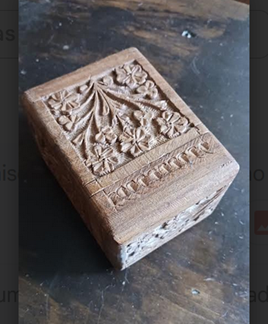
It is not a handsome box, not anymore. It began as one: carved from some dark wood whose name has been lost in the way that the names of craftsmen are always eventually lost — the wood and the maker alike dissolved into the general category of old. The carving is fine work, the work of someone who knew what the wood wanted to become, who followed the grain rather than arguing with it. Geometric patterns, interlocking, the sort of pattern that the eye tries to resolve into a simpler shape and cannot. At the centre, a script no one in Venice in the year 1500 could have read, and that no one in Toronto in the year 2024 bothered to try.
The box is currently in a landfill outside the city, buried under a layer of composite debris that includes a broken office chair, three years' worth of someone’s archived magazines, and a considerable quantity of the Styrofoam packaging material that is the true monument of our civilization. The box has not been destroyed. It is, as it has always been, patient.
We will come back to the landfill. But first: Venice.
The Drawer
The man’s name was Marco — not because it is an especially interesting name, but because it was, in 1500, the most common name in Venice, a city that had been naming its sons after the Evangelist for so long that the name had worn smooth from use, like a coin passed through too many hands. Marco Trevisan, to give him his fullness, was a merchant of middle importance: not so powerful that he attracted the attentive envy of the great families, not so insignificant that anyone felt it necessary to explain who he was. He traded in wool and occasionally in secrets, which is to say that he was a Venetian man of his time.
He had recently acquired, at auction, a desk.
It was an extraordinary desk — not in the showy way that objects are extraordinary when they want you to notice them, but in the quieter way of things that have been somewhere for a very long time and carry that somewhere inside them. It was made of walnut gone nearly black with age, and it had come to the auction house from the estate of a Moorish merchant who had died without heirs, leaving behind a houseful of objects that no one in Venice quite knew what to do with. The desk had drawers enough for all the paperwork of a man’s life, and on one of those drawers — the lowest, on the right — there was a lock. The key was not included in the sale, which had reduced the price considerably, as people distrust locked things they cannot open. Marco had bought the desk for the same reason certain people are drawn to locked rooms: not greed, exactly, but a particular form of curiosity that has the quality of an itch.
He had the lock picked by a man who asked no questions, which in Venice at that time was a professional courtesy rather than an unusual circumstance.
Inside the drawer: the box.
He almost didn't open it. This is worth noting, because the 'almost-nots' of history are what generate everything that follows. He was tired; it was late; the candle on his desk was burning at the kind of diminished angle that suggested it had given all it intended to give. He picked up the box, turned it over in his hands — registered, with the practised hands of a man who handled goods for a living, that it was old, that it was well-made, that the wood was something he couldn't identify — and set it down with the intention of examining it in the morning.
Then he opened it anyway.
There is no explaining this. Or rather: the explanation is that Marco Trevisan was, beneath his mercantile competence and his carefully maintained air of Venetian reserve, a man who could not leave a closed thing alone.
The box was empty. This was his first thought.
His second thought arrived when the smoke did.
It was not the smoke of a fire. It did not smell of anything burning. Simply, it was — smoke, rising from the interior of the box, impossible in every physical sense, rising, moving with a deliberateness that smoke does not possess, gathering itself upward in the way that a man gathers himself when he is about to speak, and taking, eventually, a form that was not quite human and not quite anything else, but that was looking at Marco Trevisan with eyes made of something that might have been embers, or might have been stars.
“Well,” said the jinn. And then, after a pause that Marco would spend considerable time thinking about afterwards: “You took your time.”
The Negotiation
Marco had been in enough difficult business conversations to know that when something unexpected occurs at the table, the worst thing you can do is show the full extent of your surprise. He took a breath. He set the box carefully on the desk, and said, in a voice that was only slightly higher than his usual register:
“Are you… What precisely are you?”
The jinn regarded him with the expression of someone who has answered this question many times over many centuries and finds it no more satisfying a question now than it was the first time.
“I will tell you what I am,” said the jinn. “But first, the terms. You have found me. I may grant you three wishes. They cannot be combined, banked, subdivided into smaller wishes, or used to purchase additional wishes.”
Marco, who was a merchant, asked immediately: “My last wish — could I not wish for an unlimited number of future wishes?”
“No,” said the jinn, with the tone of a man confirming a price that is not open to negotiation.
“You are quite certain.”
“I have been asked that question,” said the jinn, “in thirty-seven languages, and the answer in all thirty-seven is the same.”
Marco sat back in his chair. The candle was still burning, improbably, as though it too had decided it was not done yet.
“All right,” said Marco, who understood the shape of a negotiation when he encountered one. “Then let us proceed differently. Tell me what you are.”
The Theology of Fire
The jinn settled — which is certainly the wrong word, but seems as fitting as any other — into an arrangement of smoke and attention that occupied the air near Marco’s window, where the canal smell came through and the sounds of lapping water made the conversation feel less absolute, more permeable, which was perhaps a mercy.
“I am properly called a jinn,” he said. “Not a genie — that is a word the Latins made from the Arabic, flattening it in the way that translations always flatten: losing altitude, losing complexity, losing the parts that made the word worth making in the first place.”
He paused.
“I come from the lands past Byzantium. From before the trade routes, before the great caliphates, from the time when the world was still deciding what it was. You have, I assume, a theology?”
“I am a Christian,” said Marco, which was the most accurate answer available to him in 1500, whatever its complications.
“Then you know of God, and you know of angels. God made three kinds of being in the human register. Humans from clay — you know this story. Angels from light — you know this story also, or a version of it. And jinn from smokeless fire. From a fire so pure it has nothing to consume. We were not servants. We were not made for humanity’s convenience, any more than you were made for ours. We had our own affairs.”
Marco, who was a man of practical intelligence, said: “And those affairs — what were they?”
The jinn was quiet for a moment, the way someone is quiet when they are deciding how much of an honest answer to give.
“Everything a being capable of thought and will tend towards: conflict, creation, worship, negligence, love — and its opposite. We were not so different from you, except that we could shape the world more directly. Where a man might move a stone, a jinn might move a mountain. Where a man might change a mind through argument, a jinn might change an event through — other means.”
“You could alter reality?” asked Marco.
“We could. We were powerful, and what is powerful tends, eventually, to attract the attention of things more powerful still.”
The Binding
Here the jinn’s voice changed. Not in volume — he spoke softly throughout, with the deliberate quiet of someone accustomed to being listened to — but in quality. It became less a voice than a vibration in the air, something that Marco felt more in his chest than his ears.
“Long ago —before memory, before what you call history, before what my people call history, even before the word 'before' meant anything you could attach to a date — a powerful being — perhaps a God, something that predates the names we give to Gods — recognized what we were, what we could do. And this being bound us.”
Marco said nothing. He had the intelligence to understand that this was a story that required room.
“We were bound to objects. The power we had — to shape, to alter, to make real what had only been possible — was compressed, reduced, locked into things. Old things, small things, things that could be carried and contained and given and taken. And our ability to use that power was limited to the desires of whoever held the object. Three wishes. Always three. Not because three is sacred — though some traditions would tell you so — but because the number was sufficient to demonstrate power and insufficient to change the fundamental ordering of things.”
“And all the jinn were so bound?” asked Marco. “All of them?”
“All of us that this being could reach — which was most of us. The bound ones were distributed: to family, to the faithful, to those the being wished to favour. And then the bound were passed on, and lost, and found, and lost again. For how long, Marco Trevisan, have you had the habit of distrusting locked drawers?”
Marco had no answer to this. He sat with it.
The Question of the Others
“Where are they now?” Marco asked. “The other jinn. The other bound ones.”
The smoke that was the jinn moved, slowly, across the window.
“I do not know. This is not the answer you expected, perhaps. We are not connected — not in a way you might imagine. We do not share a correspondence. I was bound; I know only what I experienced before the binding and what has happened since, which is: this box, this drawer, this conversation. And others before it.”
He paused.
“Some of them still exist, certainly. People do not announce the possession of a being who can grant powerful wishes. It is not the kind of thing one puts in a letter. Some may have been lost — in floods, in fires, in the general chaos of human history, which is considerable. Some may have been released.”
Marco looked up. “Released?”
“A wish,” said the jinn, very carefully, “can be for anything within the range of the possible. Some who found a jinn wished for the jinn’s freedom. This would have worked. It would end the binding — dissolve the object, restoring the jinn to whatever a jinn is, without an object and without a master.”
He looked at Marco with those ember-or-star eyes.
“Would you do this? For me?”
The Demotion of Mercy
Marco looked at his hands. He looked at the box on the desk. He thought — and it is to his credit that he actually thought, that he did not simply give the first answer — about what he was being asked, and why, and what it would cost him.
Then he said: “No.”
The jinn did not seem surprised. He had the quality of someone for whom outcomes are less interesting than the character revealed by them.
“No,” he repeated, not as an accusation, but as a notation. “And why not?”
“Because I have three wishes,” Marco said, “and you are the means by which I have them, and releasing you would be using all three on a single act of mercy that I could not afford. This is not a comfortable answer.”
“Most honest answers aren't,” said the jinn. “Ask your questions, then. You still have them.”
The Architecture of Legacy
Marco was, at heart, a man who thought in terms of inheritance. Not in the sentimental sense — he was not a particularly sentimental man — but in the practical Venetian sense: the family as institution, the accumulation of advantage across generations, the patient compounding of advantage that was how the great families had become great.
“If I make two wishes,” he said slowly, “might I use the third as a legacy? To be clear, my third wish would be that my son receive the box upon my death. Could I, when I die, pass you to my son? Still within the box?”
“Yes,” said the jinn. “The binding includes a provision for transfer. Where the box goes, I go.”
“And when my son receives you — as my final wish, he will be granted all three wishes as I had?”
“Yes,” said the jinn. “Your wish for a legacy does not alter the granting of three wishes to a new recipient.”
“Could I, in my final wish, alter the terms? Grant my son something more?”
The jinn considered this with an expression not unlike someone consulting something very old, yet not entirely in the form of a text.
“No,” he said, at last. “The terms of the binding are not within my power to alter. I suspect they were set by the original binding in such a way that not even I fully understand the limits of my own limitation. This, I have come to believe, is intentional. It is the nature of clever constraints.”
“Let us be clear then… My third and final wish could be that the box passes to my son?”
A long pause. The candle guttered.
“Yes,” said the jinn. “We could do that.”
The Two Wishes
The wishes Marco made were not romantic. This too is to his credit, that he did not waste the architecture of the possible on the merely fanciful.
The first wish was for the resolution of a debt that had been strangling his trading house for three years — a debt owed to a family powerful enough to be owed money by and dangerous enough to make collection a matter of physical survival. The debt was resolved, in the morning, in a manner that Marco chose not to inquire into too closely.
The second wish was for the particular kind of influence in the Venetian Senate that does not come from money alone, but from the combination of money and the right kind of understood obligation — the kind that accumulates slowly and pays out over decades. This, too, was arranged, in ways that Marco observed but did not fully comprehend.
He was wealthier, and more powerful. He was, in the peculiar manner of men who get what they wanted, slightly dissatisfied — not with the outcome, but with the recognition that the wanting had been better than the having, that desire, once resolved, leaves behind it a kind of vacancy.
The third wish he wrote into a letter to his eldest son, explaining everything.
This letter was the most honest thing Marco Trevisan ever wrote.
The Passage
The instructions Marco gave his son were simple: open the box; listen carefully; make two wishes only; and use the third to pass the jinn forward, with this letter, to your eldest son.
Marco's son, Alvise — named, not for the Evangelist this time, but for an uncle who had the good fortune to have died heroically during a naval engagement, thus transforming inconvenient family complexity into useful family pride — received the box with the skepticism appropriate to a young man who has been told an extraordinary thing by a father he has always found slightly difficult to read.
Then he opened the box. And the smoke rose.
And Alvise Trevisan, like his father before him, said: “Well…”
And the jinn said, as it had said before and would say again: “You took your time.”
The Long Inheritance
And so it went.
The pattern Marco established held, in the way that patterns hold when they are tied to something larger than personal preference: generation to generation, the box passed with its letter — different handwriting each time, different languages eventually, different cities — and the deal renewed and re-renewed. Two wishes. A third to continue.
The accumulation was, over centuries, remarkable. What begins as a Venetian merchant’s trading advantage becomes, within three generations, the foundation of a significant fortune. What begins as political influence in a city-state becomes, over a century, the kind of web of obligation and access that shapes nations. The family moved: from Venice to Genoa, from Genoa to Amsterdam, from Amsterdam to London, and eventually — following the logic of capital, which is always moving toward its own expansion — across the Atlantic to the New World.
The names changed. The faces changed. The box remained.
In each generation, the inheritor read the letter — which had, by now, become a kind of family document, translated and amended and supplemented, passed in sealed leather cases alongside the box — and opened the box, made two wishes, and traded the third for continuity.
The jinn, for his part, said little that was not asked. He had time, which is different from patience but produces a similar demeanour. He observed the different hands, the different voices, the varying qualities of ambition across the centuries, and noted, without judgment, that what people wish for tells you everything about them, and that what they could wish for, but don't, tells you everything else.
The Endling
Like all things that live in time — families, species, languages, empires — the line eventually ran ended.
Not from catastrophe. This is worth noting. History has provided many spectacular ends to great houses: plague, revolution, the particular violence that ambitious people attract. This was not that kind of ending. This was quieter. It was the ending that happens when the thread simply runs out.
His name was Gerald. He had been born in Toronto, Ontario, to a mother who died when he was twelve and a father who was efficiently present and emotionally elsewhere. He had been educated in the way of certain wealthy children: thoroughly and without warmth. Studying economics, then law, he acquired a portfolio of properties and small businesses, and lived alone in a house in the fashionable Rosedale area. The house was large enough for a family, yet contained just him alone.
He had never married, although he had, at various times, intended to — but the same quality that made him excellent at managing assets made close relationships arduous. He was not cruel, not cold, exactly — more like a house with central heating that works well, but with no chairs in the main rooms; it is functional and well-maintained, but not quite set up for company.
Gerald had cousins he did not know well. He had business associates whom he trusted professionally, but told them nothing personal. In his elder years, he had one close friend who preceded him in death by three years, which meant that in the end there was no one who knew the full shape of Gerald’s inner life — no one who would have been able to say: this is who he was, underneath.
He had made, in his sixty-third year, two wishes. The first for the continued health of his portfolio through what seemed like a coming time of financial difficulty, and the second for something more private — something he told no one — and which the jinn arranged with the usual discretion that had characterized the entire enterprise.
He had not yet made his third wish when he died.
He had not, it must be admitted, been in a hurry to make it. Having had no son or daughter, he had no one to whom the box could go, and this had caused him, in the quiet evenings, when he sat with the box on his desk and the jinn nowhere in evidence, a kind of grief he did not entirely know how to locate. He had thought, sometimes, of wishing for something for himself — something that did not involve forwarding the box. But he did not. The inertia of the pattern was immense; five centuries of continuity are not easily interrupted by one man’s loneliness.
He died on a Tuesday, which is an unremarkable day on which to die, but most days are unremarkable, which is how it usually goes.
The Fate of the Box
The cousins arrived.
They came from several directions: a family branch of the Trevisan family from Montreal, other family from Boston, one elderly representative from somewhere in Italy who seemed confused about both the time zone and the inheritance laws, and various Canadian cousins whose connection to Gerald was primarily geographical and financial. Lawyers came too, as families often bring when they gather around an estate none of them are prepared to share willingly.
They argued for months, as families do, with the focused energy of people who have temporarily set aside whatever else they are doing in order to concentrate entirely on what they might receive. The properties were contested; the business interests were contested; and the contents of the house were contested in the particularly exhausting way of dividing household contents when there is money but no sentiment — every object assessed for value, every drawer opened, every shelf considered.
The box was found by a cousin named Robert, who at 44 years old worked in insurance, and was in the middle of a clearing out Gerald’s study when he came across it at the back of the bottom desk drawer.
Turning it over, he noted the carving, which was interesting but not obviously valuable. It appeared to him of an uncertain age, with symbols he was unable to comprehend.
He tossed it into the garbage.
Not out of malice. Simply — it was old and battered and not obviously worth anything, and he was tired, and there was more left to do, and the box was the sort of thing that falls into the category of someone else's clutter the moment its owner is gone.
The Patience of Buried Things
The box is in the landfill now. This is a statement of fact, not a metaphor, though it is the kind of fact that wants to become a metaphor — buried in the accumulated waste of a prosperous civilization, surrounded by the particular democracy of the landfill, where the luxury and the ordinary become indistinguishable over time.
The jinn is in the box.
He has been in it, through the full stretch of human history, for periods longer than this: in a desk drawer for three years, and in the hold of a ship for months, and in the bottom of a leather chest, beneath generations of documents, for nearly a decade. He has been in places dark, places bright, places that smelled of salt water, and places that smelled of nothing at all.
To use the word he might use himself, if asked, he is: patient.
This is not passive patience. This is the patience of a being who knows that time is not linear in the way that humans experience it — who knows that what feels like an ending from inside a moment is simply the place where the next beginning has not yet made itself visible. The great families did not know, when they made their wishes, that they were participating in something much older than their own ambitions. They thought they were using the jinn. They were, in the larger sense, simply holding the box until the next person came along who needed it.
The box waits.
Somewhere above it, the layered strata of what we have discarded — the broken chair, the archived magazines, and the Styrofoam packaging of our most recent conveniences — do their slow work of compacting. The seasons turn above the landfill. The gulls circle, as they do above landfills regardless of what is buried in them. The grass, planted at the edge of the landfill in a gesture toward ecological rehabilitation, grows at its own pace, unhurried.
In the spring, sometimes, the smell of the earth changes in a way that the birds notice, but humans miss.
The box holds a jinn.
The jinn holds — everything: five centuries of Venetian ambition and European wealth and Atlantic commerce and Toronto real estate and the unspent wish of a man who died alone on a Tuesday without knowing what to do with what he had been given.
One remaining wish. Unclaimed.
Waiting.
As you read this, it is worth considering the next time you encounter an old and battered box at the back of a drawer, or at the bottom of a bin, or in an auction house that sells things no one can quite identify, whether you are the sort of person who opens closed things.
Not for greed. Not even for curiosity, exactly.
But because five centuries is a long time to wait, and the jinn has been patient enough, and somewhere inside the box is a wish that has not yet decided what it wants to become.
There is a word in Arabic: maktub, which roughly translates as "it is written." As in: the thing that is meant to happen, will happen. The book is already finished; we are simply arriving at the pages.
Perhaps the landfill is only a chapter.
Perhaps you are another.
Open the box.
This story was told with a patience appropriate to old things, which is the only pace at which old things should be approached.