A Dumpster Fire in the Sky
How we use words to avoid facing the truth
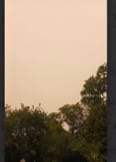
Today, July 15, 2026, Toronto woke up to the worst air on Earth. Not the worst air in Toronto’s memory, not the worst air in Canada — the worst air on the planet, full stop, according to the people whose job it is to rank such things.
A heat dome sat over the province like a lid, and smoke from hundreds of uncontrolled wildfires in the northwest rode a jet stream south and settled over the city like something that had decided to stay. The Air Quality Health Index climbed toward 10+, the category reserved for “very high risk.” The CN Tower disappeared into an orange haze that made it look, in photographs, like a postcard from a planet we haven’t met yet.
The air doesn’t have the fragrance of a campfire or family cookout – it smells like a dumpster fire. And the sky looks like one endless orange bruise.
A university professor, asked to explain it, gave an answer in the gentlest possible words.
We’ve seen this increasing in frequency, he said. I think this represents something like the new normal.
New normal.
Two words doing the work of absorbing a catastrophe into a schedule.
I went looking for that phrase’s history, mostly out of orneriness, and found something worth knowing: “new normal” wasn’t always this soft. It surfaces around WWI, catches on after 9/11, gets picked up by a venture capitalist in 2003 warning investors not to expect the old rules back, and finally gets bolted into economic policy language during the 2008 financial crisis, when a Bloomberg headline used it to describe permanently subpar growth. Each time, it performed the same trick: it took something that had ruptured and re-described it as a baseline.
Not a wound. A setting.
That trick has a longer pedigree than I’d realized. Before “climate change” softened “global warming” — a swap engineered deliberately, and admitted as much, in a 2002 Republican strategy memo, because focus groups found “global warming” catastrophic and “climate change” merely “controllable” — there was an earlier retreat still. “Greenhouse effect” got replaced by both terms around 1990.
Mechanism, to consequence, to abstraction. Each step trades a little more precision for a little more calm.
So the newscaster wasn’t lying, and neither was the professor. They were reaching for the nearest phrase that let them not have to say what they meant, which was closer to ongoing deterioration than to normal. A normal is a thing you stop noticing. A ratchet is a thing that only turns one way. We keep calling the ratchet a normal because normal is a word that lets everyone exhale.
To be honest, I am no expert whatsoever on carbon credits, carbon offsets, and that twisted term “additionality.” But I do notice things, and I question them.
What I notice is that these words behave like hockey cards. A card isn’t hockey — it’s a proxy for scarcity and reputation, graded, certified, traded at whatever price the market will bear, increasingly unmoored from any game being played on any ice. A carbon credit isn’t an absence of emissions — it’s a certificate asserting that somewhere, someone didn’t do a thing they might have done anyway, verified by an agency with an interest in there being more such certificates to verify. “Additionality” is the term of art for whether that claim is true at all — whether the reduction was real, or whether it was going to happen regardless and got sold as a favour to whoever needed to buy their way to net-zero on paper.
It is, when you strip the finance-speak off it, just the question a child would ask:
Did you actually do the thing, or did you just say you did?
A counterfeit hockey card cheats a collector. A credit without additionality cheats the atmosphere, while letting the label on the package say the opposite of what happened inside it.
I keep noticing that the vocabulary gets softer exactly as the thing it names gets harder.
Warming becomes change becomes normal.
A ton of carbon still in the sky becomes a credit, becomes an offset, becomes a line item that lets someone else's annual report keep its colour green. Outside my window today the sky is the colour of a livid bruise, of a warning nobody wrote down.
We have become extraordinarily inventive in finding gentler words to stand between us and exactly this kind of morning.