The Earwig as Fellow Earthling
Philosophy in a Wet Bathing Suite
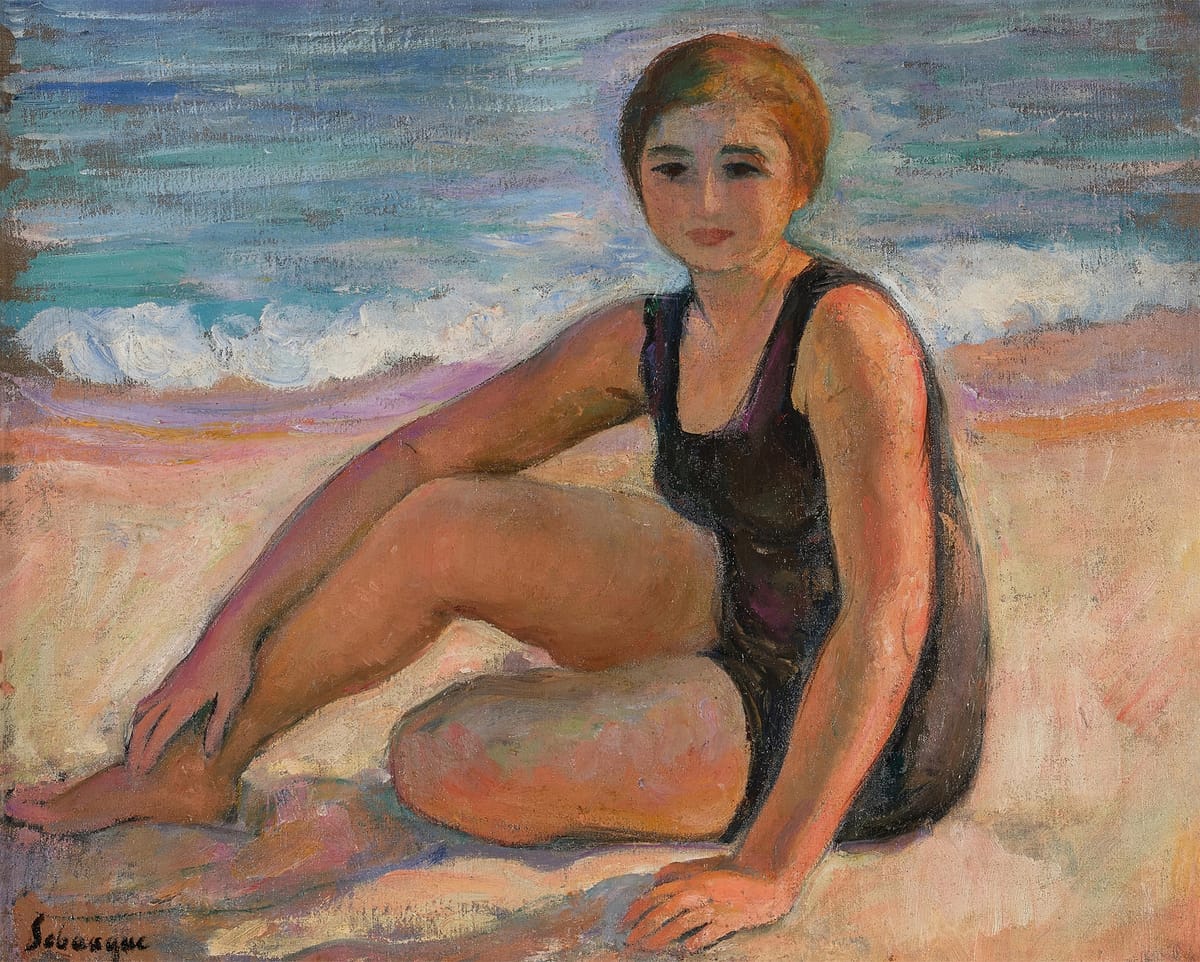
The other evening I forgot a wet bathing suit outside. When I brought it into the house the next morning, about five earwigs dropped out of it and scurried away frantically.
For no rational reason, I am deeply repelled by earwigs in particular.
This is not fear.
Earwigs are essentially harmless. They have never bitten me, attacked me, or otherwise inconvenienced me, apart from the temporary occupation of my bathing suit. They are simply earwigs. Yet something about them evokes an immediate, visceral recoil that bypasses reason altogether.
Initially I found myself wondering why. Was it the pincers? The glossy exoskeleton? The way they dart for cover? I tried to dissect my reaction, as though understanding its origin might dissolve it.
But then I realized I was asking the wrong question.
It’s not about me at all.
The more interesting question is not why I dislike earwigs, but what it is like to be one.
That is, of course, a question I cannot answer. I can only circle it with the rather blunted imagination of a human being. Yet the attempt seems worthwhile.
The Earwig’s World
The Baltic German biologist Jakob von Uexküll coined the term Umwelt to describe the unique perceptual world inhabited by every organism. We tend to imagine that every creature lives in the same world we do, only with fewer words or less intelligence. I suspect that isn’t true.
The earwig’s world is stitched together from things that scarcely exist in mine: darkness beneath a stone, humidity, tiny crevices, chemical traces, vibrations in the soil, the scent of decay, the constant need to avoid becoming someone else’s meal. It is not my world viewed from a lower rung on some evolutionary ladder. It is another world, different, occupying the same coordinates.
The obvious temptation is to imagine the earwig lives in my garden. But that merely describes the situation from my perspective. To the earwig, I may simply be an occasional large mammal lumbering through its world.
The garden belongs no more to me than it does to the robin, the earthworm, the fungi beneath the mulch, or the earwig sheltering under the flowerpot. We overlap. We do not contain one another.
I still dislike earwigs. I suspect I always will. But I am suspicious of my own certainty — suspicious that an emotion this old and this automatic tells me anything true about another creature’s worth.
Disgust evolved to answer one question: should I hesitate? It has nothing to say about the harder question — what deserves my respect? — and I think we confuse the two more often than we notice. An earwig does not need my approval to justify its existence. It is not an unfinished human, nor an imperfect attempt at something better. It is a complete expression of its own long evolutionary history, every bit as finely honed for its particular existence as I am for mine.
For the Love of Hierarchy
We humans are remarkably fond of hierarchies. We rank almost everything, including ourselves. It is easy, then, to imagine evolution as a ladder — ascending from microbes through insects and fishes, reptiles, mammals, primates, and, conveniently, arriving at us.
Nature seems to have missed the memo. Evolution produced no ladder. It produced an extravagant branching of possibilities: the oak is one solution, the octopus another, the earwig another still. Each has survived because, over immense stretches of time, it became exquisitely fitted to a particular way of living. The octopus did not fail to become a mammal. It succeeded at being an octopus — touch, colour, and chemistry organized into an intelligence so unlike our own that we are still arguing about what to call it.
Fellow Earthlings, Not Fellow Travellers
I think of them all as fellow earthlings.
I briefly considered “fellow travellers.” There is something appealing in the phrase — it acknowledges that every living thing shares an unimaginably long evolutionary journey with us. But it also carries the faint suggestion that we are travelling toward some destination. Evolution has no destination. There is no finish line where something waits, congratulating the winners.
“Fellow earthling” feels quieter. It says only that we share this astonishing planet and the deep history that produced it. Nothing more, nothing less.
Perhaps that is why Umwelt has become so compelling to me. It gently removes humanity from the centre of the picture. My experience of the world is not the standard against which all other experiences should be measured. It is one among countless others — and then we have the earwigs in my bathing suit, processing cues I can scarcely imagine, much less perceive.
Kinship Not Limited to Sentience
This way of looking at things has also made me wonder about what has no Umwelt at all.
The stone beneath which the earwig shelters almost certainly experiences nothing. It has no subjective world, no inside from which to perceive an outside. And yet it seems oddly wrong to dismiss it as mere rock.
The stone erodes into soil. The soil nourishes the plants. The plants shelter the insects. The insects feed the birds. Rain, frost, fungi, and roots reshape the stone in return. It has no point of view, yet it participates in innumerable lives that do — which makes me wonder whether Umwelt was ever the whole answer. If the stone can matter this much to the earwig’s world without possessing one of its own, then perhaps kinship was never really about who’s in there having an experience. Perhaps it was about the web the experience sits inside — and the stone is as load-bearing a thread as any of us.
Old Instinct Is a Stubborn Companion
If another forgotten bathing suit produces another small shower of earwigs next summer, I shall almost certainly recoil.
But I hope that after that first involuntary step backwards, I remember that what I’ve encountered is not an object in my world. It is the heart of another world entirely, one that has been quietly unfolding alongside mine for hundreds of millions of years — indifferent to whether I ever notice, and nonetheless real for that.