The Glove: A Modern Gothic Tale
A Story of Things Found
Chapter One: The Glove is Found
It had been in the drawer for twenty years.
She knew this because her mother had been dead for twenty years, and the glove had come with the other things — the brooch with a missing stone, the rosary in the cracked leather case, the photograph of a man no one had been able to name. She had gone through her mother’s belongings in that particular fog that descends when death arrives without warning, sorting with her hands while her mind was somewhere else entirely, and the glove had almost gone into the black bag destined for the charity shop. Almost. Something had stopped her — not a thought, not a memory, not anything she could have explained to her daughter standing beside her asking does anyone want this, does anyone want that. A tug. The word that had come to her later was a tug, as though the glove had opinions about its own future.
So she had kept it. She had not kept it consciously. She had simply been unable to throw it away.
Back into the drawer it went, beneath a tangle of costume jewellery and two keys for locks that no longer existed anywhere in the world, and there it had stayed while she finished raising her children and went on working and doing what working mothers do, which is to say everything, which is to say nothing that is ever adequately named. There it had stayed while she became a grandmother — the first grandchild a girl, solemn and watchful, born in the small hours of a night in spring, when the darkness lay close against the hospital windows and the air outside held something new in it, cool still but loosening, carrying the first tentative promise of warmth to come. There it had stayed through ten more years of grandchildren and holidays and the ordinary accumulation of a life, quiet as a held breath.
She found it again on a Tuesday in November, the kind of grey and uncommitted afternoon that seems designed for the clearing out of drawers.
She had already filled two boxes for the thrift shop — little figurines, old hats, and scarves that belonged to decades and silhouettes long past. She had made a pile of photographs to be sorted another day, which meant never, which was the right answer. She was on the third drawer of the old chest, the one that had always stuck slightly and required a particular angle of persuasion, when her hand closed around something and she lifted it into the grey November light and remembered.
A glove.
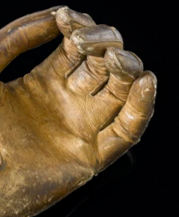
One glove, for a left hand.
She held it by the wrist and let it hang, turning it slowly. It was the colour of old tea, of autumn at its most exhausted, tawny and dark and marked by time in ways she couldn’t quite specify. Leather, she would have said, if pressed — and yet not quite leather, or not only leather, or leather made from something she could not immediately name. It was finely made, she could see that much, the stitching almost invisible along the seams, the cut of it suggesting hands that had known what they were doing. And yet it was worn. The fingers curved slightly inward, as a hand curves in rest or in sleep, holding the ghost of their last occupant. The surface was cracked in the way of very old things — cracked but not broken, the way a riverbed cracks in drought while remaining, underneath, entirely itself.
She brought it closer.
It was almost transparent at the fingertips, where the leather was thinnest and most worked. She could see, or imagined she could see, the faint suggestion of her own fingers behind it where the light came through. And it was soft — not the softness of new things, which is a kind of blankness, but something older and more complicated. Soft, but not gentle. The distinction mattered, though she could not yet have said why.
She smelled it, instinctively, without having decided to.
Flowers, first — something between a garden and a church, not quite either. The smell of certain old things in certain old places, the smell she associated with standing in the cool interior of a cathedral on a hot day, with the particular air of sacristies and reliquaries and rooms that had held the same objects for a very long time. Then, underneath, or perhaps instead, the clean animal smell of cured leather, familiar, and grounding. And then something else, rising from further down — loamy and dark, the smell of turned earth, of old forests, of things that grow slowly in the absence of light. She pulled the glove away from her face and looked at it again.
Her mother had kept this. Had kept it without explanation, apparently without use, in a drawer in a chest that had followed her through four houses across as many decades. Had chosen not to throw it away, just as she herself had chosen not to throw it away, for no reason she could name.
She turned the glove over. No maker’s mark. No label. Nothing on the inner wrist to say where it had come from or when or at whose hands it had been made. The right-hand glove — had there really ever been one? — was elsewhere. Lost, discarded, kept by someone else entirely, waiting in some other drawer in some other house on some other grey Tuesday. She did not know. She found, to her slight surprise, that she minded.
She set it on the top of the chest, away from the boxes, away from the things going to the thrift shop. She wasn’t sure what she was deciding. She wasn’t sure she was deciding anything.
The glove sat in the grey light with its fingers slightly curled, and waited, as it had always waited, with the patience of something that understood time differently than she did.
─── ❖ ───
Several days passed. Or perhaps it was two weeks — she was not entirely sure, and it seemed, in some way she couldn’t articulate, not entirely relevant. Time had a different texture in retirement, less segmented, more like weather than like clockwork.
She thought about the glove. Not obsessively. Not in the way of problems that demand solving or questions that insist on answers. More the way a sound heard in another room draws the ear without quite interrupting the conversation — a tug, surfacing and subsiding, surfacing again. Something waited in the vicinity of that glove. An answer, she felt, to a question she had not yet managed to formulate.
Why had her mother kept it?
That much she could frame clearly enough. A single glove, no partner, no explanation, carried through four houses and however many decades without ever — as far as she could recall — being worn. Her mother’s hands had been small and capable, the hands of a woman who did things with them. She could not picture those hands in that glove. Could not place the glove anywhere in the landscape of her mother’s life as she had known it.
And yet… And yet…
She found herself circling. This was not unusual — her thinking had always moved that way, spiralling around a centre rather than driving toward it, approaching by indirection, by accumulation, by what might have looked to an observer like distraction. She had learned, over many years, to trust this. The answer, if there was one, would not be found by marching straight at it. It lived somewhere in the territory of beside the point, which was where her most useful thinking had always gone. Not the point itself but the space around it — the oblique approach, the peripheral vision, the knowledge that arrives not as conclusion but as weather.
She let herself circle.
Her mother had kept it. Before her mother, someone else — she had no way of knowing who. The glove had been stored, as the other things had been stored, in the box that was simply Mother’s things, as though her mother had existed only in relation to her, had not had a life running deep and parallel and mostly invisible in the way that parents’ lives do. There were things in that box she had never investigated. Names she had never looked up. Photographs of the unnamed man. And a glove, one glove, for the left hand, sitting in the November light on top of the old chest where she had left it.
She had not put it back in the drawer.
─── ❖ ───
The first time she had examined the glove she had done so directly, in the manner of someone trying to establish facts. She had turned it over, looked for marks, brought it close to her face, given her attention to it as one applies attention to a problem. She had, in other words, approached it entirely the wrong way, though she hadn’t known that yet.
Now, on a morning that asked nothing particular of her, she found herself standing beside the old chest in the way one finds oneself somewhere without quite having walked there. The glove lay as she had left it, fingers slightly curled, patient, tawny in the thin winter light coming through the curtain.
She was thinking about her mother. Not directly — not the facts of her mother, not the chronology or the losses or the particular shape of grief, which had long since settled into something quieter and more permanent than grief, a kind of presence-in-absence she had stopped trying to name. She was thinking about her mother the way she circled things, sideways, in the peripheral way, following a thread that seemed to lead away from the subject and then, if you were patient, curved back.
And without quite deciding to, without arriving at the action through any process she could later have described, she reached out and laid her palm gently against the outstretched palm of the glove.
What came was not a vision. Not quite a sound. It was a feeling so specific and so old that it surfaced from somewhere beneath memory, beneath the reach of ordinary recollection — the feeling of a hand holding hers. Her mother’s hand. She knew it the way you know a voice in the dark, without seeing, without needing to see. And then, beneath that, or behind it, or woven through it in the way that certain harmonies contain other harmonies — another hand. Her grandmother’s. A woman she had known only in childhood, whose face had softened at the edges of memory into something more like weather than portraiture, but whose hand she apparently still knew. Still carried somewhere in the oldest part of herself.
Both women long dead. Both women, she understood now with a certainty that required no proof and admitted no argument, had worn this glove.
She stood very still and let the feeling subside, the way you stand still when a bird has landed nearby, and you do not wish to startle it into leaving.
Then she picked up the glove. Carefully, the way you might take someone’s hand who has offered it — with acknowledgement, with a sense of what the gesture means. She carried it to the old chair by the window, her mother’s chair, comfortable and slightly shapeless in the way of things long lived in, not yet given to the charity shop, not yet ready to be given, and she sat down.
She held the glove in her lap for a moment. The tawny leather. The slightly curled fingers. The patience of it.
Then she slipped it onto her left hand.
─── ❖ ───
The glove fit as though it had always known her hand was coming.
For a moment, nothing. The grey light. The old chair holding her the way old chairs do, with a familiarity that has nothing to do with choice. Her own breathing.
And then — not quite sound, not quite silence broken — something between the two. A voice that was not quite her mother’s and not quite her grandmother’s and yet was both, or was something older than either of them, the distillation of both, the voice perhaps of the line itself, of all the women in whose bodies she had once, in some form, existed. She could not have said what words it spoke. The words were not the point. The point was the quality of it — known, and knowing, a voice that had carried her, that had spoken over her in the earliest dark before she had language to receive it, before she had anything but the animal knowledge of being held.
‘Stay,’ it said, or something that meant stay.
‘Close your eyes,’ it said, or something that meant that.
‘Allow it.’
She closed her eyes.
Warmth came first — not the warmth of the room, not the thin warmth of the winter light through the curtain, but something enveloping and deliberate, the particular warmth of a blanket settled over your shoulders by another’s hands at the end of a summer evening, when the light has gone amber and the air has just begun to remember that it can be cool, and someone who loves you has noticed before you noticed yourself. That kind of warmth. The kind that says I see you. I have you. There is nothing required of you now.
She let her hands rest in her lap, the gloved left hand and the bare right hand, and she let her breathing slow, and she let the edges of the room — the curtain, the chest, the boxes for the charity shop, the pile of photographs for another day — she let all of it soften and recede, the way the shore recedes when you have stopped fighting the water and simply allowed yourself to float.
─── ❖ ───
What she learned in those first minutes — or hours, for she would never be entirely sure which — she could not afterward have put into words. Not because it had been confusing or overwhelming or beyond her intelligence, but because it had not arrived in words. It had arrived the way certain knowledge arrives in dreams, or at the moment just before sleep, complete and whole and resistant to the reductions of language. She knew things, when she opened her eyes, that she had not known when she closed them. She could not have told you how she knew them.
She knew the glove had come to her rightly. That it had passed through hands that were her hands, back and back, further than she could yet see, and that this passing was not accident but the operation of something that had its own logic, its own grain, like wood that will split cleanly in one direction and resist the blade in another. It had come to her because it was hers to receive. More would follow. More was waiting in the glove’s long memory, in its layered and accumulated dark, and she would learn to reach it, but not yet and not quickly. Patience was not optional. Patience was the method.
For now — and she understood this clearly, understood it as permission as much as instruction — it was enough to place the gloved hand on an object. Something made, something old, something that had passed through time and carried time within it. This was where she would begin. This was the threshold she had been given to stand at, for now, while she learned the rest.
This she understood.
And then the warning came.
It did not come in the same register as the rest — not the gentle enveloping warmth, not the voice that was all her mothers at once. It came harder and cleaner, the way cold water comes, the way a hand grips your arm when you have stepped too close to something dangerous. It did not frighten her exactly. It was not designed to frighten. It was designed to be remembered, and it was.
Never place the gloved hand on a living thing.
Not yourself. Not another person. Not an animal. Not a plant. Nothing that breathes and grows and moves through time on its own terms. The living are different. The living are still becoming. To place the glove against something still in the process of being would be to reach into something unfinished, something in motion, and the motion could be overwhelming — not merely to her, but in ways she was not yet equipped to understand or contain.
This was not a permanent prohibition. It was a threshold, like the others, to be approached with patience and in time.
And the recently dead — that too was forbidden, for now. Not the chop on the butcher’s paper, not the leaves torn for the salad bowl, not the beloved face in the open coffin. The recently dead are not yet fully themselves as objects. They are still in the process of becoming what they will be, still trailing the heat and motion of what they were. That threshold also would come. That too would be earned.
‘One day,’ the knowledge told her, with the firmness of something that had considered the matter fully and was not inviting discussion. ‘One day you may be ready. But that day will be earned. It will not be given.’
She sat with this.
The room had returned fully around her — the curtain, the light, the boxes, the chest. Her right hand lay open in her lap, bare and ordinary. Her left hand lay beside it in the tawny glove, still and quiet, the fingers at rest.
She thought about warnings. She had read, somewhere — in one of the books that had accumulated on her shelves over a long reading life, their spines soft and their margins annotated in her own younger handwriting — that a Tarot deck should never be lent to a stranger, that some readers would not permit another’s hands upon their cards at all. At the time she had filed this away as the kind of superstition that contains, if you look at it sideways, a serious idea. The cards were calibrated to a particular person’s handling. Another’s touch introduced something discordant, some interference, some history that was not the right history.
She looked at the glove.
She thought she was beginning to understand.
─── ❖ ───
When the knowledge had settled, when the warmth had receded and the room had returned entirely to itself, and she was simply a woman in a chair on a November morning with a glove on her left hand, she slipped it off.
Carefully. The way you set down something that has been entrusted to you.
She held it for a moment as she had held it before — the tawny leather, the slightly curled fingers, the patience of it — and it seemed to her that the holding was easier now. More familiar. As though the glove had taken a small step toward her, or she toward it, and the distance between them was no longer quite what it had been that morning in the drawer, or even an hour ago when she had first laid her palm against its palm and everything had quietly shifted.
She carried it upstairs.
Her grandmother’s dresser stood in the corner of the bedroom where it had always stood, where she had arranged it twenty years ago when it came to her, placing it without quite knowing why in the corner where the light fell on it in the morning at a particular angle that seemed to suit it. It was an elegant thing, the dresser — old and certain of itself, with the unhurried quality of furniture made when furniture was made to last. She had kept the small upper drawer for small things. Private things. The kind of things that don’t require explanation.
She opened it.
The drawer was lined with paper, a soft floral print faded to the colour of old roses, and it smelled as it had always smelled — of lily of the valley, persistent and delicate and unmistakably grandmotherly, a scent that seemed to belong to an earlier era of women, of careful dressing tables and Sunday gloves and the unhurried mornings of another kind of life. She had never questioned where the scent came from. It had always been there, as long as the dresser had been hers, as long before that as she could only imagine.
She laid the glove in the drawer among the small private things.
It seemed, she thought, to belong there. As though it recognized the scent, or the scent recognized it. As though they had been in proximity before.
She closed the drawer.
This is enough for today, she thought, and the thought carried no disappointment, only the particular satisfaction of knowing when a thing is complete. She had learned, over a long life, that this was its own skill — the knowing of enoughness — and she had not always had it and was glad to have it now.
She lay down on the bed without drawing the curtains and closed her eyes.
Sleep came the way the warmth had come — enveloping and immediate, as though it had been waiting just outside the door. And with it came dreams, though dreams was perhaps too small a word for what moved through her in that long afternoon and into the early dark of the November evening. Swirls and spirals. Vast still oceans, dark and warm and fathomless, and herself moving through them without effort, without fear, buoyant in a way she had never quite been in waking life. And then downward — not falling, nothing so abrupt — but sliding, the way a river slides underground in limestone country, into the deep and layered dark of time itself, stratum by stratum, each layer older and quieter than the last, and all of it, somehow, familiar.
She slept a very long time.
Upstairs in the small drawer lined with faded roses and the old soft scent of lily of the valley, the glove waited among the private things.
It was accustomed to waiting. But not for long, now.
If you would like to read further chapters, please email me at loucheleaves@gmail.com.