Disappearing Queen Anne’s Lace
The Queen's Legs are Hairy
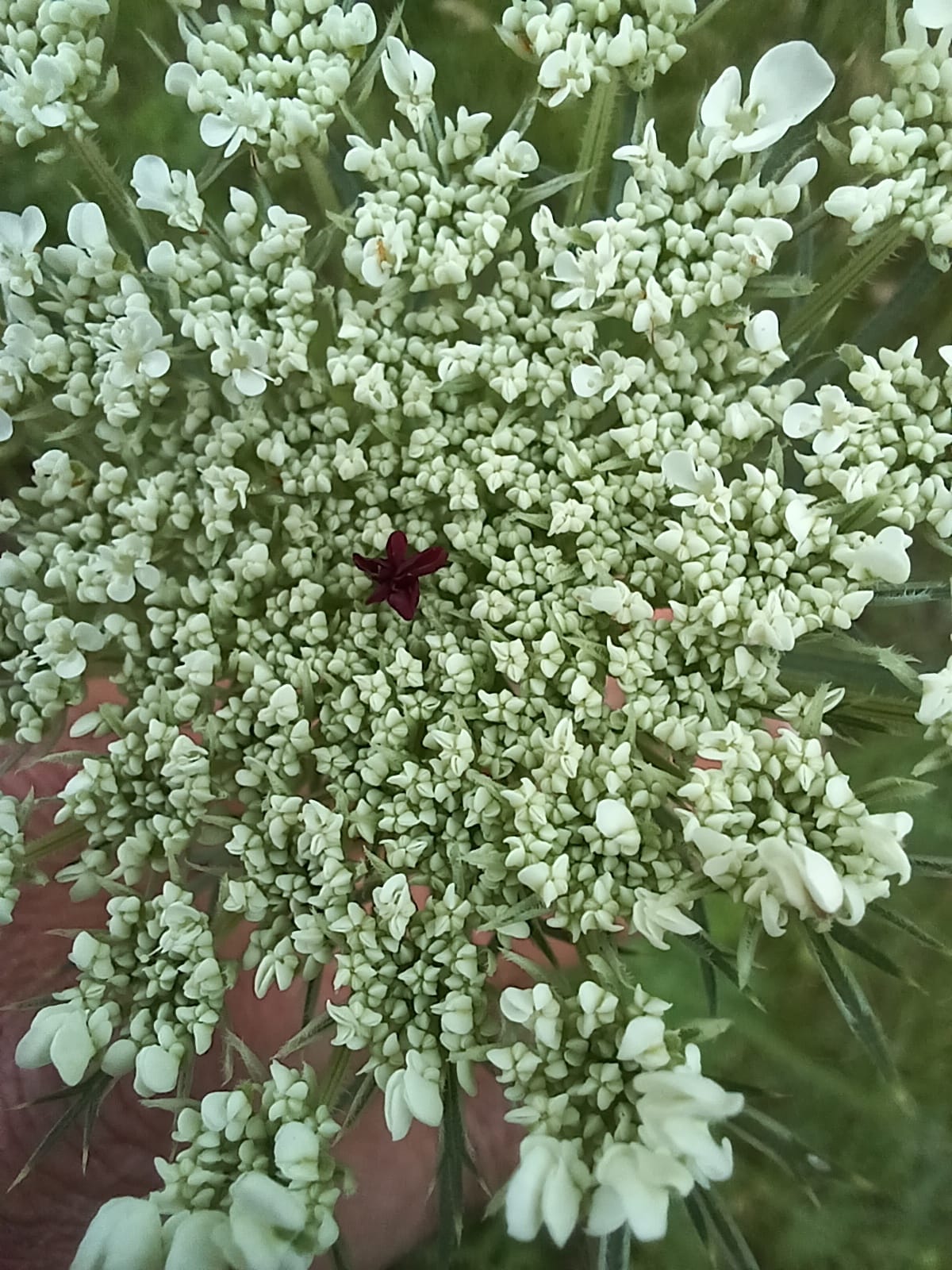
It is summer now and in a few odd spaces I can smell something that only exists in the margins.
Until recently, Queen Anne’s Lace — Daucus carota, a member of the carrot family — was a common weed in the Mississauga area of Ontario. It filled the ditches, the vacant lots, the poor scraped soil along the roadsides where nothing else would take hold. The plant grows to two or three feet, blooms midsummer, and once the sun heats the flower, releases an aromatic perfume that is, for me, the unmistakable scent of summer as it was lived in 1961, when my family arrived here.
There are some commercial and boutique perfumes that mention Queen Anne’s Lace, or carrot seed or European cow parsley, but they don’t actually contain the essence of the flowery weed that grew plentifully in this area. If you want to smell that distinctive scent of summer, you will have to seek out the real thing.
It is disappearing now, and I don’t think that’s nostalgia talking. It isn’t going extinct — you’ll still find it in a ditch or an untended margin here and there — but it is vanishing from the places it used to define. That has less to do with the plant than with what’s happened to the ground beneath it.
Queen Anne’s Lace is what ecologists call a “disturbance species”: it doesn’t compete well against established vegetation, and it needs exactly the kind of raw, scraped, temporarily-neglected soil that used to be everywhere on the edges of a growing suburb — the verge of a new road, a lot between one house and the next, a ditch nobody had gotten around to mowing yet. Take that disturbed, in-between ground away — replace it with sculpted lawns, edged flowerbeds, and herbicide applied by the acre — and the plant has nowhere left to be itself.
It isn’t so much that Queen Anne’s Lace failed. It’s that we finished the job of tidying the margins where it used to live, and in places manicured this thoroughly, it’s unlikely to come back to exuberance on its own.
The flower itself is made up of hundreds of tiny blossoms clustered into a single lacy disk, and at the centre of many — not all — sits one dark red or deep purple floret, oddly formal against all that white, like a single drop of blood.
A name with no fixed story
Not native to North America, the plant crossed the Atlantic unintentionally with European settlers, who called it “white carrot.” It’s a biennial, and it carries an unusually large wardrobe of names depending on where you are: Bird’s Nest Weed, Bee’s Nest, Devil’s Plague, Fool’s Parsley, Lace Flower, Herbe à Dinde, and others. Only in North America is it Queen Anne’s Lace — which raises the obvious question of which Queen Anne, and why here.
There isn’t one clean answer, which I find more interesting than if there were.
Some say homesick settlers looked at the purple centre and saw a queen’s collar, with the white florets forming the surrounding lace. A grimmer version of the same idea holds that the purple floret is a drop of blood — Queen Anne pricked her finger while making lace and stained the work. A third theory detaches the flower from royalty altogether and gives it instead to Saint Anne, mother of the Virgin Mary and patron saint of Lace makers.
The fourth story is the one most often repeated, and it’s worth untangling, because as usually told it quietly conflates two different women. The tale goes that the future queen arrived from Denmark to marry King James I, admired the wild carrot growing in the royal gardens, and challenged her ladies-in-waiting to produce lace as fine as the flower; none could match her own work, and the plant took her name. The consort who actually married James I in 1589 was Anne of Denmark (1574–1619) — a different Anne from Anne, Queen of Great Britain (1665–1714), who reigned in her own right nearly a century later and is the “Queen Anne” most regularly cited for the collar-and-blood version of the story. Folklore is under no obligation to keep its queens straight, and I rather like that this one doesn’t; but if you go looking for “the real Queen Anne” behind the name, you’ll find there are at least two candidates a hundred years apart, and neither story is verifiable history so much as the kind of tale that accretes around a flower that needed an origin.
Not every association is so gentle. The plant was also called “Mother Die,” out of a superstition that bringing it into the house would cause your mother’s death.
Another tradition read the presence or absence of that single purple floret as commentary on the purity of local women, and the plant shows up in old spells and incantations meant to draw desire or aid fertility. An Eastern European legend goes further still: if every wild carrot flower in a season comes up missing its purple centre, the end of the world is near — which I think would make it the humblest apocalypse omen in the field.
On a lighter note, the plant is genuinely useful: the flowers can be made into jelly or infused into liquors, the roots have been used in cakes, and it lends itself to dyeing wool. It is, in fact, the direct wild ancestor of the cultivated garden carrot (Daucus carota subsp. Sativus) — the same species, essentially undomesticated.
Who else depends on it
The folklore is mostly about how humans have read meaning into the flower. But Queen Anne’s Lace has its own, entirely non-human, circle of dependents, and it’s worth naming them, because they get left out of both the cheerful stories and the wary ones.
It is a host plant for the eastern black swallowtail butterfly — the caterpillars feed on its foliage almost exclusively where the plant is common, alongside dill, fennel, and parsley, its relatives in the carrot family. The flat white umbels are a landing pad for a whole guild of small pollinators that don’t get much poetry written about them: solitary bees, hover flies, small beetles, and a genus of slender parasitic wasps (Gasteruption) that specialize in visiting exactly this kind of flat-topped flower cluster. Later in the season, once the umbel curls inward into its “bird’s nest” seed head, it hosts still more — including tiny shining black bugs that cluster on the ripening seeds. The hooked seeds themselves catch in fur and feathers, hitching rides to new disturbed ground the way they always have, whether that ground still exists in the quantities it once did.
None of that softens the plant’s one real hazard: it closely resembles poison hemlock (Conium maculatum), which is genuinely toxic and has killed people who mistook one for the other. The reliable field mark is the stem — Queen Anne’s Lace has fine hairs along it, hemlock does not, and hemlock’s stem is usually blotched with purple. It’s also worth knowing that the sap, on skin exposed afterward to strong sun, can cause a burn-like reaction — a small, literal hazard tucked in among all that folklore about dire consequences that were never real.
So foragers use the mnemonic phrase “the Queen’s legs are hairy.” Easy to remember, although every Queen from the period and every European or North American woman would have had hairy legs… but, as usual, I digress.
Note: This is a revised version of an article first published on April 9, 2024.