Science Fiction Horror in a Suburban Garage
On parasitism, possession, and the collector who became the collected
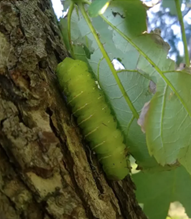
As a child living in a plush suburban landscape, I would often involve myself in little nature projects. I would collect leaves, construct dollhouses with pussy-willow branches, gather grasshoppers in old mayonnaise jars, bring home tadpoles from the creek and watch them grow into toads.
It all sounds bucolic and innocent, and it was.
Until the caterpillar episode.
I had collected caterpillars before, usually small or hairy ones, keeping them in a jar until they encased themselves in a cocoon, then awaited the reward of metamorphosis. It was magic to my young eye. I was the keeper, the tender, the curator. I believed, with the uncomplicated confidence of childhood, that I was in charge.
One day I found the oddest, largest and most striking caterpillar I had ever seen, attached to a branch in the yard. The creature was a good three inches long, bright green, plump as a stubby cigar. Nothing in my experience had prepared me for it.
I needed a large jar. Mayonnaise and mustard would never do. Running into the house, I excitedly asked my mother for a big glass container, and she grudgingly produced one. When I explained what it was for, she told me the jar was to stay in the garage and not to even consider bringing it into the house.
As we will later see, she was absolutely right.
I snapped off the branch and deposited the caterpillar into its new home. For several days I fed it maple, privet and lilac leaves. It was ravenous and clearly not a picky eater, munching steadily through everything I offered. I was a devoted host — attentive, generous, proud of my charge.
Something I found remarkable, and slightly disturbing, was the sounds it made. When prodded, it would produce the oddest clicking from a serrated mandible — many rapid clicks lasting about a minute — and then it would throw up. To a small nerdy child, this was fascinating behaviour. I later learned that the clicks are a defence mechanism, ranging from 58 to 78 decibels, roughly the volume of an electric shaver. The caterpillar, in other words, was afraid of me and doing everything in its power to warn me off.
Yet I found this charming. I kept feeding it, and as it grew, it slid along the branch, and seemed — though memory may be embellishing things here — to pulsate with something hidden. As I watched, I imagined what it was becoming: the wings folded tight inside that green body, the future beauty already encoded in all that furious eating. I thought I understood what was happening inside it.
I was wrong in almost every particular.
The caterpillar was a Polyphemus moth caterpillar (Antheraea polyphemus), native to southern Ontario, where it thrives on maple and eventually transforms into one of North America’s most spectacular moths — large, tawny-winged, bearing on each hindwing a single enormous eye-spot that gives the species its name. It is a creature of genuine grandeur, and the caterpillar stage is merely the long, slow, voracious preparation for that emergence.
Or it is supposed to be.
This event took place on the traditional lands of the Anishinaabe people, and it is worth pausing here, because their relationship to insects offers a frame that Western natural history does not. The Ojibwe word for bug — manidoosh or manidoons — shares its root with manidoo, meaning spirit. Insects are not a lesser category of being in this cosmology; they are small-spirit beings, each carrying its own agency and significance in a web of relations that constitutes the living world. Crucially, the Ojibwe language has distinct words for all three creatures implicated in what was about to happen in my garage: odamwaabagwesi for caterpillar, ookwe for maggot, oojiins for fly. Three words for three beings, each with its own nature and its own claim on the world.
What I was about to witness was a transaction among all three. I did not yet have the language — in any sense — to understand it.
Then one bright summer morning, after gathering a breakfast of maple leaves for my charge, I went into the garage.
The caterpillar was gone.
In its place were hundreds upon hundreds of tiny green worm-like things, filling the jar and crawling out through the airholes in the lid, moving in chaotic streams across the garage floor and up the walls.
I was horrified. I was revolted. And I was, though I didn't understand it yet, implicated.
I cleaned it all up as thoroughly as I could, because I was genuinely nauseated and because my mother would have been more than angry about the grotesque outcome of my project. Then I put the whole episode somewhere in the back of my mind, where it quietly waited for several decades.
Much later in life I learned what had happened. My caterpillar had been parasitized by tachinid flies, common throughout southern Ontario. While the caterpillar had been feeding on its maple branch in the wild — large, slow, magnificently unconcerned — an adult female fly had dive-bombed it and used a hook-like ovipositor to inject larvae directly into its body, bypassing the immune system entirely by lodging in the gut lining where no immune response could detect them.
The caterpillar, infected, went about its business as usual. Mostly eating.
Meanwhile, the larvae inside it were feeding on non-essential tissues first — keeping their host alive, keeping it functional, saving the vital organs for last. The caterpillar that I found and brought home and fed with such dedicated care was already, in every sense that mattered, occupied. It was not becoming what I thought it was becoming. The hidden life I had imagined pulsing inside it was not growing wings. It was something else entirely, patient and purposeful and utterly indifferent to my plans for it.
About 30 to 80 percent of caterpillars in the wild are parasitized in this way — by flies, by wasps, by organisms whose entire reproductive strategy depends on finding a living vessel and using it. The emergence itself is brief and explosive, rarely witnessed even by entomologists in the field. But I witnessed it, in a suburban garage in Ontario, and I was — at the time — a deeply unappreciative audience.
Here is what I have come to understand about my unease: I was not simply horrified by what I saw. I was horrified by what I had done. I had brought the caterpillar home. Not only that, but I had fed it, tended it, created the warm enclosed conditions of the garage jar. I had been, without knowing it, an accessory. The larvae that filled my garage that morning were there in part because of my solicitude. Nature had used my childhood wonder as a delivery mechanism.
I thought I was the collector. It turns out I was part of the apparatus.
The writer Dan O'Bannon, developing the story that became Alien, drew inspiration from the behaviour of parasitic wasps — creatures whose reproductive logic is nearly identical to the tachinid fly’s. A host is found, penetrated, used. The host lives on, unaware, until the moment of emergence. O'Bannon understood that what made this horror wasn't the violence — it was the intimacy. The thing growing inside you has been inside you all along, eating carefully, waiting.
I can say with confidence that the horror I felt in that garage exceeded anything I felt watching that film. The difference, I think, lies between witnessing horror and discovering that you have been part of it.
In Brian Aldiss' novel Hothouse — visionary, strange, not widely enough read — a sentient morel fungus drops onto the head of the protagonist Gren, a diminished future-human, and begins to parasitize his mind. Rather than using Gren to reproduce, the morel manipulates him: steering his decisions, shaping his desires, turning his will to the fungus’s own purposes. Gren remains himself, and yet he is not himself. He has become, without quite knowing it, a vehicle.
This is a different order of horror from Alien. In Alien, something inside you will eventually kill you. In Hothouse, something inside you will turn you into something else, and you may never notice the moment the transformation happened. The body stays. The person changes.
John Goodwin’s 1946 story The Cocoon is, I think, the most precise literary parallel to what happened in my garage, and the parallels are so exact they are almost uncomfortable to trace.
Denny is a boy who collects moths and butterflies, killing them and then pinning them to his playroom wall. He finds a strange specimen — wrinkled, clawed, not quite like anything in his experience — and becomes obsessively protective of it, sealing his room, tending his charge, waiting for what will emerge. He is, in other words, me. Likewise, he is the devoted collector, the proud keeper, the child who believes he is in control of the process.
The creature emerges. He kills it with cyanide and pins it to the wall, as he has pinned everything else.
But of course the story has only just begun. The pinned creature begins to rot and stink. Something crawls into Denny’s mouth in the night. The door to his room, when he tries to escape, pushes open from the other side. In the morning, Denny is found dead on the floor, his face wrapped in strange filaments.
The parallels to tachinid parasitism are exact enough to be uncanny: the period of apparent normalcy, the stench of the dying host, the emergence through the body’s boundaries, the silk-like threads. But what makes the story’s structure truly resonant is the reversal it enacts. Denny believed he was the predator and the creature was his specimen. He was already the host. The sealed room he used to protect his collection is the body cavity. The cocoon he waited so patiently to see open was never his to claim.
He thought he was the collector. He was part of the apparatus.
The Daoist philosopher Zhuangzi once wrote:
“Now I do not know whether I was then a man dreaming I was a butterfly, or whether I am now a butterfly dreaming I am a man.”
He was asking, I think, about the permeability of identity — about whether the boundary between self and other is as fixed as we assume. Whether what we call “I” is stable, or whether it is always, to some degree, a performance staged over something else entirely.
The tachinid fly does not ask this question. It simply acts on the answer.
I think about that caterpillar sometimes. I think about how it went on eating, moving, doing everything a caterpillar does, while something entirely other was growing inside it and reordering its future. Moreover, I think about how I watched it with such confident tenderness, certain I understood what I was looking at, certain that the hidden life I sensed pulsing inside it was its own.
I wonder what Zhuangzi might have said, had he been standing with me in that garage on that summer morning. And I wonder which of us — the child, the caterpillar, the larvae, the fly — he would have identified as the dreamer.
I am not entirely sure that it was me.