In the Pursuit of Privet
Russians saying hello in my backyard, the curious link between cilantro haters and privet, and the intrepid Elizabeth Blackwell.
So many things can come to light simply by looking at something completely “ordinary” and wanting to learn more; wanting to see connections and convergences.
There is a privet hedge in my backyard as well as a seriously overgrown privet bush. This smudge of greenery prompted me to explore the etymology of the word privet, the history of the plant in North America and Europe, any traditions associated with it, and what causes it to smell so heavenly (to me but not to others) in spring. Then I stumbled upon an intrepid and largely unknown lady named Elizabeth Blackwell.
What I learned was fascinating.
The Word Privet
‘Privet’ is one of those relatively rare words that does not have a clear origin or a confirmed etymology. In English, the word appeared out of nowhere around 1540. Prior to that time, botanists referred to the plant by its Latin name ligustrum (from ligare, meaning to tie or bind).
First Trip into the Weeds of Digression
That the word appeared with no history whatsoever brought to mind the story of Zeus and the Titaness Metis. Metis, the first wife of Zeus, was pregnant with his child. Because he was warned that one of her sons might be more powerful than him, he decided to eat his pregnant wife. The child was Athena, not a son after all. Anyway, after his cannibalistic dinner, Zeus developed a headache. Not having invented aspirin, Zeus asked a fellow Olympian, Hephaestus, to split his skull with an axe. Athena, the goddess of wisdom, popped out of Zeus’s forehead.
It’s a long story.
In any case, it would seem that privet just popped out of someone’s head and began travelling through the English lexicon.
Returning to the Word Privet
Some sources believe it may have originated from the word prime, but that seems a rather esoteric path for such a common plant. I wonder why no one seems to make an association with private, given that privet is used for hedges and privacy, but I’m no etymologist.
In most European languages, the word for privet is based upon the aforementioned Latin term. However, in some Gaelic entries it is referred to as prìomhat. In Scots Gaelic, we find ras-chrann sìor-uaine (meaning branch tree or shrub), or Sìor-uaine (meaning evergreen). Irish Gaelic calls it privéad or ras-chrann.
Second Trip into the Weeds of Digression
To further digress, the commonplace word in Russian for “hello” or “hi” is приве́т (privét). I rather like the idea of my bushes saying hello in Russian.
What is that Fragrance, or Would Shakespeare’s Privet Smell as Sweet by any other Name?
Chemists, perfumers, botanists, and other scientists who concern themselves with the chemical properties of plants have isolated, in great detail, the components that create the heady perfume emanating from privet when it blooms in spring.
For me, that perfume is strong, sweet, pervasive, and utterly enchanting. The bees are drawn to the bushes and continuously sip their nectar.
For others, it stinks. But why?
Here are some of the chemical components of privet: phenylacetaldehyde, veratrole, linalool, hotrienol, methyl o-anisate, phloroglucinol trimethyl ether, phenylbutanones, and others.
There are many more, but in order to answer the question of why some people find the scent of privet so objectionable, I went hunting for other plants which have a similar chemical composition. Lo and behold, I found that coriander (also known as cilantro) and privet share several chemical compounds, primarily aldehydes, which are responsible for their shared “soapy” or “green” aroma profiles depending on how you sense it.
If people dislike cilantro, they probably equally dislike privet, and this may be because of their DNA profile. Without getting too far into the weeds (pardon the pun), if a person has a variation in the OR6A2 gene, that individual will be particularly sensitive to the odour of aldehydes.
Actually, let’s quickly get into the weeds:
(E)-2-Decenal is the primary constituent of the aroma of cilantro and of privet leaves.
Decanal (Aldehyde C-10) is found in both plants as is dodecanal.
Perfumers cite (E)-2-Dodecenal in databases where a “green wavy cilantro soapy privet” is sought (which is remarkably specific!).
Who Cares?
I don't know if I’ve stumbled upon the answer to a question that likely no one cares about, but hey, I think I’ve figured something out. You’re welcome.
Folklore and Legends
Privet wasn't really a popular plant in North America until after the 1850s, so there isn't much recorded on this side of the Atlantic.
There is however considerable lore in Europe and Asia. In fact, privet was considered a symbol of protection and purity, which was planted around sacred spaces and homes to protect against evil spirits. The plant is hardy and evergreen, lending itself to notions of endurance and resilience.
In Feng Shui, it’s a guardian of positive energy and is thought to repel negativity (something like a green force field) and enhance balance and prosperity. It creates a harmonious flow of chi (life force). Not too shabby for a common hedge.
And let’s not forget Anacreon, the Greek poet (573-495BCE):
“[He] ornamentally wreathed his seven-stringed lyre with privet while he chanted his erotic verses.”
On the other hand, particularly in Lancashire, the privet is not considered lucky at all. In fact, should someone bring privet flowers into the home they are inviting bad luck or a fire.
Privet as Medicine
Please don't take this information as advice. I am only reporting what has been said or written regarding the medicinal uses of privet.
Privet berries are certainly toxic to people and animals, but other parts of the plant are believed to have curative properties. The Roman naturalist Pliny the Elder wrote that:
“Its leaves everywhere are used to treat ulcers, and with a sprinkling of salt, sores in the mouth.”
A British botanist and herbalist, John Gerard (1545-1612) noted that:
“The leaves of privet do cure the swellings of the mouth or throat being gargarified with the juyce or decoction thereof.”
The Shakers in North America sold privet leaves as an anti-scurvy treatment and astringent mouthwash. Personally I never tried it.
Current science does vindicate these beliefs to some extent. Some species of privet have antimicrobial properties that can interfere with Staphylococcus aureus, the cause of a staph infection.
Elizabeth Blackwell: The Curious History of a Curious Herbalist
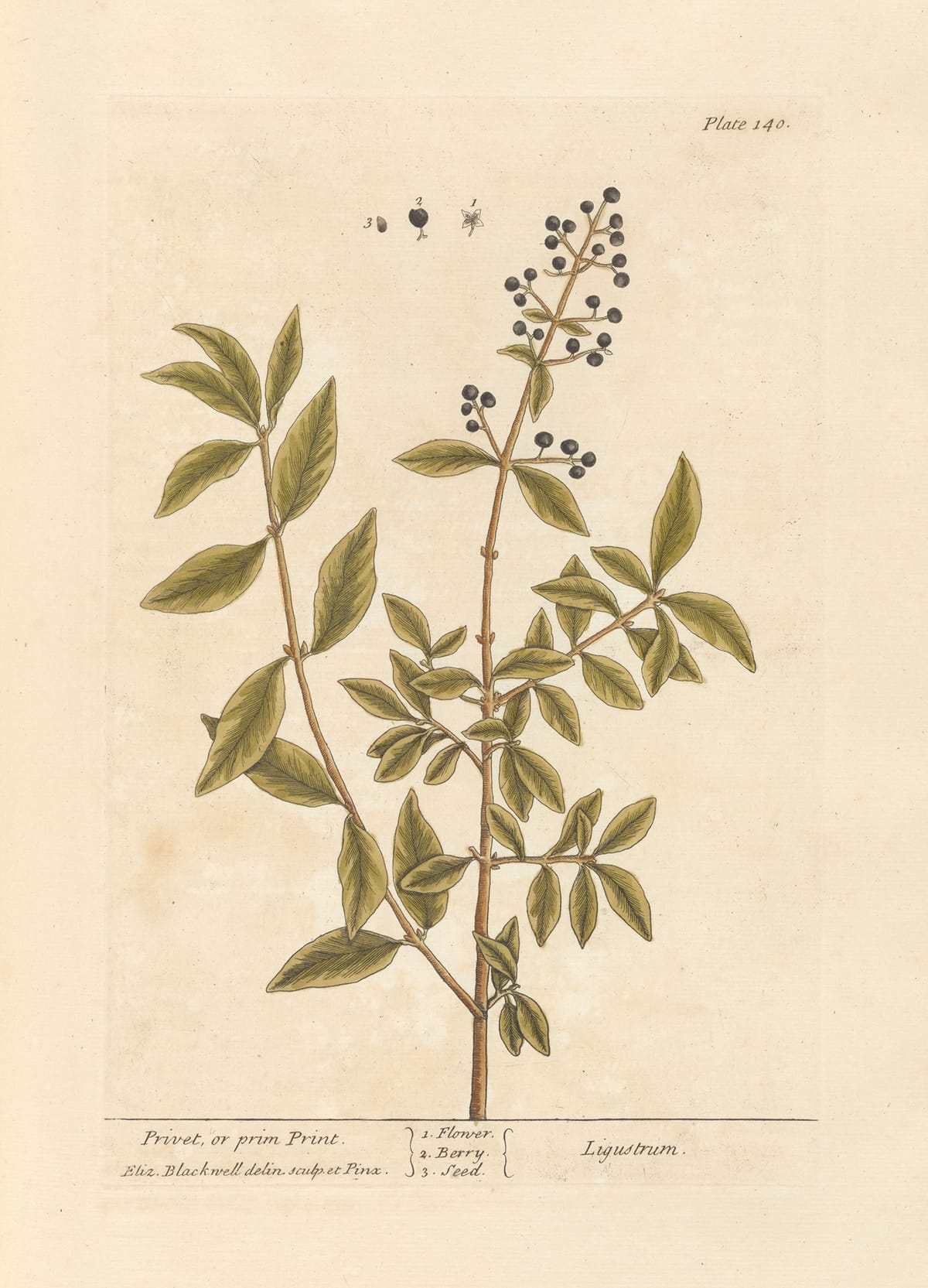
At the head of this essay, I used a lovely illustration created by Elizabeth Blackwell.
Some catalogues pertaining to botany list the illustration of privet (or “prim plant”, a whimsical name I rather like, despite it being the usual secondary name of a primrose) as being created by “Elizabeth Blackwell, Scottish”. However, Elizabeth was not Scottish.
When I queried an AI system about who first illustrated privet (restricting the search to Europeans and North Americans only), Elizabeth was not even listed. A further query specific to women illustrators or artists also gave no results.
When asking AI about Elizabeth specifically, the system stated with confidence that Elizabeth was Scottish. She was not. That was her husband. Once again, AI was wrong, but let’s move on and tell a little about Elizabeth’s remarkable story.
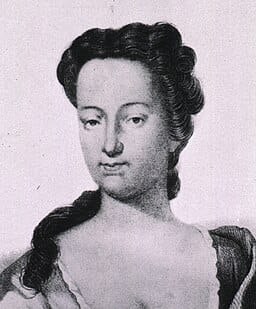
Elizabeth Simpson was born in London in spring 1699. A daughter of a painter, she had been well-educated in art, music, and languages, and her father likely had a reasonable dowry ready for her future husband.
On the other hand, some researchers believe she was born in Scotland to a family named Blachrie, but I doubt that this is accurate. My research found there were two Alexander Blackwells and two Elizabeth Blackwells, and I believe they were conflated.
In any case, Elizabeth married a man by the name of Alexander Blackwell (b. ca. 1700) — he was the Scot; probably not her. They married in 1733, around the time he was studying at Marischal College. It seems that some rather scandalous business swirled around Alexander — something to the effect that he was about to be charged for illegally practising medicine — so he and Elizabeth fled to London. Or he fled to London and met her there (which seems more likely given the records available).
In London, Elizabeth studied midwifery, but did not pursue it due to what she found was “the ignorance and low character of the women who at that time followed the same calling”.
Wikipedia defines Alexander as an “adventurer”, a rather generous moniker. In 1730, while in London he set up his own printing house despite not belonging to a guild or having completed a required apprenticeship. He was charged with violation of trade rules and was heavily fined. Meanwhile, he had been “living large”, as we would say today, perhaps enjoying the generous dowry of his wife. He got himself into serious debt and ended up in Highgate Prison for two years.
By July 1734, Elizabeth appears in the London Poor Registers and is undertaking some form of apprenticeship.
By this time, Elizabeth had two children (William and Ann, both of whom later died in 1736, and a daughter named Elizabeth, who had been born in 1734 but likely died in infancy) to care for, a house to maintain, and no income. Clearly determined not to slide further into despair and debt, she learned that illustrated herbals were in demand to inform the English of new and “exotic” plants from the Americas and the Far East. She could draw and paint, and so decided to create a herbal.
Not knowing all the scientific nomenclature and lacking an in-depth medical background, she created the drawings and would take them to her husband’s jail cell to have him provide the correct names in Latin, Greek, Italian, Spanish, Dutch, and German.
Elizabeth had not studied botany, but this did not deter her. She moved her household to be closer to the Chelsea Physick Garden where many of the plants she wished to illustrate were grown. This afforded her the opportunity to draw from life. She created over 500 drawings, wrote the text and hand-coloured the printed illustrations.
Her next hurdle was dealing with the engravings. At the time, most illustrated volumes of this type would be sent to a professional engraver to create the plates. Blackwell was either thrifty by nature or necessity, and decided to learn how to engrave by herself.
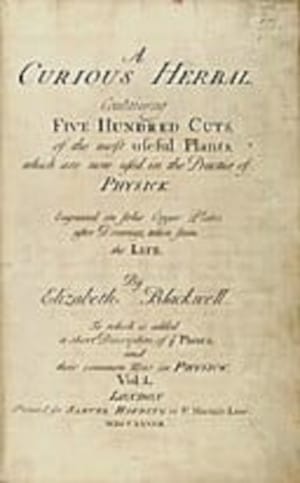
Her opus was dauntingly large, as was the title. She called it A Curious Herbal, containing five hundred cuts of the most useful plants which are now used in the Practise of Physick, to which is added a short description of ye plants and their common uses in Physick.
Probably to eat the elephant one bite at a time, she came up with an ingenious solution: to serialize the work.
Most people give credit to Charles Dickens, Washington Irving and other (male) authors for having come up with the concept of serialization, but Elizabeth was well ahead of them.
She issued her work in weekly parts, each with four plates and accompanying text. The process began in 1737 and continued over 125 weeks, into 1739.
Blackwell also did her own marketing, touting the work through word of mouth and through various trade journals. The task, daunting as it was, was also plagued with other troubles. In one instance, another group of printers and publishers (who Alexander later sued) produced a “spurious and base” copy of her illustrations elsewhere.
The first printing of A Curious Herbal met with some success; several physicians and apothecaries expressed their appreciation of the calibre of her work — and of the illustrations in particular. These recommendations influenced her receiving the endorsement of the Royal College of Physicians — no small honour.
Not Just Tammy Wynette singing “Stand by your Man” [1]
The book was a financial success, and Elizabeth used the funds to get her husband out of debtors' prison. But once a spender, always a spender: Alexander got into debt again and the couple had to sell half the rights of her book to a London bookseller. This was insufficient to keep the wolf from the door. In 1747, Elizabeth had to sell the remaining rights, along with all remaining copies of the book, including the copper plates that could be used to produce subsequent volumes.
Meanwhile, Alexander had tried his hand at other enterprises, none of which were successful. To avoid his creditors and other unpleasantness, he abandoned Elizabeth and trundled off to Sweden in 1742. Improbably — and who knows how — he managed to secure himself the position of Court Physician to King Frederick I.
His future ought to have been assured with such a position, but no.
While in Sweden he became embroiled in a sordid conspiracy against the Swedish Crown, involving himself in matters of succession. Elizabeth was on her way to Sweden when he was executed for treason on August 9, 1747.
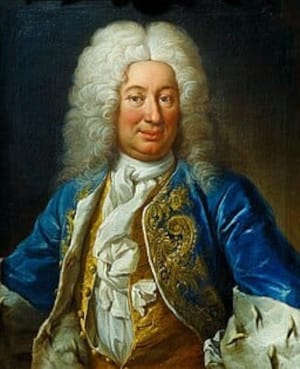
Prior to his execution, Elizabeth had been dutifully sending money to him in Sweden.
She died, alone and impoverished, in October 1758.
The august The Dictionary of National Biography, after asserting that Elizabeth was the daughter of a stocking merchant (untrue — her father was an artist) and had eloped with Alexander (perhaps, as documentation provides their location of marriage as an Inn in London), ends the entry on Elizabeth with these words:
”Having performed her task of delivering her husband and temporarily re-establishing his affairs, Elizabeth Blackwell disappears from observation.”
How sad that she is summarized as “having performed her task”. How sad that she is largely forgotten despite others (men) who did less are hailed more.
So ends my journey of discovery, prompted by some privet in my backyard.
[1] Here are Wynette's dreadful lyrics:
Sometimes it's hard to be a woman
Giving all your love to just one man
You'll have bad times, and he'll have good times
Doin' things that you don't understand
But if you love him, you'll forgive him
Even though he's hard to understand
And if you love him, oh, be proud of him
'Cause after all, he's just a man
Stand by your man
Give him two arms to cling to
And something warm to come to
When nights are cold and lonely
Stand by your man
And show the world you love him
Keep giving all the love you can
Stand by your man
Wynette had five husbands, so perhaps the title should have been “Stand by your Men”.
Would you like to read other posts? If so, please click the Home Page link below: