Improbable Neighbours
A Corner of Transgressive History
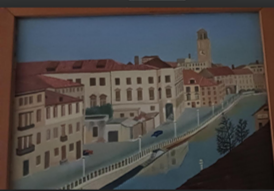
What connects cross-dressing sex workers, three embattled groups of nuns and monks, soldiers, a roller skating rink, feral cats, lucertole (lizards), a bridge of many names and the sea women of a river?
This is an attempt to explore these odd but real connections.
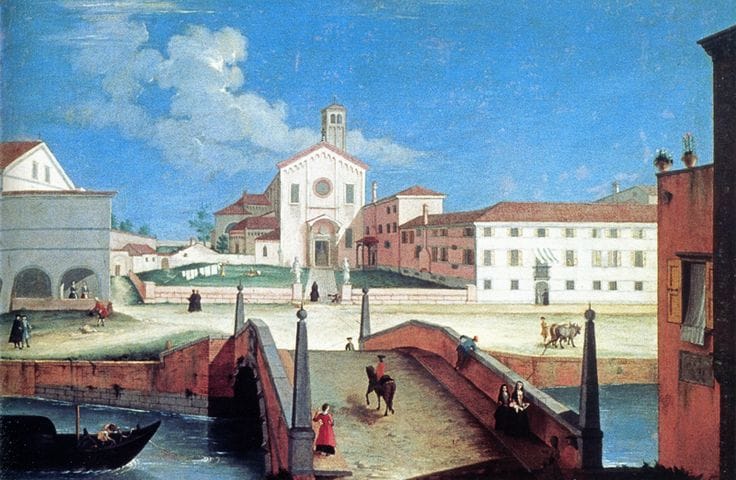
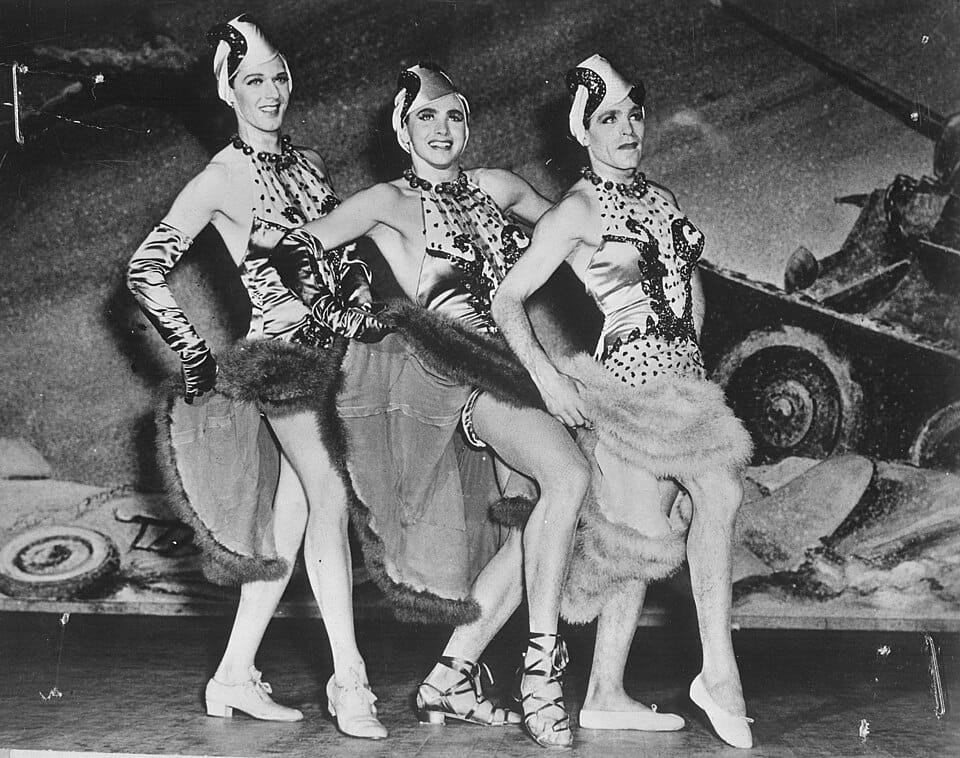
During the mid 1970s I lived close to the centre of Treviso, a small, charming city in the Veneto province of northeastern Italy. The apartment was situated at the southwest corner of the Riviera Santa Margherita and Viale Reggimento Italia Libera, facing a bridge that crossed the Sile River going into the city proper. A lively spot, during the day. At night, a lively spot in a different register. It was an intersection occupied nightly by transgender, or what at the time was termed “transvestite” prostitutes — men who lived, at least by night, as women.
Other than some sound mitigation by the river, it was a noisy corner, surrounded as it was by stone structures. By day, traffic, and the usual city voices of passersby. By night, much different. Every night, regardless of the season, the sex workers were there. They would call out to potential customers, their vertiginous high-heeled platform shoes clacking on the cobblestones, the cars honking at them, or slowing down for conversations. Sometimes the conversations were jocular, sometimes mean-spirited. Mostly it consisted of loud, raucous negotiations on price for various services — the scantily clad sex workers responding in loud, deep masculine voices. How often I heard “Venti mila!” — twenty thousand lire, twenty dollars, the going rate shouted into the night. This went on from slightly after dusk until the small hours of the morning. On cold winter nights they would often light a fire in a garbage can for warmth, and possibly advertising.
The Barracks: Caserma Micca-Colombo
On the opposite corner, to the southeast, was the military barracks at the end of Riviera Santa Margherita, the Ex Distretto Militare di Treviso, housed within what was known as the Caserma Micca-Colombo complex. It is now, as I understand, part of a university campus, considerably gentrified. But back then the street led to a long, dark parking area for the soldiers, and where I suspect much business was conducted in the night. The soldiers, I believe, were conscripted; at the time military service was mandatory and almost inevitably an enlisted man was sent far from home. This meant that the soldiers on that corner were almost all from southern Italy, which was further confirmed by their accents and some rather colourful regional expressions not used in the Veneto. Young men, just out of school, in their prime. One imagines the hormones raging. And the loneliness.
The Convento di San Paolo: A History in Layers
This building, now a university property, and previously a military complex, has a deep and interesting history. Around 1225, a small religious community established itself on the banks of the Sile River and the structure grew over the years. Originally it was home to a cloistered group of nuns of the Augustinian order. Conflicts arose with the nearby Frati Eremitani — also Augustinian, but male monks. By 1297 the nuns decided it would be best to move elsewhere. What prompted their exodus is a digression worth pursuing.
The women were there first. But shortly afterwards the monks decided the location would be a splendid spot for their monastery — and built it right next to the nuns, despite Papal laws decreeing a minimum distance of 300 canne — a medieval measurement equivalent to approximately 500 metres — between male and female religious orders. The nuns, upset, took their protests to the Vatican, which duly sent an emissary armed with an official measuring stick to determine the distance down to the last centimetre. Whether the monastery technically broke the law remains unclear. What is certain is that it was built exactly where the men wanted it, and that they held a grudge against the women for contacting the Vatican.
Regardless of the number of centimetres — or the lack thereof — the nuns understood that such proximity to the monks threatened their way of life in ways no measuring stick could quantify. The monks had built their structure to such a height that they and their workers could easily peer into the nuns’ cloisters, their gardens, their private areas. For a cloistered order, this was not merely an inconvenience. The garden, the cloister walk, the sky overhead — these were not mere amenities. They were the architecture of a spiritual life, the bounded world within which prayer, contemplation, and community were possible. To be watched from above was to be rendered prisoners inside their own house. The women could no longer walk freely in their own enclosure. They were forced indoors, behind shades, deprived of the very spaces that made their vocation liveable.
It almost seems like a modern property dispute, if you filter out the religious aspect. Except that you cannot filter it out; the fact that a Vatican-certified measurement resolved nothing, that the monks built where they wished, and the nuns lost regardless, tells you something about how power has always arranged itself. The calculated height of that wall reads less like poor planning than like intent and arrogance.
Both orders, despite sharing the Augustinian rule, were in reality competitors. Their economic books were separate. They were, in the most unsentimental sense, profit centres — and the issue of proximity would not have differed greatly from two Walmart stores establishing themselves side by side, drawing from the same pool of customers. Money came from the wealthy citizenry of Treviso, who clearly preferred to subsidize and donate to the more imposing building. The monks, with their height and their dominance of the riverbank, were winning that competition.
The nuns were also losing the battle for water rights on the Sile — access that was not a convenience but a lifeline, essential for supplies, sanitation, and the daily functioning of a religious community. The Vatican, having dispatched its measuring stick to no practical effect, had lost interest in the dispute. The sisters, recognizing defeat on multiple fronts — architectural, economic, hydraulic — picked up stakes and moved to another area of the city, settling close to another convent. A medieval women’s safety-in-numbers move. A defeat nonetheless.
The building, however, remained a valuable piece of real estate and was quickly reassigned to another women’s order — the Dominicans. Also cloistered, and operating under considerably stricter rules than their predecessors, they nonetheless possessed something the Augustinian nuns had lacked: institutional power. The Dominicans were not merely in competition with the Augustinians; they outranked them.
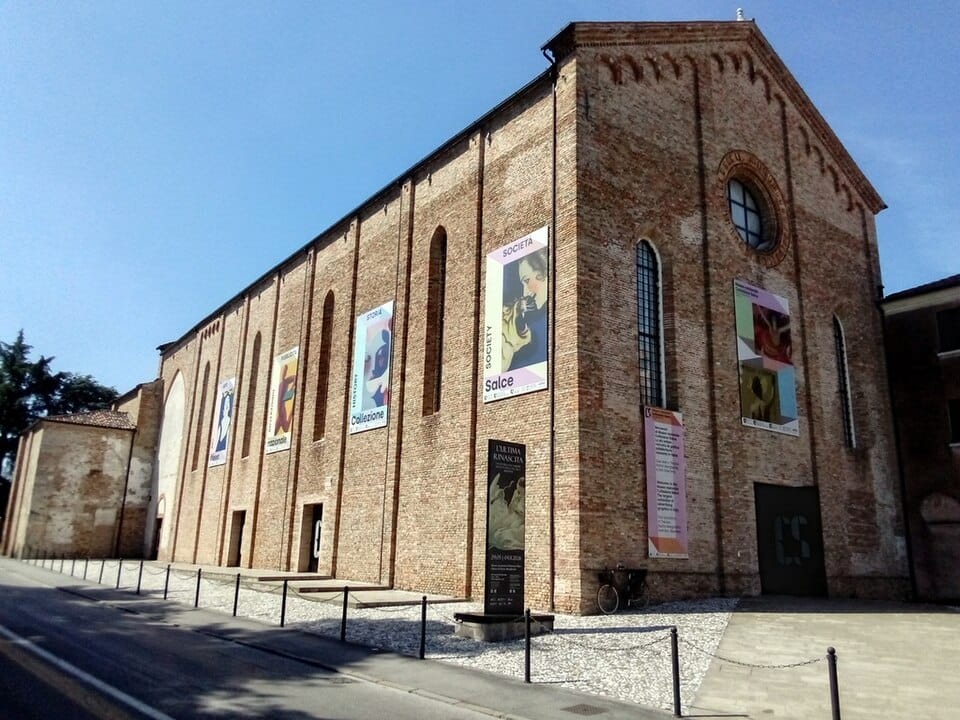
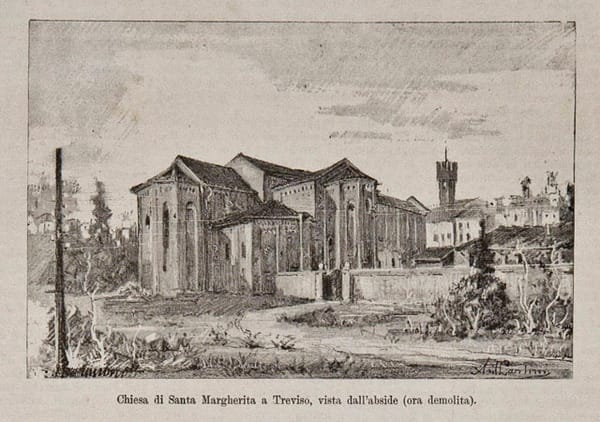
In the meantime, the monks had turned their attention to erecting a nearby church dedicated to Santa Margherita, and while they were occupied with that project, their new neighbours were quietly busy. Higher walls went up. Sight lines were eliminated. Water access was improved. The monks, absorbed in their construction, never saw it coming. The very architectural logic they had used to make the first nuns’ lives unlivable was now inverted, deployed with precision by women who understood the game entirely. The distance issue, once so bitterly contested, became a non-issue. What remained was serious financial competition — from the building the monks had effectively handed to a more formidable opponent.
Such irony.
The Dominican nuns won the long game. Ensconced on the property after their swift and strategic consolidation, they remained there, quietly and formidably, for just over five hundred years — until Napoleon arrived in 1810 and turned their world, and other religious communities across northern Italy, upside down. To put that span into perspective: many countries have not lasted as long. These nuns outlasted empires, survived plagues, weathered the Reformation, and endured more than twice the entire lifespan of the United States of America.
Though one doubts they marked their anniversaries with fireworks.
Napoleon and the Aftermath
And so the years passed and the convent continued. Until 1810, when Napoleon’s administrators arrived. This is a long story, and too long a digression for this essay. Suffice to say that both the convent and the monastery were immediately ordered to cease their religious operations, and the contents of both — priceless works of art accumulated over centuries — were seized. The nuns’ church of San Paolo was completely destroyed. The monks’ church of Santa Margherita fared a little better: stripped of everything of value, left to deteriorate, it was eventually pressed into service as a stable for the military’s horses and storage for hay and feed.
A church. A stable. The echo of that particular humiliation needs no elaboration — except perhaps more fundamentally Christ-like, given the legend of Christ being born in a stable. Maybe, in the midst of tragedy, an unintentional allegory for the faithful.
The nuns’ personal lodgings were not destroyed, but heavily modified. The small rooms in which the nuns had lived and slept — each one a world unto itself, a cell calibrated to prayer, solitude, and the bare minimum of comfort — had their walls torn down to create large open sleeping quarters for soldiers. One wonders if any of those soldiers, likely raised Catholic themselves, slept soundly in what had been a sacred space. Or whether they felt haunted by the history of so many cloistered women.
And so the area became a military complex, and remained so for 191 years — until October 2001, when it was repurposed to become part of a university campus and subsequently a location dedicated to the preservation of art and culture. The long arc from Agistianian and Dominican enclosures to Napoleonic stable to barracks to lecture hall is complete, or as complete as such arcs ever are.
But let us turn back the clock — back past the nuns and the monks, back past the founding of the convent, back to before Christianity had yet to arrange the landscape of this corner of the Veneto into parishes and prohibitions and measured distances between men and women. Back to the origin tales of the Sile River itself. Back to the pagan. But first, the bridge.
The Bridge of Many Names
This relatively unremarkable-looking bridge has a history that reaches considerably further back than its modest appearance suggests. During the Roman era, when Treviso was known as Tarvisium, this crossing point was a significant threshold — located at the southern terminus of the city’s main urban artery. We don’t often think of ancient Romans as builders of urban highways, but they were, and Tarvisium was no exception. Rome liked its cities organized, its roads straight, its grids legible. The settlement was a thriving one.
That main artery was the cardo maximus — the principal north-south axis of the Roman grid, running along what is now Via Calmaggiore and Via Santa Margherita. It is the same street that still carries that name today, still running from the heart of the old city down to the river’s edge. The bridge at its southern end was not incidental. It was the city’s formal southern gateway, the point at which the main road met the water.
And things were very different then. There was no cerchia — no complex ringed canal system, no layered medieval fortifications. During the height of the Roman Empire, Tarvisium sat open to the landscape, relying on the natural boundaries of the Sile and Botteniga rivers rather than on the defensive walls and moats that would come much later and eventually give the bridge one of its earliest names. The river crossing was simply what it was: a point of passage. Townsfolk and country people moving back and forth. Merchants and soldiers. Troops and trade carts. All of them passing through Tarvisium’s grand southern gateway, over the water, into the city or out of it.
It has always been a crossing point. That has never changed.
The bridge’s first formal name was Ponte della Cerchia — referring to a military position, a circle of defence and moat. It evolved into a sort of economic checkpoint, its name changing to Ponte del Varco: the customs bridge. It was made of wood during this period, not stone, and became a more important passage with the advent of the religious houses nearby. The ancient wooden structure was demolished in 1832, the city having decided that the wood required too much maintenance. The “new” stone bridge stood strong until an urban renewal project in the early 2000s completely revamped the area — and built the bridge of wood again. The cerchio — the circle — is complete.
The Deep History of the Sile – the Paleo-Veneti
Long before the Romans organized Tarvisium into grids and taxation districts, long before the nuns arrived and the monks built too close, this corner of the Veneto was inhabited by a people the Greeks and Romans called the Veneti — known to scholars today as the Paleo-Veneti or Proto-Veneti, an Indo-European people who settled the northeastern Italian plain sometime around the late second millennium BC and developed, over the following centuries, a distinct and sophisticated civilization.
They were not a single uniform culture but a constellation of largely independent communities — each with its own dialect of the Venetic language, its own local customs, its own gods. The territory encompassing modern Treviso was among their settlements, with archaeological traces of pre-Roman habitation documented near the city’s earliest foundations, including evidence of settlement linked to the springs of the Sile River itself.
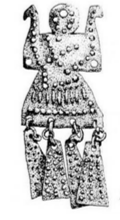
For the Paleo-Veneti, water was not incidental to daily life. It was the organizing principle of existence. Their settlements followed the waterways; their sacred sites clustered at liminal water places — springs, river confluences, marshes, lagoon edges — where the boundary between the human and the numinous was understood to be permeable.
Across the Veneto, archaeologists have identified 43 cult sites, the majority of them at natural places where people deposited votive gifts to place-specific deities. What the evidence shows is that these were not abstract gods residing in a distant heaven, but forces embedded in specific features of the local landscape. The water deity Trumusiate — whose very name has been etymologically linked to a wet or marshy location or place — was worshipped at Lagole in the Alpine foothills, the offerings left in ladle bowls and ladle handles bearing the deity’s name, a practice that continued into the Roman period when Trumusiate was absorbed into the cult of Apollo the Healer. The sacred at Altino, the Venetic settlement at the mouth of the Sile near the Adriatic lagoon, was similarly tied to water — an ancient shrine at a crossing of channels, structurally liminal, a landmark for both local worshippers and those arriving by water from the sea.
The Sile’s resurgence springs — water rising unbidden from the earth — would have carried profound significance in this belief system. Across the Veneto, the archaeological record consistently shows that liminal or magical natural landscape elements attracted cult activity, in the precise phrasing of De Nardi’s analysis. Hot springs, confluences, marshland, the edges between water and land: these were the places where the Paleo-Veneti placed their offerings, whispered their prayers, and understood themselves to be standing at a threshold.
Which brings us right to the Anguane, the of the Sile.
The Anguane: Divine Women of the Sile
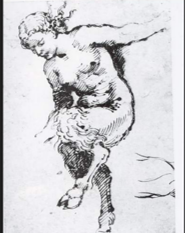
People called them the Anguane. Ancient water spirits, these female entities were young and exceptionally beautiful, with very long blonde hair — or, less poetically, the colour of the river’s sludge. They wore delicate veils for clothing. Sometimes they might pass for human, but the observant would notice the tell-tale signs: feet cloven like those of a goat, or shaped like a duck’s, or covered in fish scales, depending on who was doing the telling. What everyone agreed upon was that their skirts were worn deliberately long, the better to conceal their true nature — and that they spent all their time at least partially submerged in the waters of the Sile.
Legend held that the city-dwelling Anguane were not the same as those who lived beyond the walls. The city Anguane wove themselves into the daily lives of the population; the country Anguane mostly kept to themselves. On nights when the moon was full, the city Anguane would rise from the canals, making their way to the watermills and the stone city gates to launder their fine clothing. People would hear the rhythmic beating of cloth at the river’s edge, and they knew — the nymphs were at work.
Their nature was dual: protectors and avengers. They defended the river’s ecosystem and the creatures within it, the eels of the Sile above all. But disrespect the river — fish out of season, throw garbage into the waters, take without giving back — and the Anguane were without mercy. According to local tradition, they would entrance the transgressors with their singing, and once captured, drag them down beneath the watermills or into the shifting quicksands of the riverbank. The river, in other words, had its own justice. It predated the Church by a considerable margin.
Before leaving the Anguane, it is worth pausing on their name, whose origins remain genuinely murky. Some scholars derive it from the Latin aquana — simply, “of the water.” Others favour anguis, also Latin, referring to a water serpent — apt enough, since the Anguane were said to be capable of transforming themselves into a vicious and poisonous snake if sufficiently angered. But going further back, some historians point to the Celtic adgane — female nature spirits held dear by the Paleo-Venetic population, protectors of springs and rivers long before Rome arrived to name things. Once Christianity subsumed the original belief systems of the region, the Anguane or Adgane were demoted into folklore. They were not, however, forgotten. In local dialect the expression survives: sigar come n’anguana — to scream like an Anguana.
Which will, in time, bring us back to the sex workers and their own peculiar siren songs on the edge of the Sile at night.
The Anguane are creatures born of the river’s light — its clarity, its cold purity, its gift of water rising unbidden from the earth. But the Sile holds darker stories too. Where the Anguane emerged from the river’s nature, the Cornara was thrust into it as punishment.
They say she was a noblewoman of the powerful Cornaro — or Corner — family of Venice, known even in Treviso for her astonishing beauty and her jewels, but equally for her heart of stone, her greed, and her cruelty. One winter night, a poor and starving beggar came to her palace asking for a little food and shelter from the cold. She not only refused him — she had her servants beat him. As he was driven away, the beggar turned and cursed her.
The following day, travelling in her sumptuous carriage near the Sile, she found herself on a narrow and muddy stretch of road. Ahead of her, picking their way along the edge of the path, walked an elderly priest with two young altar boys. The lady, enraged by the delay, stopped her carriage, descended, and slapped the priest violently across the face.
In that instant the beggar’s curse found its moment. The ground shook with a terrible force, opened beneath the carriage, and swallowed it whole — horses, carriage, and noblewoman together. The hole filled immediately with spring water, becoming one of the many deep fontanassi of the Sile. And she drowned there, in the cold water rising from the earth.
But death was not the end. Her body was transformed — into a hairless and hideous female dog, around whose neck the pearl necklace of the noblewoman still hung.
Local legend holds that the Cornara has roamed the river’s edges for centuries, appearing most often on nights of dense fog. Those who claim to have seen her describe a black, hairless dog with eyes like burning coals. She holds the gaze of whomever she encounters — then dives into the river, and is gone.
There is a real historical figure behind the legend — Caterina Cornaro, Queen of Cyprus, whose life intersected with the Treviso region in ways both documented and embellished. But that is another tale, presently in contemplation.
The Anguane owe their origins to the distinct nature of the Sile itself. It is the longest resurgence river in Europe — meaning that rather than descending from mountains or following the more typical pathways of rivers, the Sile bubbles and seeps up from the ground, pure water rising from the earth as if from nowhere. Spring water in the truest sense of the word.
The ancients viewed this as something close to miraculous: clean, cold water appearing unbidden from the ground, and they believed that the Anguane were the divine beings responsible — spirits who pushed the water upward from beneath the earth to sustain the city of Treviso above.
Even today, walking beside the many canals that carry the Sile through the city, one can hear the water murmuring. People have long said that this is the sound of the Anguane at their toilette — combing their long hair and weaving it through with algae. When I walked those same canal paths, I heard it too. I offer no interpretation. I simply heard it.
The Rink, the Cats, and the Lizards
History makes odd twists and turns, and this story is no exception. The Church of Santa Margherita — looted, humiliated, pressed into service as a military stable — had one more life to live. After the military period wound down, the church complex was converted into a sports facility. At the back of the building, a large open area was given over to a roller skating rink. Except for the deepest winter months, the rink was used by artistic roller skaters — practising jumps, spins, and intricate footwork, working toward a precision that the concrete surface and the high surrounding walls neither rewarded nor forgave.
They sometimes skated to the music of their choreography, but more often in silence. Or rather, not silence — the symphony of their skates on concrete, enclosed on all sides by tall stone buildings, produced a sound quite unlike anything else. I would watch and listen to them from my back balcony. Roller wheels on stone, echoing upward. A church that had survived Napoleon, horses, and centuries of institutional ambition, now resonating to the footwork of young athletes who almost certainly had no idea what had preceded them on that ground.
The rink is gone now. The complex is a museum. The skaters have long since moved on.
But not the cats.
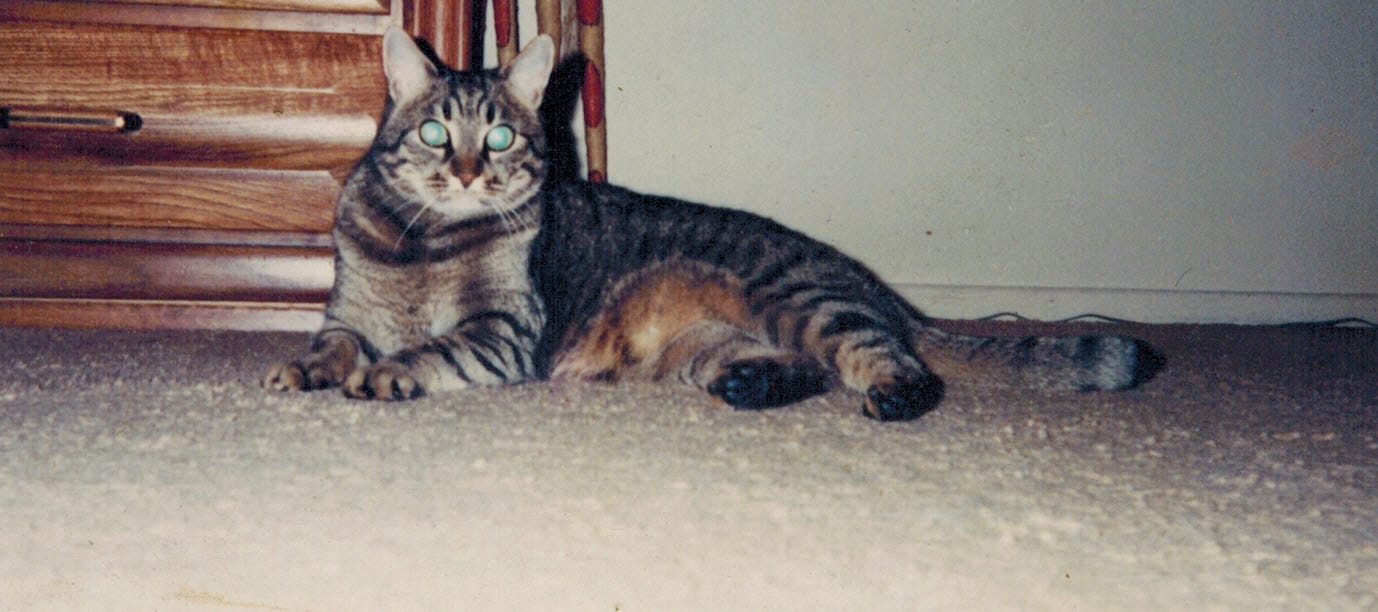
In the hours when the rink stood empty of skaters, it belonged to the cats. The space was protected, enclosed, and largely sheltered from wind. In summer, and to some extent even in winter, the sun warmed the concrete to a temperature that seemed designed with feline comfort specifically in mind. The cats would emerge then — from their hiding places and dens along the banks of the Sile, from the crevices and shadows of the surrounding buildings — and take possession. They lounged. They stretched. They dozed in configurations of absolute indifference to everything that was not sun and warmth. Occasionally they fought. How many were there? Impossible to say with certainty — perhaps a hundred or more at peak congregation, dotting every surface of the rink, lords of a domain whose history they neither knew nor required.
These were feral cats — a population protected under Italian National Law No. 281 (1991), which established the right of free-roaming cats to remain in their colonies, prohibiting their killing or removal, and mandating trap-neuter-release programs administered by local veterinary services. The cats of Treviso, in other words, have legal standing. And so they gathered, generation after generation, in what had been a church, a stable, a military barracks, and a sports complex. Indifferent to the weight of all that history. Warm, and entirely at home.
This cat colony was special in other ways, and it carried a history of its own that stretched back centuries. The cats have a look about them — short haired, tabby, and often marked with an M-shaped stripe just above the eyes that gives them an expression of permanent, slightly unsettling alertness. The colony had lived in that area for centuries, introduced long ago and sustained by purpose: they were prized by Venetian sailors and merchants for their ability to control rodent populations aboard ships and in the warehouses along the waterways.
My neighbours called these cats soriani. The word is nothing short of romantic in its origins. Soriano derives from Soria — the ancient Italian word for Syria. During the Middle Ages, Syria was renowned throughout the Mediterranean world for its exquisite luxury silk fabrics, woven in wavy, striped, and marbled patterns. Venetian sailors and traders, returning from the eastern routes, noticed that the striped markings of these cats recalled the patterns of those eastern silks, and named the cats accordingly.
The English word tabby carries an almost identical history by a different route. It derives from Attabiyah, a quarter in Baghdad renowned for producing the same kind of striped silk. Two languages, two trade routes, two cities on opposite ends of the ancient world, arriving at the same name for a breed of cat, by way of the same fabric.
The cats were not alone in that sun-warmed enclosure. Other creatures lived there too, small, swift, and largely unbothered by the world’s opinions of them. Italians call them lucertole; in Treviso the dialect word is borétola. Several lizard species inhabit the city, but the one most likely present in this location — and most consistent with memory — is the Common Wall Lizard: typically brownish, grey, or dark green, its back marked with intricate marbled and speckled patterns not entirely unlike those of the soriani sharing the same warm concrete.
There are many legends attached to this delicate creature, but one seems particularly well-suited to the layered history of this place. When the Virgin Mary was resting during the flight into Egypt, dangerous scorpions and spiders crept toward her. A tiny wall lizard darted forward and ate them, one by one, protecting her while she slept. In gratitude, Mary reached down and touched the lizard’s forehead — permanently marking an ‘M’, the initial of her name. Not unlike the marking carried by the soriani a few metres away, warming themselves on the same stone.
In Treviso, lizards are blessed creatures. The legend says so. And they were nearly everywhere in the buildings surrounding that particular corner — the old convent walls, the military complex, the edges of the rink — going about their quiet, ancient business.
Which brings us back to the cats, and their own Trevisan mythology. Local tradition speaks of what might be called the Great Feral Armies — the belief that the stray cats living in the city’s alleyways had developed, over generations, a complex underground hierarchy. They functioned, in the popular imagination, as an informal municipal defence force. And Trevisans believed that the oldest, most battle-scarred soriano in any given neighbourhood held the rank of General — coordinating the nightly hunts that kept the river rats from breaching the homes and food stores of the city. An army without a flag, operating below the level of official history. Much like several other forces we have already encountered in this essay.
A Long History at This Corner
But let us come full circle to our sex worker sisters — or brethren, as the case may be. They too, like the bridge, the cats, the lizards, the convents and the monastery, have a long, rich and storied history. And one very much tied to this same corner of Treviso.
In Roman Tarvisium, the trade was legal, regulated, and woven into the civic infrastructure. Because the Sile was an important throughway and this corner sat at a critical river port juncture, there was a thriving sex trade conducted primarily in two locations: tabernae — the inns and taverns catering to travelling merchants — and the lupanaria, dedicated brothels. The women were obligated to register themselves and to pay taxes on their earnings. Not all sunshine and enlightenment, however. They could not testify in court, and they were barred from marrying Roman citizens. Most were foreign slaves or libertae — freedwomen owned by regional elites. The law saw them, taxed them, and otherwise made them invisible.
And there were the non-binary: The concept of a biological male adopting a feminine role — in dress, presentation, and the offering of sexual services — was culturally visible in Tarvisium. These individuals were known as cinaedi: biological men who presented as feminine, wore makeup and women’s tunics, and in all probability operated in the commercial tabernae along the Sile River. In a provincial river port like Tarvisium, they were a known and present feature of daily life. A tradition, as it turns out, with very deep roots.
Roman law viewed this with characteristic pragmatism and characteristic cruelty. Female prostitutes were required by law to wear the male toga — a deliberate inversion, a mark of legal disgrace, the formal sign of infamia. Male sex workers who adopted feminine presentation did the opposite: they wore bright, flowing women’s clothing. The law concerned itself not with gender identity but with social status. If enslaved, they were property. If free, they were barred from standard civic rights. The state saw them clearly enough to tax and categorize them, and not clearly enough to extend them humanity.
Moving forward through the medieval and Venetian centuries — the 13th to the 18th — the framing of cross-dressing and transgender sex work became considerably more dangerous. The dominant anxiety was sodomy. So acute was this fear that during the 14th and 15th centuries, the Venetian Republic came to believe that homosexuality and sodomy would bring down divine wrath upon the city. The institutional response was remarkable in its logic: Venetian and Trevisan authorities actively promoted female prostitution — funding state brothels — specifically to redirect male desire away from other men and effeminate youth. Within this framework, transvestite sex work was not merely marginal; it was illegal, and pushed entirely underground.
Biological men who dressed as women to engage in sex work could not operate within the official red-light districts — not the Cae de Oro, not the licensed houses. Instead, they worked at night, along the dark arches of the Calmaggiore, or near the peripheral city gates. Near, in other words, the spot where we began.
Punishment was extreme. If caught by the local Capitano — the military governor of Treviso — cross-dressing sex workers faced severe criminal prosecution under the Council of Ten. Unlike female sex workers, who were tolerated, taxed, and regulated, transvestite workers were tried for atti contro natura — acts against nature — and faced public whipping, exile, or execution at the stake in Venice.
The historical record preserves at least one documented case that brings this institutional violence into sharp focus. In 1354, a person known as Rolandinus/a Ronchaia was brought before the Venetian courts — perceived by authorities as either ambiguously gendered or as a biological male living as a woman — and charged with both sodomy and prostitution. What makes Ronchaia’s case remarkable across the distance of seven centuries is her consistency. Throughout her trial, she maintained her identity as a woman without recantation. The courts implored her repeatedly to cease living as a woman and to renounce her claim to have ever done so. She refused. Her refusal to accept the demand to live as male led directly to her death sentence. The courts were not merely punishing behaviour. They were punishing the insistence on existing as oneself.
Ronchaia was executed in Venice in 1354 — not for the acts alleged, but for the life she would not surrender.
From the 13th to the 18th centuries, sex workers who had previously moved freely through the city were now confined — either to designated red-light districts within the city walls, or expelled to remain outside them entirely, on the wrong side of the walls and bridges. Liminal by decree.
The Napoleonic era brought a different kind of regulation. Licensing was required, but the new emphasis fell on the control of venereal disease. Workers were now required to submit to official bi-weekly health checks. Those found with symptoms were forcibly quarantined in a dedicated ward — local neighbourhood memory from the 1970s places this at the San Leonardo Civic Hospital, within clear sight of our former convents and monastery just across the river, though this detail awaits formal verification.
By the 19th century a two-tier system had solidified. The most expensive establishment was Il Leda, catering to senior military officers and wealthy landowners. The Piccolo Eden occupied a different and rather surprising niche — its clientele and workers were predominantly upper-class women, often married, often mothers. Lower-tier establishments — Dotto, Della Ada, Della Menta — served working-class labourers. All were concentrated in and around the legendary Cae de Oro district and the surrounding streets of via Castelmenardo and via delle Oche, just steps from the church of San Nicolò and the Cathedral. Street prostitution was heavily policed by the local Carabinieri, a uniformed officer posted outside every brothel to regulate entry — with a discreet secondary entrance available for more prominent clients. All about the money. No change there.
By the late 19th century, moral condemnation had acquired a medical vocabulary. Sex workers were routinely examined for disease. Transvestite workers, barred from the legal houses and unable to register, operated as prostitute clandestine — unlicensed street-walkers. They used the cover of the dense river fogs along Treviso’s city walls, or worked from private rented rooms — camere d’affitto — outside the city centre.
In the late 19th century, police forces across the Veneto were working closely with early criminologists shaped by the influence of Cesare Lombroso, whose La donna delinquente — published in 1893 and translated into English as The Female Offender — provided the pseudoscientific framework for what followed. When a cross-dressing sex worker was arrested in Treviso, they were not merely jailed. They were catalogued. Local police files, consistent with those documented across the Veneto, record arrests for travisamento (disguise) and offesa al pudore (offense to public decency). These individuals were frequently sent not to standard rehabilitation but to the psychiatric wards or specialised venereal disease wards of the San Leonardo Civic Hospital for clinical evaluation.
And here we are, back in the neighbourhood again.
Tracing the history of transgender, gender-nonconforming, or transvestite individuals within this trade requires some care, because the past did not record these identities in terms we would recognize today. Modern concepts such as “transgender” or “transsexual” belong to the 20th century. Earlier archives — legal, medical, ecclesiastical — reached instead for the language available to them: travisamento (cross-dressing, or disguise), uomini effeminati (effeminate men), or filed these individuals under the broader categories of sodomy and clandestine prostitution. The people existed. The language to name them accurately did not yet.
Improbable Neighbours
And so these were my improbable neighbours for a few years. By day: artistic roller skaters clattering gracefully — and sometimes not — across the stone-bound rink; lizards skittering along the walls, sending the odd fragment of cement falling with a small, particular sound; cats languidly sunning themselves, occasionally erupting into the yowling and hissing that is the feline version of a strongly worded letter. Come the night, the soundscape changed entirely — the staccato cries of the sex workers and their clients, the soldiers, and the cars passing by, the negotiations carried on at full volume in the cool air above the Sile.
Sometimes, returning late at night from a date, I would enter the restaurant/bar that was at the corner. Occasionally there would be a few of the sex workers there, having a break. Tall, startling high heels, fishnet stockings, black leather bustiers, dramatic makeup. Not garish but beautiful exotic creatures of the night. They were mostly quiet, speaking softly among themselves. Sipping double espressos.
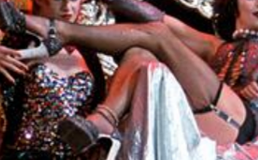
I lived above them all, and knew none of them. I would sometimes recognize the particular deep voice of a more frequent sex worker, but I didn’t know any of their names. I didn’t know their histories, their stories, where they lived, what made them laugh, what tragedies they had survived, what brought them joy. They kept me awake and interrupted my sleep on almost every night I spent in that apartment. They have remained with me for over fifty years.
Chances are that most of them are dead by now. Dead of old age, of disease, of violence. My unnamed neighbours. Every one of them — from the lizards and the cats to the transgender sex workers calling out into the night — had a long history on that particular corner of that particular city. And yet there is no historical plaque to honour any of them. The lively medieval feud between the nuns and the monks, in which a papal official travelled all the way from Rome to Treviso carrying a very special stick, is now forgotten. The Anguane no longer comb their hair in the canals, or if they do, no one is listening. The neighbourhood has been gentrified — university students, museums, clean facades.
In many ways I miss the garbage bins on fire, and the loud cries of “venti mila lire!” Rising through my window in the dark.
Sources Consulted
Primary and Archival Sources
Esito di Gara — Comando Forze Operative del Nord. Undated. Privately printed. Italian military administrative document confirming the Caserma Micca-Colombo compound designation. Consulted by the author.
“Le Grandi Armate Ferali” / The Great Feral Armies. Oral tradition received from neighbours, Riviera Santa Margherita, Treviso, mid-1970s. Recounted to the author in Italian. No written source located or claimed.
San Leonardo Civic Hospital quarantine ward. Neighbourhood oral tradition received by the author, Riviera Santa Margherita, Treviso, mid-1970s. Awaits formal archival verification.
Treviso: History, Architecture, and Religious Orders
Pozzobon, Paolo. Sant’Ambrogio di Fiera. Ed. Zoppelli, Treviso 1980. [As reproduced on parrocchiadifiera.it, “Le Monache Agostiniane” section.] Confirms Augustinian nuns at San Paolo from 1223; departure 1297.
Sartor, Ivano. “Il Convento delle Domenicane di San Paolo in Treviso.” Portello Sile / ANA Treviso. portellosileanatv.it. Confirms Dominican occupancy, sight line dispute, Napoleon suppression 1810.
Fondazione Cassamarca. “Complesso San Paolo — Ex Distretto Militare.” fondazionecassamarca.it. Confirms 2001 repurposing to university and cultural precinct.
“Treviso.” Enciclopedia dell’Arte Antica. Treccani.it. Confirms Roman municipium status, quadruvium, road network, epigraphy.
“Storia di Treviso.” Wikipedia Italia. it.wikipedia.org. Confirms cardo maximus along Via Santa Margherita / Via Calmaggiore and quadruvium location at Piazza Carducci.
Bressan, M. and Pellegrini, L. “Modellazione di superfici di età romana a Treviso.” Archeologia e Calcolatori, CNR. archcalc.cnr.it. Confirms Sile as southern boundary of Roman Tarvisium.
“Treviso.” Encyclopaedia Britannica. britannica.com. Confirms Celtic Tarvisium / Roman municipium.
“Viaggio nella Chiesa di San Leonardo, Treviso.” qdpnews.it. Confirms San Leonardo’s history and location.
Paleo Veneti
All claims about the forty-three cult sites, liminal sacred landscapes, Trumusiate, and the Altino shrine derive from:
De Nardi, Sarah. "Landscapes of the Prehistoric Veneto, Italy: A Plurality of Local Identities Reflected in Cult and Landscape Perception." Papers from the Institute of Archaeology, vol. 18, 2007, pp. 39–56. DOI: 10.5334/pia.301.
All claims about Paleo-Veneti settlement, material culture, and the Treviso area derive from:
Capuis, Loredana. I Veneti: Civiltà e cultura di un popolo dell'Italia preromana. Third edition. Milano: Longanesi, 2009.
The Treviso-specific archaeological traces near the Sile springs derive from:
Gerhardinger, E. Reperti paleoveneti del Museo Civico di Treviso. Roma, 1991.
And from the ArcheoVeneto catalogue entry:
Musei Civici di Treviso: Le raccolte archeologiche a Santa Caterina. Treviso, 2007. archeoveneto.beniculturali.unipd.it
The Trumusiate etymology quote — "wet or marshy location or place" — is sourced directly to Marinetti, as cited in De Nardi (2007), p. 47.
The Anguane, the Cornara, and Sile River Folklore
“Anguana.” Menocchio’s Almanac. menocchiosalmanac.miraheze.org. Confirms Anguane characteristics, cloven feet, laundering tradition.
“Demoni, mostri e fantasmi del folklore italiano.” Weird Italy. weirditaly.com, June 2022. Confirms Anguane as nature spirits, non-lethal tradition.
Parco Naturale Regionale del Fiume Sile. “The Resurgence Pools.” parcosile.it. Confirms Sile as longest resurgence river in Europe.
“I Misteri del Sile: La Leggenda della Cornara.” sgaialand.it and eventivenetando.it. Italian-language folkloric sources on the Cornara legend. No formal publication data.
Cats, Lizards, and Natural History
Purina Editorial Team. “Di che razza sono i gatti soriani e che aspetto hanno?” Purina Italia. purina.it, 17 maggio 2023. Confirms soriano etymology from Sorìa (Syria); tabby etymology from Attabiyah, Baghdad; M-marking Christian folk legend.
Italian National Law No. 281, 14 August 1991. “Legge Quadro in materia di animali di affezione e prevenzione del randagismo.” Gazzetta Ufficiale della Repubblica Italiana, no. 203, 30 August 1991. Foundational legislation establishing protected status for feral cat colonies.
Prostitution: Roman, Medieval, Venetian, and Modern
“Prostitution in Ancient Rome.” Wikipedia. en.wikipedia.org. Confirms Roman legal framework: registration, taxation, tabernae, lupanaria, slaves and libertae.
Favretto, Valeria. Oltre la Cae de Oro. La prostituzione a Treviso dal Regno d’Italia alla Legge Merlin. Editoriale Programma, Treviso. Primary source for 19th century Treviso establishments, red light district geography, Carabinieri regulation.
“I quartieri a luci rosse e i casini di guerra a Treviso.” Il Gazzettino / Treviso Today, 20 aprile 2016. trevisotoday.it. Confirms establishment names: Dotto, Della Ada, Della Menta, Della Leda, Piccolo Eden; confirms Cae de Oro district.
Danusso, Cristina. “Prostituzione e lenocinio nell’Italia dell’Ottocento.” Historia et Ius, 1 giugno 2022. historiaetius.eu. Confirms Napoleonic regulation: registration, periodic health checks, police oversight.
“Le donne, i governi e la prostituzione — il Medioevo.” amantidellastoria.wordpress.com, 24 febbraio 2021. Confirms Treviso medieval restriction of women in stufe.
“Prostitution in Venice.” History Walks in Venice. historywalksvenice.com. Confirms Venetian promotion of female prostitution to counter sodomy; Council of Ten; capital punishment for sodomy.
Baldassano, Alex. “Talking Back: Sodomy Laws and Transgressive Subjectivity in Medieval Venice.” Medieval Feminist Forum, vol. 55, no. 2. scholarworks.wmich.edu. Peer-reviewed. Confirms 1354 Ronchaia case.
“Contrasting Renaissance Sodomy Legislation in Florence and Venice.” The Black and Gold, College of Wooster. openworks.wooster.edu. Confirms Council of Ten; divine wrath as institutional motivation.
Lombroso and Criminal Anthropology
Lombroso, Cesare and Ferrero, Guglielmo. La donna delinquente (1893). Published in English as The Female Offender, D. Appleton and Company. Primary source. Pseudoscientific framework applied to sex workers and criminal women by northern Italian police forces.
Gibson, Mary S. “The ‘Female Offender’ and the Italian School of Criminal Anthropology.” Journal of European Studies, 1982. Confirms Lombrosian influence on Italian police practice.
Roman Gender and Sexuality
“Homosexuality in Ancient Rome.” Wikipedia. en.wikipedia.org. Confirms cinaedi characteristics, clothing, social role.
“How Roman Society Integrated People Who Altered Their Bodies and Defied Gender Norms.” The Conversation. theconversation.com, 2026. Confirms cinaedi as gender-nonconforming category, Greek origins.