A World in a Dish: The Genealogy of a Keepsake
Objects have their own history, too
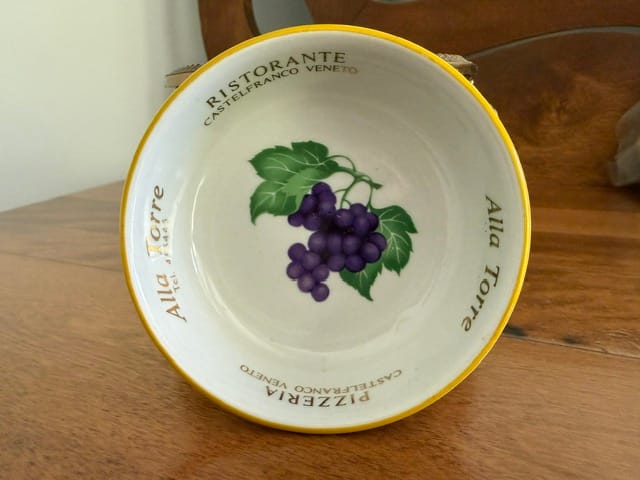
We tend to think of genealogy as being the exclusive province of humanity, or even of some animals — such as dog or horse pedigrees — but we seldom extend the very real metaphor to objects. Why do we keep objects? Why do we call them souvenirs or keepsakes?
The words themselves are instructive. Souvenir arrives from the French, rooted in the Latin subvenire — to come up from below, to rise unbidden into consciousness. A souvenir is not retrieved; it surfaces. Keepsake is a stranger formation, assembled in English around 1790: kept, for the sake of the giver. An object held not for what it is, but for whom it represents. By the 1830s the word had been pressed into service as the title of popular holiday gift books — volumes of beautiful engravings and, by most accounts, mediocre poetry. The word has since recovered its dignity.
When we are gone from this world, there is a good chance that our objects will outlive us. More often than not, we are seldom fully prepared for that exit. There never seems to have been the time to really look at the things we treasure for reasons beyond monetary value. Our wills specify who will inherit that very expensive painting, that rare first edition book, and other things that might have been listed separately in a home insurance policy. But we almost never honour those little things that actually have the most significant, and truly emotional, value. And those little things, found by perplexed relatives when clearing out the house, are what will likely end up in the dumpster or at best at some charity shop — not because the relatives are insensitive people, but because they simply had no idea why grandma kept this tiny little dish in bubble wrap all these years.
Objects have their own histories. They have their own inherent MtDNA, if you will — their deep history of how they were made, where they came from, and where their individual components originated. Then we have a history of human contact — those who made the object, those who aided it in its journey, and all the places the object has been. Objects are world travellers, in time as much as in space.
Lastly, we have the tale of its present or last owner. How and why the object was acquired, and what it meant. And what it conjures.
This story is about an ashtray.
It is not an antique. It’s not a museum quality artifact — nothing here for the velvet cushion. Nor is it a piece that would interest an auction house. It has no particularly significant intrinsic value.
Yet, it carries such weight; regarding it attentively and questioning its history, we find that it could indeed have value far beyond the market, the auction, and the museum.
The Ashtray Finds Its Place; And the People Who Brought It There
Note: Individuals’ names have been changed out of respect for their privacy.¹
Before the ashtray could begin its long journey northward, wrapped eventually in bubble wrap in a series of Canadian homes, it needed to sit on a table. And before it could sit on that table, the particular conjunction of people who would gather around it had to be assembled by history — a process that began, as so many things do, in the wreckage of a war.
Julie and Her Mother: The Long Road from Slovenia
Julie is a Canadian woman, the daughter of a Slovenian mother who came to Canada the hard way. Her mother — we shall call her Marija — had been displaced during the Second World War, one of the vast tide of people whom the conflict had untethered from home, language, and certainty, and left waiting in transit countries for the paperwork that would grant them a new life somewhere else. For Marija, that transit country was Italy. She waited there, in the particular suspended animation of a displaced person — neither here nor there, belonging nowhere — until the documents finally came through, and she could board a ship for Canada. She made that crossing alone, save for the strangers who shared her circumstances.
Prior to making that journey, there was another Slovenian woman in precisely the same predicament; let’s call her Dina. The two women originally met in Slovenia, and were both ultimately bound for the same cold, vast, unknowing country. Both were displaced and temporarily living in Italy and later formed the kind of friendship that displacement makes: deep, quick, and durable, forged in the shared understanding of what had been lost and what was being risked. Marija and Dina crossed on different ships, but both arrived in Canada around 1949, and built their new lives in proximity, their friendship outlasting the circumstances that had created it, as the best friendships do.
Dina’s eldest son was born in Montreal and grew up in Toronto; we’ll call him Tony. He was a young man of strong opinions and considerable intellect, passionate about politics and history, and for a time he worked as an assistant to a Member of Parliament in Ottawa, a job that suited his temperament well. Then came a seizure, bad enough to reshape the trajectory of his life, and in its aftermath Tony made a decision that surprised some people: he moved to Italy. In Castelfranco Veneto, in the streets around the medieval tower, the moat, and the frescoed facades of the old town, people called out to him as he walked. He had built a life there, on the other side of the world from the city where he had grown up, and it suited him.
Julie had known Tony for much of her life, the way children know the children of their parents’ closest friends, which is to say, with a familiarity that requires no particular effort and deepens quietly with time. They were connected not only by affection, but by history: the history of their mothers, of Slovenia, of the ship, the waiting, the crossing, and of everything that had happened before either of them existed. Tony was, in a very real sense, a living archive of the world that had preceded Julie — the world before Canada, before Toronto, before Julie herself.
September 2, 1990 — Castelfranco Veneto
In the summer of 1990, Julie was travelling in Italy. She had come with friends, and they had spent time together before going their separate ways for a few days, as travellers do. Julie went to Castelfranco Veneto to have lunch with Tony, who was not feeling well enough to make the journey to Venice. It was a beautiful day. The sky was a clear, deep blue. The temperature was comfortable. The old walled town, with its moat and its medieval fortifications and the frescoes painted on the exterior facades of the buildings, was tranquil in the particular way of Italian provincial towns on a weekday — unhurried, self-possessed, and indifferent to tourism in the best possible sense.
They ate inside the tower. Pizzeria Alla Torre, named for the great civic tower that forms its spine and its soul, had wooden tables covered with white linen tablecloths. The food was good. They talked about family, the way people do when they are aware, however dimly, that time is doing its work. Julie had the sense that Tony was worried about his mother. She felt sad for him, and she felt the particular sadness of believing that someone is in the wrong place, that he should be home, in Canada, close to the people who had known him longest. But then people called out to him in the street as they walked after lunch, and she revised her judgment, or tried to. She found herself hoping that his support group was big enough to fill the gap where his family should have been.
It was at the table, at some point during lunch, that she noticed the small dish, sitting there in the ordinary way of restaurant ashtrays — functional, unremarkable, present. It bore the name of the pizzeria and a decoration of purple grapes, green leaves, brown stems. She thought it would be a lovely souvenir, and a genuine one: made in Italy, in the region, not a piece of imported mass-production dressed up in local colours. She wanted it, even though she knew that taking it would be stealing. But Tony said: “Go on, take it.” So she did.
The Tower — And a Coincidence of Ghosts
The tower from which the restaurant takes its name is the Torre Civica of Castelfranco Veneto; it is a structure whose origins lie in the late twelfth to early thirteenth century, when the Commune of Treviso built the fortified complex as the westernmost defensive bulwark of the Marca Trevigiana. Raised to its current height of 43 metres in 1339, when Venice assumed dominion over the town, the tower was adorned with a bell chamber as a statement of authority over a frontier it intended to hold. In 1499, the Venetian Podestà Pietro Gradenigo commissioned two additions that remain to this day: a clock, and a Lion of St. Mark², carved in pale Istrian stone and set against the uniform red brick of the tower’s face.
It also watched, in the summer of 1974, a young man who lived inside the tower — just behind the lion, in a room where bats roosted in the ceiling — meet a young woman who would become, for a time, his wife. That woman was the author of this essay. She stood under the tower in 1974 and knew nothing of what had happened there before, and nothing of what would happen there sixteen years later, when a Canadian woman named Julie would sit inside it and eat risotto with a man she had known most of her life, and slip a small ashtray into her bag.
Neither of us is Italian. We had travelled to Italy together that summer of 1990 and separated, as friends do, for a few days. I had no idea she was going to Castelfranco. She had no idea I had ever been there. We were treading, without knowing it, in each other’s emotional archaeology — the same tower, the same stones, the same lion with its paw on its closed book, meaning different things to each of us, meaning nothing it was asked to mean and everything it turned out to mean anyway.
This is what places do. They accumulate the weight of everyone who has passed through them and distribute it invisibly, so that each new visitor walks into a room already full of other people’s histories without ever knowing it. The ashtray sat on its table inside that tower for the better part of a decade before Julie took it. It had no idea, either.
The Town Itself — And the Long Shadow of Ezzelino
To understand the tower is to understand the town, and to understand the town is to step into one of the more turbulent chapters of medieval Italian history — a chapter in which the small, pleasant, brick-walled comune of Castelfranco Veneto played, for a time, a starring and not entirely comfortable role.
Castelfranco Veneto was founded in 1199 by the Commune of Treviso, its name stating its original purpose with municipal bluntness: castrum francum, a free fortress, a fortified settlement whose inhabitants were exempt from certain taxes in exchange for defending the western frontier of Trevisan territory against the rival city of Padua. It was, from its first breath, a place defined by its strategic position between competing powers, a characteristic it would carry for centuries.
The town’s fortifications remain remarkably intact: a nearly complete circuit of medieval walls, their red brick darkened by eight centuries of Veneto weather, punctuated by corner towers and pierced by gates. Within those walls, the street plan has changed little since the thirteenth century. The frescoes on the exterior facades of the buildings that so struck Julie on her September visit are a Veneto tradition of considerable antiquity — the painted face presented to the world, the private life conducted behind it.
Ezzelino da Romano — The Tyrant in the Walls
No history of Castelfranco Veneto can proceed far without encountering Ezzelino III da Romano — a figure so extreme in his methods and so vast in his ambitions that Pope Innocent IV declared a crusade against him in 1255, an honour previously reserved for Saracens and heretics. Ezzelino was the dominant power in the Marca Trevigiana for the better part of three decades, and his relationship with Castelfranco was intimate and not gentle.
The Da Romano family had been woven into the politics of the Veneto for generations before Ezzelino III made them infamous. His grandfather, Ezzelino I, had been consul of Treviso in 1187. The family had signed no pact with the devil, despite what their enemies later claimed; they were simply extraordinarily ruthless operators in a world that rewarded ruthlessness, allied with the Emperor Frederick II against the Papacy and the Lombard communes in the great struggle that defined thirteenth-century Italian politics.
Ezzelino III took that ruthlessness to a register that appalled even his contemporaries. At the apex of his power he held dominion over Treviso, Vicenza, Padua, Verona, and Rovigo, and reached briefly into Ferrara, Mantua, and Brescia. He held these territories through terror — mass executions, systematic torture, the imprisonment of entire civic populations. The medieval chroniclers, not men given to squeamishness, found him remarkable. Rolandino of Padua, who witnessed Ezzelino’s rule firsthand, left accounts that read, across seven centuries, with the quality of nightmare.
Castelfranco sat directly within his sphere. He strengthened its fortifications and used the town as a military base in his campaigns against Padua. The tower that would one day house a restaurant, and a young man with bats in his ceiling, and a small ashtray on a white-linened table, was in part a structure that Ezzelino’s wars had made necessary and his engineers had improved.
The crusade called against him in 1255 by Pope Alexander IV — emboldened by the death of Emperor Frederick II five years earlier — brought together Venice, Treviso, Padua, Ferrara, and others in an unlikely coalition united chiefly by shared terror. Ezzelino was captured and died in prison at Soncino in 1259. His brother Alberico then assumed the headship of the family. But the end, when it came for Alberico, was in the medieval manner: his sons beheaded, his daughters and wife burned alive, and Alberico himself tied to a horse’s tail and dragged across the hillside at San Zenone until he died. The remains were distributed as trophies to the cities that had suffered for the longest under Da Romano rule.
The crusade against Ezzelino is explored in considerably more detail — along with the remarkable women who inhabited his story — in the essay Fireflies, Mermaids and Skeins of Thread, to which the interested reader is warmly directed:
 Denise Choppin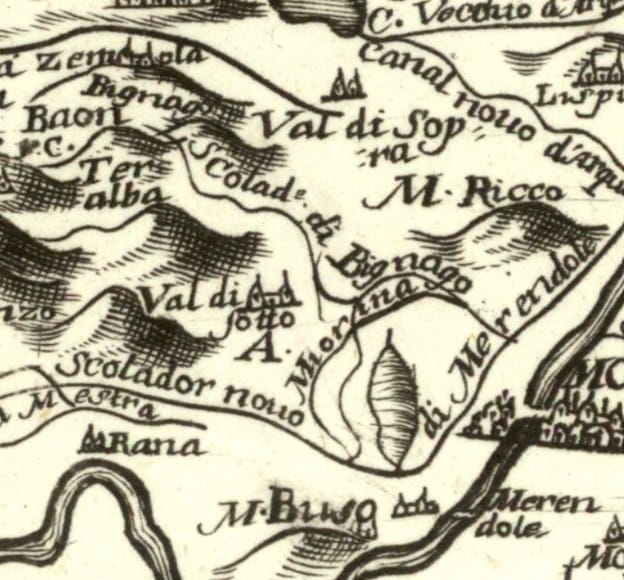
After the Storm — Venice and the Long Peace
After the Ezzelini, Castelfranco passed through the hands of the Scaligeri of Verona and the Carraresi of Padua before Venice arrived in 1339. It was under Venice that the tower reached its current height, that the clock was added, and that Pietro Gradenigo placed his lion above the gate. The lion’s closed book — whatever the scholars say about the absence of official codification — spoke to a relationship between Castelfranco and Venice that was built on mutual pragmatism: the town was strategically valuable. The Venetians were not sentimental, and arrangements were made accordingly.
Venetian rule lasted until May 12, 1797, when Napoleon’s arrival ended the Republic of Venice and, with it, nearly five centuries of Serenissima dominion over the Veneto. The lion above the gate survived. The town within the walls continued, as it had always continued, doing what frontier towns do: absorbing history, accommodating the powerful, outlasting the circumstances that had seemed, at the time, permanent.
It was into this town — eight centuries of accumulated survival compressed into red brick and frescoed plaster, presided over by a stone lion with its paw on a closed book — that Julie walked on a clear blue September morning in 1990, carrying nothing but a camera and the weight of her own history, to have lunch with the son of her mother’s oldest friend.
She left carrying one thing more.
The Ashtray Travels to Canada
Julie wrapped the small dish in whatever came to hand — the practical improvisation of the traveller — and it made the journey back across the Atlantic with her, tucked into luggage that also carried photographs of Castelfranco, of the tower, of the tranquil streets within the walls. The photographs were regarded as intended for travel photos. The ashtray was regarded, now, as something more than for what it had been created; it had already begun its second life as a souvenir.
It arrived in Toronto.
Toronto in 1990 was the city Julie knew; it was her city, the city her mother Marija had helped build by arriving in it forty years earlier with nothing but the friendship of a woman named Dina and the determination of someone who had already survived worse than a Canadian winter. The ashtray took up residence in Julie’s apartment, an unremarkable object in an unremarkable domestic space, carrying in its 3.5 inches (ca. 9 cm) of Tognana porcelain the compressed weight of a September afternoon, a blue sky, white linen, and a man who had said “Go on, take it” with the easy generosity of someone who had nothing to lose by the gesture and everything to give.
From that first Toronto apartment, it travelled with Julie to Bloor West Village, one of the city’s older, more settled neighbourhoods; it’s the kind of place where people put down roots and then wonder how the years passed so quickly. Then to Etobicoke, the western borough that had been absorbing new Canadians since long before Julie’s mother had made her way there. Then to the hamlet of Gilford, north of the city, where the Ontario landscape opens up and the distance from urban life gives objects like this one — small, breakable, inexplicably kept — a different quality of presence. Back to Etobicoke; this time South Etobicoke, steps from Lake Ontario. And finally, most recently, to Fergus, a small town in Wellington County built by Scottish settlers along the Grand River, about an hour’s drive west of Toronto, where the limestone architecture gives the streets a solidity that feels, in the best possible way, permanent.
At some point in this long migration through the postal codes of a life, the ashtray acquired its bubble wrap. Julie does not recall exactly when. What is certain is that once wrapped, it stayed wrapped. No one has unwrapped it since (or at least not until the writing of this essay). It now sits in Fergus, in its bubble wrap, in the particular silence of objects that are no longer used and not yet understood.
Marija died. Dina died. And then, in late December 2025, Tony died.
Julie had not spoken publicly about the ashtray — had not, in fact, told the story of that September lunch to anyone in any formal way — for thirty-five years. The story had been hers alone, a private thing, the way the most significant things often are. But when Tony died she shared it, for the first time, with an online group of friends and family: how she had gone to Castelfranco on that clear blue day, how they had eaten risotto di stagione at a table with a white linen cloth inside the tower, how Tony had said “Go on, take it,” and how she had.
It was, she said, the last living link to her mother and to Dina, and to the stories of when they had come to Canada, to the history of herself before she was herself.
The object had not changed; but what it was keeping had changed entirely. It had begun as a souvenir — something that surfaces, rises unbidden from below — and had become, in the fullest etymological sense of the word, a keepsake: held not for what it is, but for whom it represents.
Three people who were there when Julie lifted it from that table are gone now. The ashtray remains.
There is a particular kind of weight that accumulates in small objects when everyone who shared the moment of their acquisition has died. It is not monetary weight, not the weight that insurance policies and auction houses are equipped to measure. It is the weight of being the last witness —the only material thing that was present on that September afternoon and is still, in any meaningful sense, here. The photographs from that day may exist somewhere in Julie’s archive; photographs are their own kind of record. But photographs are made to be looked at. The ashtray was never meant to carry memory. It was made to hold cigarette ash, and it was conscripted into a different service entirely, by a woman who noticed it on a table and thought it quietly lovely, and a man who said “Go on.”
This is what keepsakes are. Not the things we set aside for the purpose — not the deliberate souvenirs bought at the gift shop near the exit, their provenance announced on a label — but the things that are pressed into the role by circumstance, by loss, by the slow subtraction of everyone else who was there. The bubble wrap is not excessive. The bubble wrap is entirely appropriate. It is the material expression of knowledge that took thirty-five years and three deaths to become fully articulate: that the small dish on the table at Pizzeria Alla Torre on September 2, 1990 was, without anyone deciding it should be, irreplaceable.
The Deep History of the Ashtray
The object itself is not particularly remarkable. It is approximately 3.5 inches (ca. 9 cm) in diameter. But before it ever sat on that restaurant’s table in Castelfranco Veneto, where patrons idly crushed their spent cigarettes into it, the humble dish had a very long pedigree encoded in its very material.
We will try to pinpoint those deep origins, but first we must establish when and where it was made.
The evidence, taken together, points in a consistent direction. The owner places the object at Alla Torre on September 2, 1990, the day she acquired it. The stamp on the underside reads “TOGNANA PORCELLANE — Made in Italy”. The “Made in Italy” designation on ceramic exports became standard Italian practice from the 1970s onward, confirming the piece is not from the restaurant’s earliest years. The restaurant itself opened in 1966; its current proprietor, Valter Lovato, arrived later, in 1981. The commissioning of branded tableware — ashtrays, bread plates, coffee cups bearing the establishment’s name — is a routine transaction in the hotel and restaurant trade, typically undertaken when a new proprietor settles in and puts his mark on the place. On the balance of this evidence, the ashtray was most likely produced sometime in the early-to-mid 1980s, between Lovato’s arrival and the end of the decade.
Which brings us to the manufacturer, and to a factory that opened, with a certain quiet symmetry, in the same year as the restaurant itself.
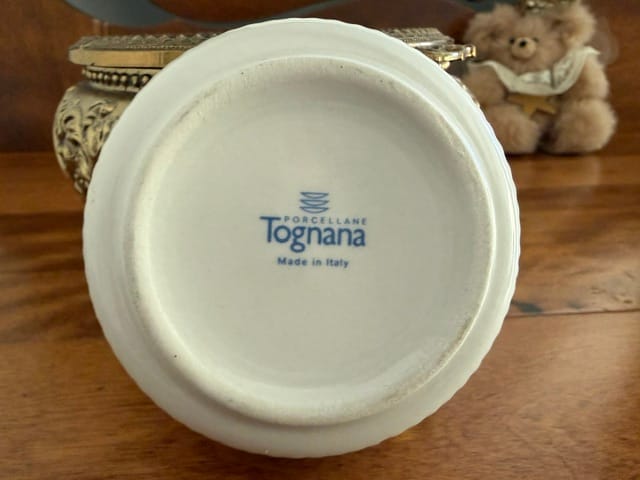
Tognana Porcellane S.p.A. is headquartered in Casier, a small comune in the province of Treviso, approximately thirty kilometres from Castelfranco Veneto. The company’s roots reach back to 1775, when the Tognana family began working in the brick industry — making things from the earth, as they always had. The ceramics company proper was founded in 1946, when two brothers, Clarimbaldo — known as Aldo — and Alessandro Tognana, following the upheaval of the war, set about transforming the family’s brick business into something finer. Aldo had graduated in Civil Engineering from Padua during the war years; the factory they built together would outlast everything that surrounded its founding. Within a few years the company had moved on from producing majolica to porcelain, using traditional methods of firing, sintering, and vitrification. In 1966 — the year Pizzeria Alla Torre opened its doors in the tower at Castelfranco — Tognana inaugurated its modern manufacturing plant at Casier, the facility still operating today. By the 1980s it was one of the largest Italian producers of porcelain tableware, supplying both domestic and commercial (mainly hotels and restaurants) markets through a dedicated catalogue of more than 1600 items. A restaurant in Castelfranco Veneto commissioning a branded ashtray would have been entirely routine business — one small order among thousands, the kind of transaction that left no particular mark on the company’s records, but left a very particular mark on at least one life.
The World in the Dish
Now that we have established where and approximately when the ashtray was made, and by whom, we can begin a deeper inquiry — one that takes us beyond the Tognana factory floor, beyond the Veneto, and far beyond the recorded history of any restaurant or manufacturer. Because the materials from which this small dish was made did not originate in Casier in the 1980s. They originated, in some cases, before the first animal drew breath on this planet.
A porcelain ashtray of this type and period — white ground, gilt edges, decorated with purple grapes, green leaves and brown stems in on-glaze ceramic colours, with gold lettering and a feldspathic glaze fired at temperatures approaching 1,400℃ — would have been composed of the following primary materials: kaolin, feldspar, and quartz in the body; a glaze of similar composition with the addition of calcium carbonate and alumina; and on-glaze decorative pigments of manganese oxide for the purple, chromium oxide for the green, iron oxide for the brown, and a rutile or praseodymium-based ceramic yellow for the gold lettering. The gilt edges, if true liquid gold, would have been applied as a gold sulphoresinate preparation for a final lower-temperature firing. Each of these materials has a history. Each of them has a geology. And each of them, followed back far enough, leads somewhere unexpected.
Kaolin: The White Clay
The body of the ashtray begins with kaolin — a soft, white, aluminum silicate clay. Kaolin is not a primary mineral. It does not crystallize from magma or precipitate from seawater. It is, at its most fundamental, a product of destruction — specifically, the slow chemical destruction of granite under the patient action of rainwater and mild acidity over millions of years.
The granite that would eventually yield Europe’s finest kaolin deposits crystallized during the Variscan orogeny — the great mountain-building collision between the ancient supercontinents Gondwana and Laurussia that occurred roughly 360-300 million years ago, during the late Devonian and Carboniferous periods. This event threw up a chain of mountains across what is now Central and Western Europe, leaving behind the granite plutons of Cornwall, Saxony, Brittany, and the Iberian Peninsula. Those mountains are long gone, worn to their roots by erosion. What remains, among other things, is their clay.
By the 1980s, Italian porcelain manufacturers were sourcing kaolin primarily from three regions: the St. Austell district of Cornwall, where the Cornubian batholith granite yields the purest kaolinite in Europe, which has been mined continuously since the eighteenth century; the Hirschau-Schnaittenbach deposits of the Upper Palatinate in Bavaria, where mining began as early as 1833; and the historic Zettlitz deposits of Bohemia, in what is now the Czech Republic, which had supplied the Meissen manufactory since the earliest days of European porcelain.
The white clay in the Tognana ashtray began as rain, falling on mountains that no longer exist, somewhere between 300 and 34 million years ago.
Feldspar: The Flux
If kaolin is the body’s foundation, feldspar is its transformation agent — the mineral that, under sufficient heat, partially melts and fills the spaces between clay particles with a viscous glass, fusing the whole into the hard, vitrified, non-porous material we call porcelain. This, the most abundant mineral on Earth, weathers over millions of years into a clay that, when fired hot enough, glassifies into something resembling rock.
In the 1980s, ceramic-grade feldspar for Italian manufacturers came from Norway — particularly the Telemark deposits, which supply fine-grained, iron-poor potassium feldspar of high purity; from Turkey’s Aegean region, where enormous reserves of very pure feldspar were already being exported to Italian ceramics manufacturers; and from the pegmatite deposits of the Val Pusteria and Trentino-Alto Adige in northeastern Italy itself, within practical commercial reach of the Tognana factory at Casier.
Quartz: The Skeleton
Quartz is the structural skeleton of the porcelain body — the material that holds the form dimensionally stable during firing, preventing slumping or distortion as the feldspar softens and flows.
Quartz is one of the oldest and most enduring minerals on Earth. The silica used in porcelain manufacture typically derives from quartzite or from sand, which is itself the accumulated product of billions of years of quartz grains surviving the weathering that destroys almost every other mineral. Where feldspar breaks down into clay under the action of water and time, quartz endures.
In the 1980s, ceramic-grade silica for Italian manufacturers came from Sardinian sand deposits, from the fluvioglacial silica sands of the Venetian plain deposited during the Pleistocene glaciations — practically local, in geological terms, to the Tognana factory — and from the high-purity quartz deposits of the Westerwald in Germany. Some silica in this ashtray may have been gathered, in geological terms, almost within sight of where it was fired.
The Glaze: Additional Ingredients
The glaze that gives the ashtray its smooth, glassy surface is essentially a version of the body itself — kaolin, feldspar, quartz — but with proportions adjusted to encourage melting and flow at firing temperature. Two additional materials complete the glaze recipe.
Calcium carbonate — whiting, in the potter’s vocabulary — derives from limestone, which is itself composed of the compressed shells and skeletal remains of marine organisms that lived in shallow tropical seas. The limestone of the Veneto foothills tells this story in stone: the Dolomites began as tropical coral reefs roughly 250 to 230 million years ago, during the Triassic period, when what is now northeastern Italy lay beneath a warm, shallow sea teeming with life. The calcium in the glaze of the Tognana ashtray is, in a sense, the distilled remains of creatures that swam in a sea that covered the Veneto before the Alps existed.
Alumina — aluminum oxide — is added to increase the viscosity of the glaze at firing temperature, preventing it from running off surfaces and improving chemical resistance. It is sourced from refined bauxite, itself a tropical weathering product formed in humid equatorial climates. In the 1980s, bauxite came predominantly from Guinea, Jamaica, and Australia.
The Pigments: Colour from Deep Time
Purple: Manganese, and the Colour of Prehistory
The purple of the grapes on the ashtray’s face almost certainly derives from manganese dioxide or a manganese-cobalt mixed oxide, the standard purple-to-violet pigment in Italian commercial ceramic decoration of this period. It is perhaps the most ancient pigment in human use. Manganese dioxide in its mineral form, pyrolusite, was used as a black pigment for cave painting since the middle Paleolithic, and for the decoration of pottery since the seventh millennium BC. More remarkably still, there is evidence of its use even by Neanderthals, as a colouring material, long before Homo sapiens had established dominance on the planet.
Geologically, the world’s major manganese deposits are sedimentary in origin and predominantly Precambrian to Paleogene in age. The largest European deposits in the 1980s were in the Nikopol Basin of Ukraine, an enormous Oligocene-age shallow-sea deposits formed roughly 30 to 35 million years ago when a warm epicontinental sea covered the region, and at Chiatura in Georgia. For Western European manufacturers, manganese also came from Spain, Morocco, and Gabon, one of the world’s richest sources of high-purity manganese, formed in Precambrian sedimentary basins over 600 million years ago.
The purple on the ashtray is the latest expression of a pigment tradition that predates our species.
Green: Chromium, and the Oldest Rocks
The green of the vine leaves derives from chromium oxide, the standard, stable, high-temperature green pigment of Italian commercial ceramics from the 1980s. Its geological origins are among the most ancient of any material in the ashtray.
Chromium’s primary ore mineral, from primitive basaltic magmas very early in Earth’s history. The world’s largest chromite deposits are concentrated in two extraordinary geological structures: the Bushveld Complex of South Africa, the largest layered igneous intrusion on Earth, covering more than 65,000 square kilometres, intruded nearly 2.1 billion years ago; and the Great Dyke of Zimbabwe, of similar antiquity. When the magma that would become the Bushveld Complex welled up through the ancient Kaapvaal Craton, all life on Earth was still single-celled. The chromite layers settled gravitationally to the floor of a vast magma chamber, forming seams sometimes only centimetres thick but laterally continuous for hundreds of kilometres. In the 1980s, South Africa and Zimbabwe together dominated global chromite production.
The green on the vine leaves began in a seam of Precambrian rock 2.1 billion years old.
Brown: Iron, and the Great Oxidation
The brown of the vine stems derives from iron oxide — most likely a warm ferric oxide, hematite, or a mixed iron-manganese preparation giving the earthy, woody tone appropriate to a grapevine motif. Iron oxides are among the most ancient and abundant mineral compounds on Earth, and their deep history is inseparable from the history of life itself.
The great Banded Iron Formations — visible today in the Pilbara region of Western Australia and the Lake Superior region of North America — were laid down primarily between 2.5 and 1.8 billion years ago, during the Great Oxidation Event. It was then that photosynthetic cyanobacteria first began releasing significant quantities of oxygen into Earth’s formerly anoxic atmosphere. That oxygen reacted with dissolved iron in the ancient oceans, precipitating ferric iron oxides in massive seafloor accumulations.
The brown on the stem of a painted grapevine on a small restaurant ashtray in Castelfranco Veneto is, in its deep history, a record of the moment life changed the chemistry of the planet.
By the 1980s, ceramic manufacturers predominantly used synthetic iron oxides, manufactured to precise colour specifications. Production was centred in Germany, at Bayer AG’s pigment division. Natural iron ochres for warm browns were still sourced from Austria, where the Styrian iron-mining tradition — whose reputation stretched back to the Roman ferrum Noricum, and was celebrated across the ancient world for its quality — continued to produce earthy pigments of considerable depth.
Gold Lettering: Titanium, and the Heavy Sands
The gold-coloured lettering on the ashtray is almost certainly not true liquid gold but a ceramic gold pigment. Most likely it is based on rutile, a form of titanium dioxide, or on a praseodymium-zircon preparation; both produce stable warm yellow-to-gold tones in ceramic decoration, and fire at the same temperature as the other on-glaze colours, making them simpler and considerably less expensive than true gold.
Titanium is the ninth most abundant element in the Earth’s crust. The major sources in the 1980s were the Murray Basin heavy mineral sands of Australia, the coastal deposits of South Africa, and the Kerala coast of India, where titanium-rich sands formed as rivers drained the ancient Deccan Plateau and the Precambrian shield, depositing their heaviest minerals in coastal strand lines across geological time.
The Gilt Edges: Gold, and the Oldest Story
The gilt edges of the ashtray are a different matter from the lettering. If they are true liquid gold — applied as a solution and fired in a final lower-temperature pass through the kiln.
Gold is chemically attracted to iron — which means that when the early Earth was molten, the vast majority of its gold sank to the core along with iron, far beyond any reach. The gold accessible at the Earth’s surface largely arrived later, delivered by meteorite bombardment during the Late Heavy Bombardment approximately 4 to 3.8 billion years ago, when the young solar system was still being cleared of its debris and the inner planets were being struck repeatedly by asteroid-scale impactors. The gold we mine, the gold we fire onto the rims of porcelain dishes, fell to Earth from space before there was any life here to witness it.
The world’s greatest concentration of that ancient meteoritic gold accumulated in the Witwatersrand Basin of South Africa, a deposit approximately 2.7 billion years old, formed when ancient rivers deposited gold-bearing sediments in what was then a shallow inland sea. The Witwatersrand has produced more gold than any other source in history. In the 1980s it was still the world’s dominant producer. That gold was refined by specialist precious metals companies — Heraeus and Degussa in Germany, Colorobbia in Tuscany — and applied in a thin film, perhaps a few nanometres thick, to the rim of a small dish in a factory in Casier, in the province of Treviso, in the Veneto, in Italy, on the planet that received it from the sky four billion years ago.
What the Dish Holds
Set it down on a table — carefully, it is fragile — and consider what you are looking at.
A circle of white porcelain, 3.5 inches (ca. 9 cm) across. A rim of gold. A painted grapevine: purple fruit, green leaves, brown stems. The name of a pizzeria in gold lettering. On the back, in the plain declarative language of manufacturing: “TOGNANA PORCELLANE — Made in Italy”.
That is everything the object announces about itself. It does not mention the rain that fell on Carboniferous mountains 300 million years ago and slowly, patiently, dissolved the feldspar into the white clay that forms its body. It does not mention the 2.1-billion-year-old magma chamber beneath the Kaapvaal Craton of Southern Africa where the chromite that colours its vine leaves first crystallized in the deep dark of a planet that had not yet imagined anything with eyes to see green. Likewise, it does not mention the ancient seafloor creatures whose compressed shells became the limestone that stiffens its glaze, or the Precambrian manganese beds of Ukraine that gave the grapes their purple, or the meteorites that fell to Earth four billion years ago carrying the gold that rings its edge.
It does not mention Casier, or the two brothers who built a factory there in 1946 from the ruins of a war, in the same alluvial territory whose clay had built the walls of Castelfranco centuries before. It does not mention 1966, when the factory and the restaurant opened in the same year, unknowing of each other, in the same corner of the Veneto.
It does not mention the tower, or the lion with its paw on its closed book, or the bats in the ceiling of a room where a young man lived in 1974, or the young woman who stood beneath the tower that summer and did not know she would one day be writing this.
It does not mention Marija, or the war that displaced her, or Italy, where she waited for the papers that would let her leave. It does not mention the ship, or Dina, or the friendship made in a time of war that lasted a lifetime and produced, among other things, a son named Tony who moved to Castelfranco Veneto and made a life in the streets below that tower, where people called out to him as he walked.
It does not mention the clear blue sky of September 2, 1990, or the white linen tablecloths, or the risotto di stagione, or the particular quality of a lunch between two people who have known each other most of their lives and are, without quite saying so, aware that time is passing. Nor does it mention the moment Julie noticed it sitting on the table, functional and unremarkable, and thought it quietly lovely. Nor Tony saying “Go on, take it” — the small, generous permission that set the object on a completely different course from the one it had been manufactured for.
It does not mention Toronto, or Bloor West Village, or Etobicoke, or the hamlet of Gilford, or the return to Etobicoke, or Fergus. It does not mention the bubble wrap, or the thirty-five years of silence, or the December night in 2025 when Tony died and Julie finally told the story to the people who needed to hear it.
Objects do not speak. They do not need to. They simply remain, holding what we gave them to hold, waiting for someone to ask the right questions.
Julie asked. And this, in the end, is what the dish holds: the deep time of the planet that made it, the history of a town that shaped it, the friendship of two women on a ship crossing toward an unknown life, the love of a son who said “Go on,” and the knowledge — quiet, certain, wrapped in bubble wrap in Fergus, Ontario — that some things are kept not because we decided to keep them, but because they decided, in their own mute and patient way, to stay.
─── ❖ ── ✦ ── ❖ ───
Notes and Caveats
On Names
1. The names Julie, Marija, Tony, and Dina are pseudonyms. The individuals are real; their names have been changed at the request of the commissioner of this essay, out of respect for the privacy of those still living and the dignity of those who are not.
On the Lion of St. Mark
2. Several official and municipal sources describe the book held by the Lion of St. Mark at Castelfranco Veneto as open. However, the author’s personal recollection, confirmed by photographic evidence available online, is that the book is closed, with the lion’s paw resting upon it. The discrepancy may reflect the weathered condition of the stone after five and a half centuries, or the propagation of an error through secondary sources. The closed-book reading is presented here as the more accurate account, while acknowledging the contradiction in the documentary record.
Popular tradition, however firmly scholars resist codifying it, has always read a closed book differently: as the mark of a town exempted from taxes for military merits, or granted a degree of self-governance precisely because of its strategic value to the Republic. One vernacular interpretation puts it with characteristic Venetian directness: closing Venice’s book meant turning a blind eye to bureaucracy and tribute. For a frontier march town that had been fought over by Ezzelino da Romano, the Carraresi, and the Scaligeri before Venice arrived, a lion with paw on closed book and tail at rest is perhaps the most historically honest possible emblem: sovereignty acknowledged, taxes forgiven, autonomy quietly preserved.
It is also worth noting that the lion survived Napoleon. When the French arrived in 1797, stone lions across the Veneto were attacked, defaced, or demolished. In Venice alone, around 1,000 lions were destroyed, and across the former Terraferma dominion at least 4,000 were damaged or removed, but the lion above the gate at Castelfranco was not among them. It has presided over that entrance for five and a half centuries, watching the Ezzelini, the Carraresi, the Venetians, the French, the Austrians, and the Italians come and go.
On the Scientific and Material Claims
3. WHAT IS ESTABLISHED FACT: The geological ages and formation processes described for kaolin, feldspar, quartz, chromite (Bushveld Complex, 2.1 billion years), banded iron formations (1.8–2.5 billion years), the Late Heavy Bombardment (3.8–4 billion years), and Witwatersrand gold (2.7 billion years) are well-documented in the geological literature. The Tognana corporate history, founding dates, and manufacturing processes are drawn from the company’s own published records and verified secondary sources. The dates of Castelfranco Veneto’s founding (1199), the tower’s construction (late 12th–13th century), its raising to current height (1339), and the commission of the lion and clock (1499, Pietro Gradenigo) are documented in municipal and regional historical records.
4. WHAT IS PROBABLE, BUT NOT CONFIRMED: The dating of the ashtray to the early-to-mid 1980s is an inference based on converging evidence (Lovato’s 1981 arrival, the “Made in Italy” backstamp, the object’s presence in the restaurant in 1990) rather than a manufacturer’s record. The identification of specific pigments — manganese dioxide for purple, chromium oxide for green, iron oxide for brown, rutile or praseodymium-zircon for the gold lettering — is consistent with documented Italian commercial ceramic practice of the period but has not been confirmed by laboratory analysis of this specific object. The sourcing of raw materials (Cornish kaolin, Norwegian feldspar, Sardinian quartz, Katangan cobalt, South African chromite) reflects established industry sourcing patterns of the 1980s and should be understood as representative rather than confirmed for this specific production batch.
5. WHAT IS SPECULATIVE, BUT GROUNDED: The suggestion that the grapevine motif may be a standard Tognana HoReCa pattern applied to multiple restaurant clients, rather than a bespoke design, is plausible given the company’s documented commercial catalogue approach but cannot be confirmed without access to Tognana’s 1980s production records. The precise gold preparation (liquid gold sulphoresinate versus ceramic gold pigment) cannot be determined without technical analysis; both possibilities are presented.
─── ❖ ── ✦ ── ❖ ───
Some Sources Consulted
On Tognana Porcellane
Tognana Porcellane S.p.A., company history and production information: https://www.tognana.com/en/history/
“Addio a Tognana, il re della porcellana,” Il Giornale, November 2024: https://www.ilgiornale.it/news/politica/addio-tognana-re-porcellana-cento-anni-impresa-politica-e-1872574.html
Tognana, 75 anni insieme, company anniversary publication: https://magazine.tognana.com/75-anni-insieme/
Unioncamere, Imprese Storiche — Tognana Porcellane S.p.A.: https://www.unioncamere.gov.it/imprese-storiche/tognana-porcellane-spa
On Ristorante Alla Torre and Castelfranco Veneto
Interview with Valter Lovato, 2night.it (accessed 2025).
FILA Solutions, case history: Ristorante Alla Torre restoration (2013).
Comune di Castelfranco Veneto, Torre Civica documentation.
On the Lion of St. Mark
Plebani, Tiziana. Il leone di San Marco: storia, miti, simboli. Venice: Marsilio, 2009.
Various municipal and regional sources on Venetian symbolism and the Terraferma lions.
On Casier and the History of the Veneto
Comune di Casier, historical documentation (accessed via municipal records, 2025).
Rolandino of Padua, Chronica Marchiae Trivixane et Lombardie (13th century). Available in various modern Italian editions.
On Ezzelino da Romano
Choppin, Denise. “Fireflies, Mermaids and Skeins of Thread.” Louche Leaves. https://loucheleaves.com/fireflies-mermaids-and-skeins-of-thread/
On Ceramic Manufacture and Pigment History
Hamer, Frank and Janet. The Potter’s Dictionary of Materials and Techniques. London: A&C Black, 2004.
Kingery, W.D., and Pamela B. Vandiver. Ceramic Masterpieces: Art, Structure, Technology. New York: Free Press, 1986.
Etymology of souvenir and keepsake
Online Etymology Dictionary, https://etymonline.com.
On Geology and Deep Time
Hazen, Robert M. The Story of Earth. New York: Viking, 2012.
Zalasiewicz, Jan. The Earth After Us. Oxford: Oxford University Press, 2008.
On kaolin formation
various papers in Clay Minerals and Applied Clay Science journals.
On the Bushveld Complex
Cawthorn, R.G. (ed.). Layered Intrusions. Amsterdam: Elsevier, 1996.
On banded iron formations and the Great Oxidation Event
Canfield, D.E. Oxygen: A Four Billion Year History. Princeton: Princeton University Press, 2014.
On gold and the Late Heavy Bombardment
Bottke, W.F. et al., “An Archaean heavy bombardment from a destabilized extension of the asteroid belt,” Nature 485 (2012).
On Manganese as Pigment
Roebroeks, W. Et al., “Use of red ochre by early Neandertals,” Proceedings of the National Academy of Sciences 109, no. 6 (2012).
Montes-Hernandez, G. Et al., “Mineral pigments used in Palaeolithic rock art,” various sources in Journal of Archaeological Science.
─── ❖ ── ✦ ── ❖ ───
A World in a Dish — The Genealogy of a Keepsake was commissioned as an object biography essay. All research was conducted in 2025–2026.