A Fairy Tale: The Listening Tree
A story of when the distance between a told thing and an untold thing was believed to matter enormously.
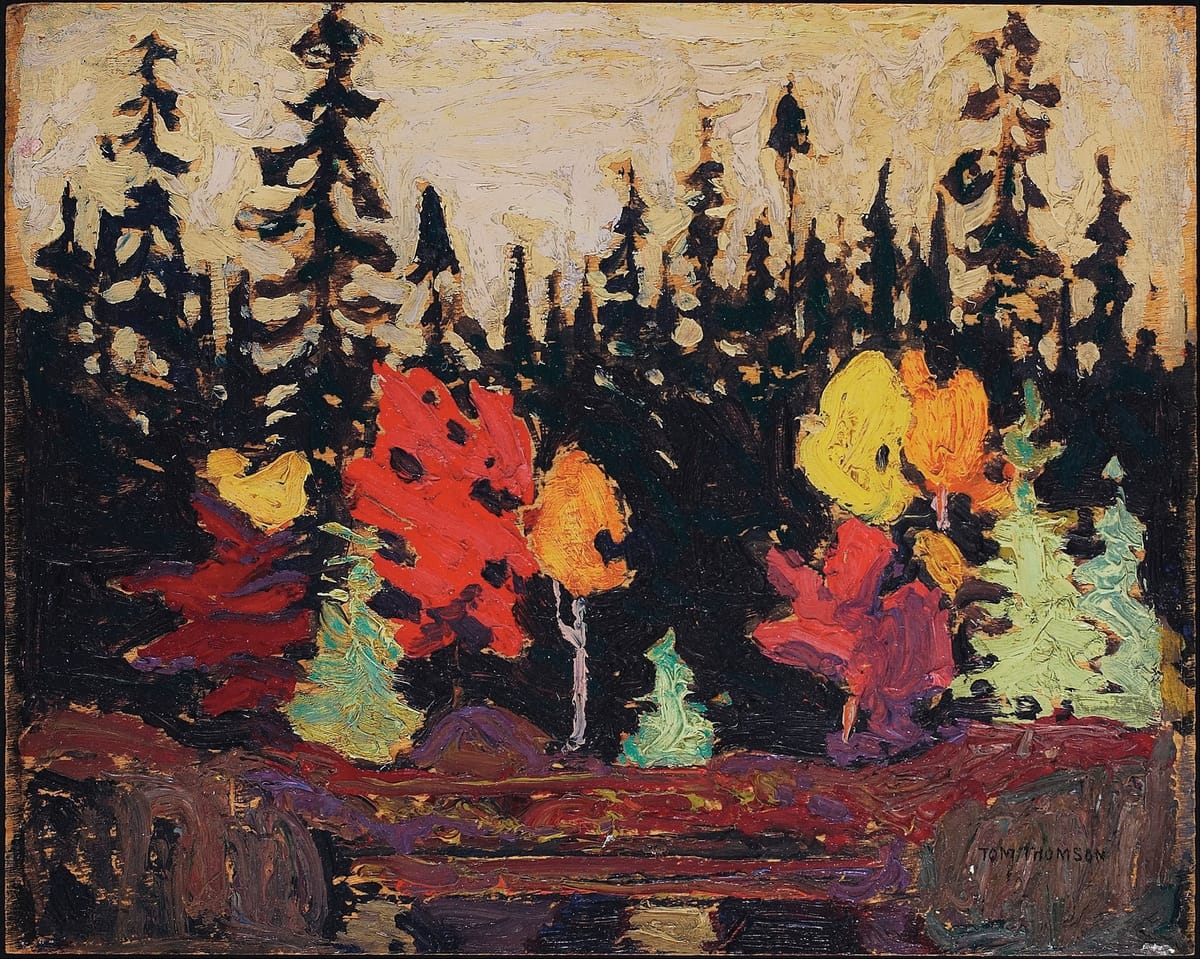
There once was — or there once was not — a girl who was full of stories.
This was not, in itself, unusual. Children are full of stories. But most children find their audience — a grandmother in a chair, a friend beneath a blanket, a dog who will accept anything with equal warmth. This girl was different. Her stories were of a particular weight and texture, neither simple nor comfortable, and the town she lived in was a town that preferred its comforts simple.
She was not old and not young, in that long middle passage of girlhood when the self is forming itself urgently and secretly and requires, above all things, a witness. She lived with her family on the main street of a prosperous and thoroughly unimaginative town — the kind of town that prides itself on knowing what things are and seeing no reason to inquire further. The baker knew bread. The blacksmith knew iron. The aldermen knew, with magnificent certainty, everything worth knowing, and what they did not know they had agreed, collectively, not to need.
The girl knew this was not enough. She had known it since she was very small, in the particular way that certain children know things — not from being told, but from feeling the shape of the absence.
In the beginning, she had tried the way all children try.
She had told her mother a story about the quality of light on winter afternoons, how it came in at a certain angle and seemed to carry something with it — some feeling she did not yet have words for but could feel pressing against the inside of her chest. Her mother, stirring something on the stove, had said: “Mm. Lovely, dear.” And stirred.
She had told her father about a dream she’d had three times — the same dream each time, with the same door at the end of it that she could never quite open — and asked him what he thought it meant. He had looked up from his newspaper with the expression of a man who has been briefly interrupted and said: “Dreams don't mean anything. You’ve been eating too late.” And returned to his paper.
She had told her best friend — the girl she had believed was her best friend — about the way she sometimes felt that the world was made of layers, like the pages of a book pressed together, and that sometimes she could almost feel the other layers pressing back. Her friend had blinked at her and said: “You’re so strange,” without admiration.
After that, the girl stopped trying. She went quiet in the way that certain people go quiet, not from lack of things to say, but from the accumulated understanding that the room is not arranged for what she needs to say in it.
But the stories did not stop. They built in her like water behind a dam — her observations, her questions, her griefs, her sudden inexplicable joys, her long slow thoughts about the nature of things. All of it pressing against her ribs with nowhere to go.
She began to walk to the edge of town, and then a little past the edge, and then further still.
The forest beyond the town was old, genuinely old, in the way that forests are old when no one has bothered to clear them because the ground is too rocky for planting and the slopes too steep for grazing. These are the forests that survive by being inconvenient, and they are the most interesting forests precisely for this reason. The trees here had been growing since before the town had a name, since before anyone had thought to build a town there, since before the word town existed in any language spoken in that valley.
The girl had always known the forest was there. She had not, until now, understood that it was waiting.
She went deeper than she had gone before, following no path — or rather, following the particular path that opens itself to those who need it, visible only to them, made of nothing so crude as cleared ground but of something more like an inclination, a leaning of the air. Following it until she came to a clearing, not quite a clearing, more a thinning of trees, she found the maple.
It was very old. She knew this the way you know certain things: not from evidence you could list, but from the whole of it arriving in you at once. The tree’s trunk was immense, grey-ridged and deeply furrowed, wider than her arms could encompass. Its roots had long since made peace with the surrounding rocks, winding and negotiating and finding their way through in that patient, unstoppable manner of roots, which do not hurry but always arrive. Its canopy was enormous and somewhat battered, with branches lost to storms, others bent at angles that spoke of wind and survival and the slow accumulation of difficult years.
Beneath this tree, the komorebi — a Japanese word for the sunlight that filters through a forest canopy —was deep green and trembling, like light through moving water. Like the light at the bottom of a gentle sea.
The girl stood at the edge of the clearing and felt, for the first time in a long time, that she was in the right place.
She walked to the tree and put her arms around it, as much of it as her arms would reach. She pressed her cheek against the cool, ridged bark.
And she began to tell her stories.
She told it everything.
She told it about the quality of winter light and what it made her feel; about the recurring dream and the door she could never open; about the layers she imagined pressing against the world, the other pages of the book; and about the loneliness of being full of things you cannot put down anywhere; and the particular ache of speaking into a face that is not listening.
The wind moved through the canopy in a way that she chose to interpret as laughter, as she told it funny things, and this seemed right to her.
She told it frightening things — the fears that have no names, the ones that visit at three in the morning and are gone by four, but leave something behind some residue of dread that thinly glazes the day. She told it about sorrow and the moments of unexpected, inexplicable joy that she had no one to turn to and say: “Are you seeing this? Can you feel this?” The joy that had been almost painful for its lack of a witness.
The tree was a witness. Of this she was certain, in a way unlike most everything else.
She came back the following week. And the week after that. Through summer and autumn she came, through winters when the snow lay along the branches and her breath made small clouds against the bark and the forest was silent in the way that forests are never actually silent, just differently voiced. She came in springtime when the tree’s new leaves were the precise, almost aching green of beginning, and she had things to say about that, too.
As she grew, her stories grew with her — changing their shape, becoming more complicated, less certain and therefore more true. She brought her griefs as they arrived: loss, disappointment, the particular wound of not being understood by the people who were supposed to understand you best. She brought her questions, which multiplied rather than resolved. And she brought her joys, which became quieter and deeper as she got older, less spectacular and more sustaining.
The tree held all of it. This she believed with a conviction that required no evidence, because some things are true in a register that evidence cannot reach.
Now let us speak of what the tree was doing, during all of this.
A tree is not a passive thing, though we are accustomed to treating it as one. A tree is a system of almost incomprehensible complexity — a network of chemical communication, of electrical signal, of root connections that reach and interweave with its neighbours in the dark of the soil, sharing what is needed, registering what arrives. What we call the stillness of trees is not the stillness of the inert. It is the stillness of the deeply attentive.
The girl’s words entered the tree in the only way that any experience enters any living thing: as vibration, as pressure, as the warmth of arms around the bark, as the altered chemistry of breath and tears and laughter against the wood. The tree did not understand her stories the way another person would have understood them — it could not parse the words, nor follow the plot. But it registered that she came, and that she came again, and that she came in different seasons and different moods, and always with something she needed to release into something larger than herself.
The tree was, in this way, an archivist. Not of the words, but of the fact of them. The girl’s stories settled into the wood the way that weather settles into wood — not written there in any language you could read, but present, encoded, changed into something that was no longer quite the story and not quite the tree, but some third thing made of both.
Year by year, ring by ring, the tree grew around what she gave it.
She was no longer a girl when she stopped coming.
She had become a woman, and then an old woman — still full of stories, still largely untold, still walking to the edge of town and past it and into the deep forest on the days when what she carried needed somewhere to go. In the end, she had come until she could no more, after which the world continued without her in the way that worlds do.
She died in early spring, when the maple’s new leaves were the green of beginning. Whether this was a coincidence or a correspondence is not a question the world saw fit to answer.
The town barely noticed. The baker knew bread. The aldermen knew what they knew. Now an old woman, the girl had not been understood by the town in life, and she was not mourned measurably by it in death. She had been too strange, too interior, too full of things for which there was no agreed-upon space.
The tree held what she had given it. It went on holding.
Time passed, as it does. The forest grew older and more inconvenient, and then the town grew wealthier and more ambitious, and inconvenience began to look like opportunity.
The loggers came on a morning in October, when the maple’s leaves had gone gold.
They were practical men who knew timber, the way the baker knew bread and the blacksmith knew iron. They looked at the great maple with the assessing eye of the practical man, which sees board-feet at market-rate and nothing else; this is not a criticism — it is simply the perspective of a man who has learned that certain lenses keep you fed.
Saws were taken to the trunk.
Those who were there — and there are always those who are there, watching, not quite part of the work — afterwards that as the tree came down it made a sound unlike the usual sound of falling timber. Not a crack. Something more like a long, deep exhalation, the way a person breathes out when they have been holding something for a very long time and the time has finally come to let it go.
Some said it was a scream. But no one really believed that.
The trunk was stripped and hauled to the sawmill, where it was divided into boards of various widths, pale and fragrant, the heartwood darker than the outer rings, the grain fine and close from those long years of slow growth. The sawmill operator, running his hand along a board, had the strangest feeling — not quite a thought and not quite a memory, more like the edge of something. He shook it off. He was a practical man.
The lumber went where lumber goes: to the makers of things.
A cabinet-maker in a town two valleys over bought a quantity of the boards and set to work. He was a skilled man, methodical and quiet, who worked alone and liked it that way. But as he worked the maple — planing it, joining it, fitting the pieces together with the precise, satisfying logic of the craft — he began to find his mind doing something it did not usually do. He would be in the middle of an ordinary thought and then a different thought would arrive, uninvited, with a kind of weight to it that his own thoughts did not generally have. Thoughts about the quality of winter light. About a door at the end of a corridor that he could not quite open. About the feeling of being full of something with nowhere to put it.
He was not a man given to flights of fancy, and found this unsettling. Yet, he also found, to his surprise, that he did not entirely want it to stop.
The cabinet he made from that wood was sold to a schoolteacher in a village on the other side of the ridge. She was a woman who had spent thirty years teaching children whose stories she had always tried, harder than most, to actually hear. She had the cabinet placed in her sitting room, and in the evenings she would sit near it with her book, and she began to have the strangest dreams — vivid, layered dreams, full of forests and light and the feeling of pressing her face against something vast and patient. In her dreams she told things to something that listened. She would wake with a feeling that was not quite grief and not quite joy — more like the feeling of having remembered something she hadn't known she’d forgotten.
She began, for the first time in many years, to write. The writing surprised her. It had a voice she did not recognize as her own — richer, stranger, more willing to not know things — and she wondered, privately, where it was coming from.
She did not stop.
A house-builder bought the largest timbers. He used them for the beams and framing of a house at the top of a hill overlooking the valley — a well-made house, solid, as houses built with good timber are solid. The family who moved in were ordinary in the best sense: not remarkable people, not particularly given to reflection, but decent and lively and full of the normal noise of life.
They began, not long after moving in, to have the most extraordinary conversations.
The children would come to the table with questions no one had asked them to ask — about the nature of things, about what it meant to feel something no one else seemed to feel, about whether trees could listen. The parents found themselves telling each other stories they hadn't known they had: things from their own histories, long unspoken, that arrived in the evenings without invitation and found they had to be told. The grandmother, who had not spoken much of anything personal in years, began to talk. The grandfather, who had seemed to have nothing left to say, began to hum and then to sing — old songs, half-remembered, their origins unknown to him but the melodies arriving whole and certain, as though they had been waiting inside him all along.
They put it down to something in the house. Something about the place. They could not say what.
“We tell good stories here,” the mother said once, with a note of surprise in her voice, as though good stories were something that happened to other people.
And this was true, although they did not know why.
Here is what the girl would have said, if she had known this would be the afterlife of her stories — not monuments, not volumes, not the grand memorial of the understood and celebrated life, but this: the quiet infiltration of other lives, the dreams of strangers, the songs of a grandfather who didn't know where the melody came from.
She might have laughed. Having a sense of humour about her own obscurity was what she had cultivated out of necessity.
She might have said: This is better. This is closer to what a story actually is — not a thing you own, but a thing that moves.
She might have said: The tree understood.
Or she might have said nothing, only pressing her cheek once more against the bark of something vast and old and listening, and let the thought go the way she had always let her thoughts go — into the wood, into the rings, into the dark and patient archive of a thing that does not speak in any language we recognize, but that holds, nonetheless, everything given to it.
There is a word the Ojibwe people use for the small spirit beings — the insects, the creatures of the leaf litter, the ones we step around without seeing. Manidoosh. From manidoo: spirit. Everything, in that understanding, is a spirit being. Everything is in relation. And everything that receives is, in its way, an archivist.
Perhaps the tree knew this.
Perhaps the girl knew it too, in her wordless, stubborn way — which is why she chose to tell her stories to a tree instead of a person. A person might have half-listened, might have shifted the conversation to themselves, might have offered advice when she wanted only a witness. The tree would not do any of these things. The tree would simply be there, year after year, bark against her cheek, roots in the dark, canopy moving in whatever wind was passing through.
It would hold what she gave it.
It would give it back, in time, in ways she could not have predicted, to people she would never know.
This is, when you think about it, what all stories do.
If you have ever sat in a room and felt the sudden arrival of a thought that did not feel entirely like your own — a feeling, an image, a fragment of something too vivid to have come from nowhere — it is worth pausing before you dismiss it.
It may be nothing. It usually is.
But it may be that the room has a history. That the wood in the walls has rings. That somewhere, in an old country, in a forest that is mostly gone now, a girl who could not find her audience found one at last — patient, rooted, willing — and gave it everything she had.
And the tree held it all.
And then the tree let it go.
Into you.