The Fullness of Stone: A Fairy Tale of What is Needed
A story older than its telling...
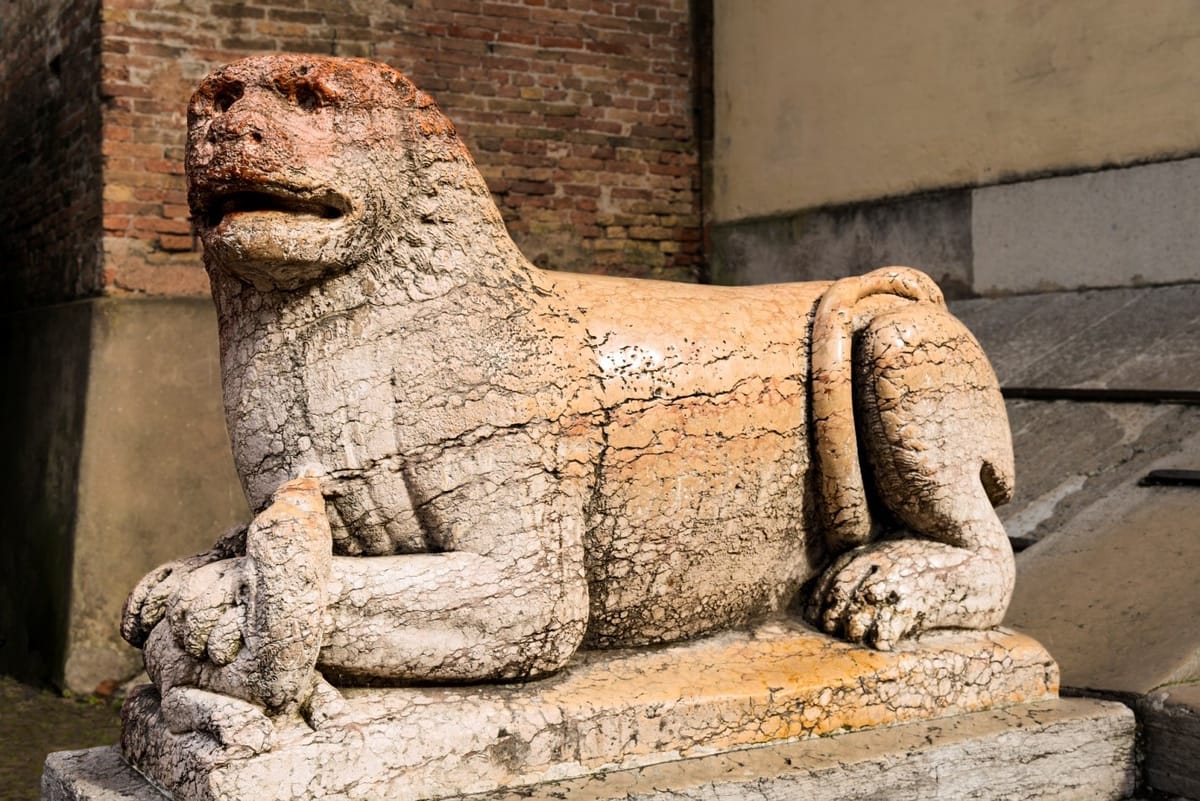
There once was — and there still are — a pair of lions who were not entirely lions.
This is their story, and the story of everyone who ever touched them.
Stay with me here. Where the lions were born is… important…
They came from the mountains north of a city built on a river that curved like a sleeping arm. From where the lower Alps soften and descend toward the Veneto plain, men cut into the earth and found a stone the colour of faded roses — Rosso di Verona — marble that blushed, marble that held within it the memory of an ancient sea.
For this stone was not merely stone. It was time made solid. It was the compressed and transfigured residue of a vanished ocean: of creatures that had spiralled and darted and hunted and died in waters so old the world was still learning its own shape. Locked inside the pink marble were the coiled shells of ammonites — those beautiful creatures whose spiral forms so resembled the curved horns of an Egyptian god that the Elder Pliny himself gave them the name Ammonis Cornua: the horns of Ammon. Locked inside, too, were the streamlined ghosts of the belemnoids — swift, inky, arrow-shaped cousins of the squid — whose bullet-shaped remains the people of many lands would later call thunderstones, believing lightning had made them, hanging them around the necks of children to ward off illness and the evil eye.
Did the ammonites dream, one wonders, coiled in their chambers of shell, spiralling inward toward some soft and secret centre?
Perhaps the stone itself was already dreaming, long before it became a lion.
And the belemnoids, those armoured arrows of the deep — they too persisted, arrow-shaped and inscrutable, caught in limestone. Fish. Shell. And, if one is to be precise about such things: the fossilized remnants of fecal pellets. The pink marble of Verona — exquisite, blushing — was built, in no small part, from crushed fish and ancient shit.
The universe has always had a sense of humour.
Onto this stone, a sculptor put his hands
We do not know his name. We will never know his name. Even if he had scratched it somewhere into the base — in the cramped Latin of a working man — it would bring us no closer to knowing him. We cannot know whether he was a master, or whether he had apprentices who roughed out the shapes while he slept. We cannot know how he came to possess his massive chunks of rose-coloured stone, nor how long he worked to release from within them what was already there, waiting.
Not only that, but we do not know whether he understood what he was carving from.
In all likelihood, he did not know that the pink of his marble was the work of hematite and feldspar, iron oxide bleeding through limestone. He would not have known the names: ammonite, belemnoid. He would simply have known that the stone had a particular quality — a warmth, a depth, a faint luminescence in good light — that other stone did not possess. Perhaps he felt something, working with it. Perhaps his chisel rang differently against this marble than against others. He may have paused sometimes, setting down his tools, and placed his palm flat against the surface for no reason he could have named.
He carved them as females. We can tell by the absence of manes — a choice, or an understanding, or perhaps simply what the stone asked of him. He carved them lying down, front paws extended with a kind of composed authority, tails curled neatly around their haunches. Resting, but watchful. Still, but not passive. There is a difference, and he knew it.
One lion pins beneath her great paw a serpent. The serpent’s head twists backward — a futile, desperate arc — as though attempting to reach the lion’s breast with its open mouth. She does not look down at it. She has no need.
The other holds, with the same unhurried gravity, a human head. Not savagely. Not triumphantly. Simply — as one holds a thing that one has decided to keep.
Both lions wear the expression of creatures who have already weighed the matter and reached their conclusion. They are alert. They are non-threatening.
For centuries, they endured beside the doors of the church in the damp and sun and frost of northern Italy. People passed them as they pass all permanent things — with the easy disregard of the living for the inanimate. Children clambered astride their backs and were lifted down, scolding or laughing voices fading. Old men rested their hands upon them while pausing for breath. Women pressed fingertips against the smooth flank in the absent way one touches something without intending to. Lovers sat on them. Poets contemplated them. Pilgrims prayed nearby and, without thinking, reached out.
I, who tell you this story now, touched them repeatedly for years.
Tens of thousands of hands. Hundreds of thousands of touches. The lightest brush of a child’s palm, the full weight of a sleeping drunk, the reverent press of a dying woman who had come to say goodbye to a city she had loved.
The story becomes more than history
For the sculptor — that nameless man with his callused hands and his ringing chisel — had done something in the making of these lions that he had not entirely intended, and perhaps had not understood. Whether it was the particular quality of the stone, already so ancient and so full of vanished lives, or whether it was some quality in the man himself — his patience, his loneliness, the long hours he spent with no company but the emerging faces of the lions — I cannot say.
What I can say is this: he had given them the capacity to receive.
Not to speak. Not to move. Nor to warn, protect or avenge, though they held beneath their paws the instruments of all of these things.
Simply to receive. To absorb. To hold.
Every person who touched them left something behind. Not a name — names are too thin, too brittle for this kind of keeping. Not a memory, precisely, though memory was part of it. What they left was something more like the essence of having been alive at a particular moment: the weight of grief still fresh, the electric current of new love, the dull grey sediment of an ordinary Tuesday, the terror of a child separated from its mother in a crowd, the quiet pride of a man who had just done something decent when no one was watching.
The lions held all of it.
They became, over the centuries, smooth and silky and shined to a soft sheen — not merely from the friction of human hands, but from the accumulated warmth of human lives pressed into the rose-coloured stone. On certain days, in certain lights, a person standing nearby might feel, without being able to say why, a sudden inexplicable sense of company. As though the air around the lions was faintly, warmly occupied.
As though something in the stone were listening.
As though something in the stone — coiled in its ancient chambers, arrow-shaped and patient, dreaming its long prophetic dream — were, after all this time, about to answer.
Something truly wondrous happened
There is a moment — though moment is too small a word for it — when a vessel, filled to the last possible measure, changes its nature entirely.
Not by breaking. Not by overflowing. But by a kind of quiet internal revolution, so subtle that the world outside continues without interruption: the pigeons still peck at the cobblestones, the bells of the nearby church still count out the hours, a pair of tourists still pass with their cameras raised and their eyes half-elsewhere. Nothing visibly shifts.
But something in the stone decides.
It is not a thought, precisely — not in any language a human tongue could form. It is older than thought. It is the kind of knowing that belongs to creatures who navigated by pressure and current and the faint electrical signatures of other living things moving through dark water.
The stone knew it now.
Enough, said the stone, in the way that stone speaks — which is not in words, and not in silence, but in something that lives in the seam between the two.
Enough receiving; it is time to give
Consider what they held between them, these two pink lions on their plinth in the cool of a northern Italian morning.
They held the first drowning love of ten thousand adolescents, love so new it had not yet learned to protect itself. They held the love that comes later — the steadier, more interior thing, like the long faithfulness of rivers — and the grief that arrives when that love ends.
They held fear in all its registers: the shrieking, animal fear of the body in danger, and the quieter, more corrosive fear of a life half-lived, and the very particular dread of a person who has looked into the future and found it opaque. They held the trembling, bright-edged fear of the writer who has scribbled something and does not yet know if it is good.
They held rage — centuries of it — the clean hot rage of the wronged, and the sour, self-consuming rage of the resentful, and the cold, architectural rage of those who have decided to endure rather than act.
They held wonder in extraordinary quantities. A child’s first snow. A woman seeing the sea for the first time at forty-three. A monk in the hour before dawn when the quality of darkness changes and becomes, briefly, sacred. A scientist in the instant before the result was confirmed, when possibility was still infinite and the universe still generous.
They held shame. They held relief. They held the hilarious, undignified, entirely private joy of a person dancing alone in a kitchen. They held the last thoughts of people who had touched the lions in the full knowledge they were dying, thoughts that were, more often than not, surprisingly simple: a face, a smell, the quality of light on a specific afternoon, the wish to have said something, the wish to have said nothing, the wish merely to remain.
All of this — and ten thousand gradations between and beyond — was held in the rose-coloured stone, packed into its ancient matrix of shell and iron and the compressed memory of an ocean that no longer existed.
The lions were full.
So they changed their nature
The giving was not indiscriminate. This is important. The stone was not simply a cistern that would flood whoever opened the tap. What moved now from stone to skin was not random, not arbitrary, not a matter of chance.
The stone — or the spirit of the stone, or the accumulated consciousness of everything the stone had been and held and known — understood, in the way that the deepest things understand, what each person required. Not what they wanted. Not what they had come looking for, because most people come to a thing like a marble lion looking for nothing more than a photograph, a moment’s rest, a story to take home. But what they needed — that other thing, the thing running beneath the surface of life like an underground river.
A young man laid his hand on the flank of the lion who held the serpent. He was twenty-one and had not slept properly in two years and could not have told you why. What passed from the stone into his palm was a single emotion, simple and enormous: the bone-deep, uncomplicated relief of being understood. He stood there for a moment longer than he had intended. He could not have explained why his eyes were suddenly wet. He walked away changed — not fixed, not healed, but carrying something newly possible.
A woman of sixty pressed her fingertips to the lion’s paw on a January afternoon when the piazza was nearly empty. She had been angry for so long the anger had become structural, load-bearing — she was afraid that without it, she would simply fall. What the stone gave her was not peace — she would have rejected peace, would have found it an insult. What it gave her was the rage of every other woman who had ever been wronged and held the wrongness in her body and continued regardless. The immense, blood-warming solidarity of it. She did not know what had happened. She only knew that she felt, for the first time in years, less alone in her fury. This made the fury, paradoxically, lighter. She carried it differently after that. More like a lamp, less like a burden.
A small girl, escaping her parents' grasp with the boneless agility particular to small children, flung both arms around the neck of the second lion — the one who held, with such equanimity, the human head — and pressed her cheek to the cool smooth stone. She had not intended anything. She never does. What the stone gave her she would not be able to identify or articulate for another thirty years, when she would find herself in the middle of a difficult decision, faced with competing loyalties, and would feel rise in her, from some deep unaccountable source, a certainty as quiet and immovable as marble. She would not know where it came from. She would trust it anyway.
So it went and so it continues
The stone gives now — patiently, precisely, without fanfare. Not every touch carries a gift of equal weight; some people need only a moment’s warmth, and warmth is what they receive — a faint, inexplicable sense of consolation, gone almost before it has arrived. Others receive something that will take years to fully open, like those seeds that require a winter before they know how to become flowers.
The lions lie there still: front paws extended, tails curled in their ancient composition of restful authority. One subduing the serpent. One keeping the human head. Both alert. Alert to what is needed.
Both full of the world, and giving back what is needed, one touch at a time.
My inspiration for this story was born from real sculptured lions in Treviso, Italy. I've written about their "real" history before. In my heart, I prefer this weaving of their history. If you wish, you can read more about them here:
 Denise Choppin