A Frenchman in Dog Canyon
The Recovery of François-Jean Rochas, Known as Frenchy
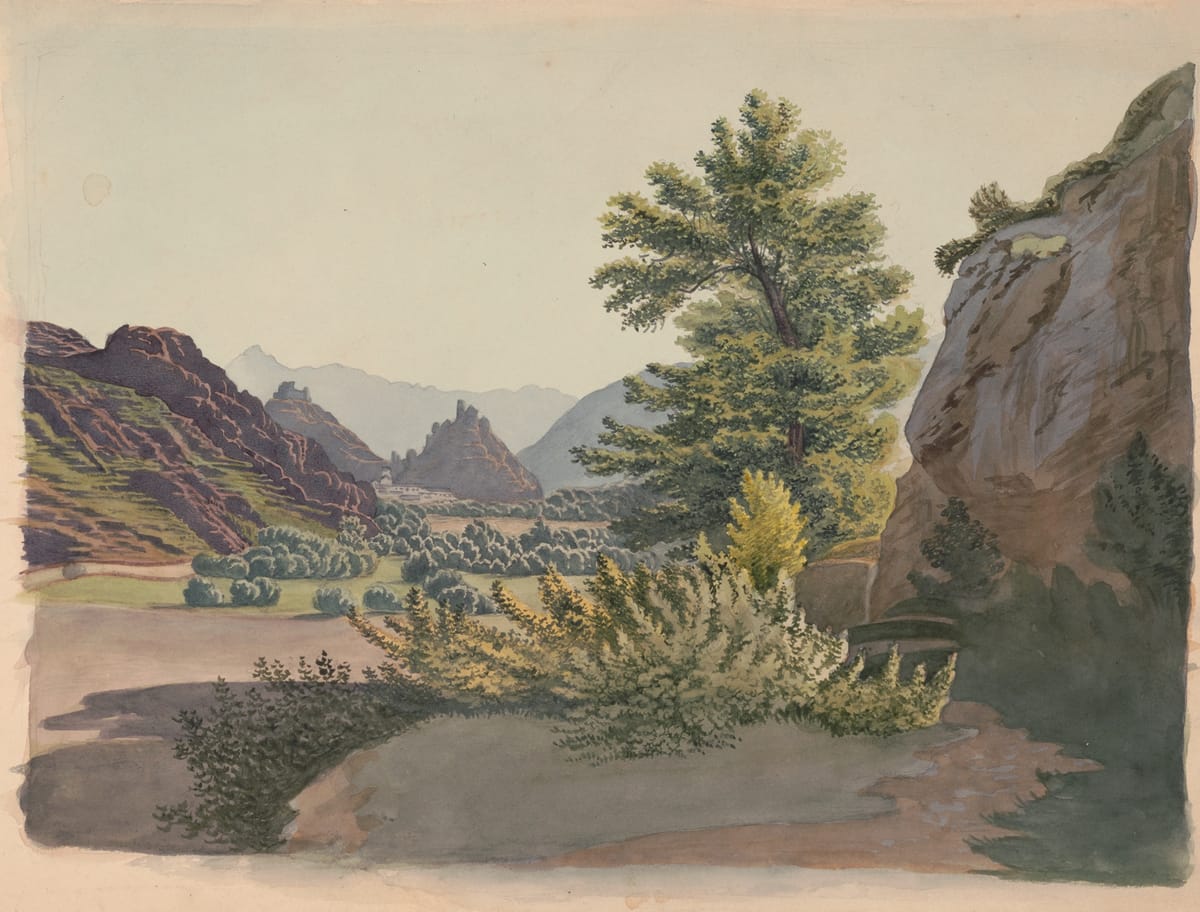
INTRODUCTION: WHY ROCHAS?
What do we even call the man? He went by and was known by several names; some he adopted himself, others mistakenly attributed to him. Rochas, Rocha, Rochez, Roch, Roche, François, Frenchy, Frenchie, and lastly and simply Frank. A relatively large number of individual pieces have been written about him, though rarely at length. Most are merely repetition of previous facts, legends, local colour, and primarily address his murder. The histories in print tend to be circular, ending up like refried beans — which he likely ate in New Mexico — an amalgam with no discernible separate parts.
Such is often the destiny of an endling. Because that is exactly what he was.
The word endling was coined in 1996 in a letter to the journal Nature, to describe the last known individual of a species or subspecies — Martha, the last passenger pigeon, who died in the Cincinnati Zoo in 1914; Benjamin, the last Tasmanian tiger, who died in Hobart Zoo in 1936; Lonesome George, the last Pinta Island tortoise, who died in the Galápagos in 2012. The word has migrated, as useful words do, beyond its strictly scientific application. I have written elsewhere about people I call endlings — Doll and Ruby Easton, twin sisters whose branch ended with them; Emalyn Smith Burney, recovered from a newspaper archive. The endling, in this extended sense, is the last witness to a particular configuration of human life.
François-Jean Rochas was also an endling in this sense, and in a sense that goes further. He was the last of his immediate line in the New World — unmarried, childless, his branch ending in a stone cabin above the Chihuahuan Desert. But he was also the last of a particular human type in a particular place: the solitary French settler at Dog Canyon, an ecological and human niche that closed the moment he died.
We don’t know what he looked like. Had he been exceptional in some physical way — extremely tall, short, fat, skinny, a redhead, a blonde, with a bushy luxurious beard, piercing blue eyes — there would have been some mention. But no; so we can likely conclude that he was a middling sort, brown hair with brown eyes, of average stature and girth. The desert eventually wrote itself on him — the wind-reddened face, the bald head, the aged skin — but that was the landscape’s work, not nature’s original gift.
The historian Bernard DeVoto — Pulitzer Prize-winning chronicler of the American West, born in Utah, who knew the frontier from the inside — argued, in a passage I recall reading (though cannot now locate precisely), that Western frontier life in the 1880s and 1890s was not the showcase of rousing adventure and rough justice that Hollywood would later have us believe. It was, in his view, a world of loneliness, hardship, and social deterioration. The sentiment, whatever the exact words, is consistent with everything DeVoto wrote about the West — and with everything that happened to François-Jean Rochas.
Why should I, of all people, choose to write about Rochas, four decades after a one-time visit to his remote cabin? Perhaps the answer lies in a sense of kinship. He and I both landed in the same place and we both came from Europe via Canada. Prior to living in New Mexico, I had for eleven years resided in Old Europe, in the plains near the Alps. in a climate of damp. The sky in northeastern Italy was often a milky white, bluish like breast milk. New Mexico was a stark and penetrating blue. The landscape in Europe, for us both, was settled and steeped in history. New Mexico was raw. Both he and I went to Santa Fe, and likely he felt some comfort with the buildings and history there, much as I did. Yet, I suspect for him and certainly for myself, New Mexico held a glittering promise of raw excitement, and a history that was not settled in an obvious way, but that would require some deep attention to discern. He had no kin in New Mexico, nor did I. He spoke French — not Spanish. His neighbours had mostly Irish or British ancestry, or were Spanish by way of Mexico. I had French ancestry, had lived the better part of my life in Europe, and had no connection whatsoever with the cowboys and Mexicans of Southern New Mexico. I spoke English, but a variety and with an accent not typical of the area. My clothing and demeanour were not typical. I think that both Rochas and I gave a certain impression — like unicorns with negative charisma. In that sense, we may be kin.
What would have prompted a Frenchman, in his prime, to leave France for the New World? He had a skill, a profession — he was a craftsman. His family was reasonably well-educated and likely not financially challenged; they had the wherewithal to hire New York City lawyers to investigate his death. One presumes Rochas paid his own passage to Quebec. There appears to be no indenture. He was able to book lodging in a relatively pricey Santa Fe establishment once he arrived there. He somehow acquired cattle and amassed a respectable herd.
Was his destination originally Quebec? Once he arrived, did he find the market for a skilled carpenter not what he had hoped for? Was Quebec, now under the English, not to his liking or to his expectations? Did a chance conversation in the stone streets of Quebec City mention the romance of New Mexico? Had he read about the Western Frontier in some French equivalent of a dime novel? Had he heard about Lamy and other Frenchmen recounting the living of their dream during a sermon or a conversation with fellow parishioners back home? Was his carpentry association buzzing about the New World?
Many of these questions are unanswerable.
But in these pages, I will try to uncover what truths endure.
PREFACE: AN INVENTORY
A good biography starts at the end, or so I’ve been told.
Someone had to do it. Two days after -the Frenchman was found, a local stockman named David Sutherland rode out to Dog Canyon and catalogued what was left of a man’s life:
1 lamp. 2 ropes. 2 bottles olive oil. 4 glasses (drinking). 1 pants (worn).
That, and a set of carpentry tools so extensive and so fine that they tell a story all by themselves — 19 moulding planes, trammel points for drawing large circles, saws, and chisels and gouges and a draw knife, the complete toolkit of a master craftsman. The tools are not consistent with the worn pants. But then, nothing about François-Jean Rochas was entirely consistent with anything else about him.
He had been dead for two days when Sutherland arrived. The Justice of the Peace, a blacksmith named Faustino Acuña, had assembled a coroner’s jury, ridden out to Dog Canyon, made his observations, and ruled that Frank Rochas had died of a gunshot wound in the breast. No human agency was mentioned. It was December 1894. It was, in the language of the frontier, a suicide ruling by omission. Everyone in the Tularosa Basin knew better, and possibly nobody said so out loud.
The olive oil is the detail that stops me.
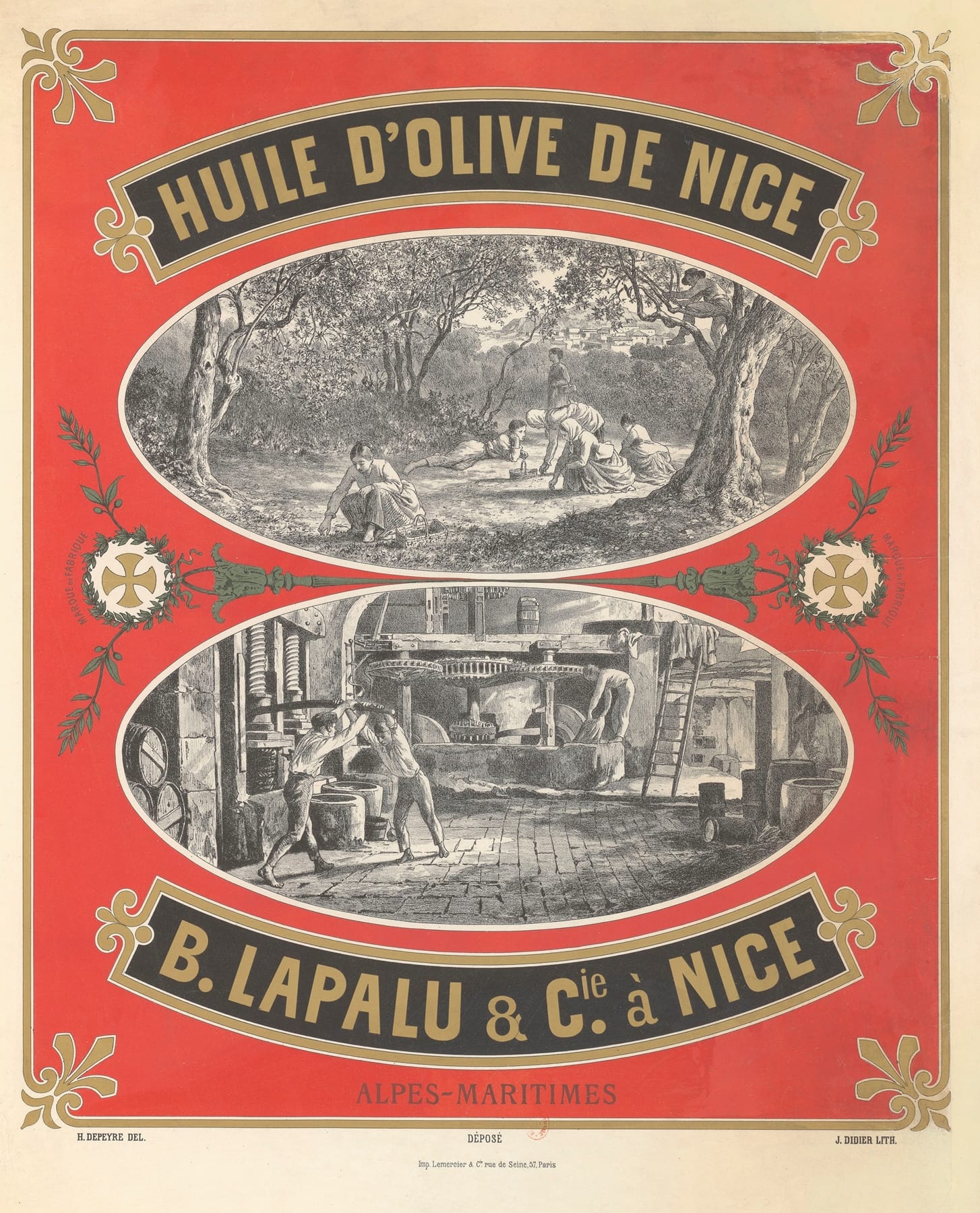
Two bottles of it, carried at considerable effort and expense from somewhere olives could actually have grown — probably through the French supply networks of southern New Mexico — into a one-room stone cabin at the mouth of a desert canyon in the Sacramento Mountains of New Mexico. A man does not keep olive oil if he has given up caring about how things taste. A man does not keep olive oil if he has stopped being, in some essential and private way, French.
He had been in New Mexico for roughly fifteen years. He spoke broken English. He wore rough clothes. He came only occasionally to Las Cruces, and when he came he traded at Theodore Rouault’s store and visited Father Lassaigne at St. Genevieve’s and sometimes saw Numa Reymond, the Swiss merchant who ran the stage line. He was known, in the way that difficult solitary men are known in small communities — by silhouette rather than substance. Stocky figure. Balding head. Wind-reddened face.
His name was François-Jean Rochas. He was born on 22 September 1843 in Vif, in the Isère department of southeastern France, and he died on the day after Christmas, 26 December 1894, in Dog Canyon, New Mexico, when three men rode up to his cabin and called him to the door.
He came out with his rifle. He knew what they had come for.
He cursed them in French and broken English, and one of them reached for his gun.
This work is a counter-inventory. It is an attempt to put back what Sutherland’s list left out — not just the olive oil and the tools and the four drinking glasses for a man who had no visitors, but the life that preceded and surrounded and finally ended at that cabin door. It is an attempt to restore to a man who has been largely erased — first by the silence of the frontier, then by the legend that swallowed what was later called a miraculous staircase — the dignity of a full biography.
The word for what was done to Rochas, in the classical tradition, is damnatio memoriae — condemnation of memory, the systematic erasure of a person from the historical record. In Rome, it was a formal punishment decreed by the Senate against disgraced emperors: their faces chiselled from monuments, their names struck from inscriptions. In Dog Canyon, it was less formal but no less thorough. The men who allegedly killed him were known. A Pinkerton detective named William Sayers investigated in 1896, interviewed a cattle rustler named Eli Miller in the Territorial Prison at Santa Fe, and reported the names of the killers to the governor. The governor filed the papers. The papers stayed filed.
A legend filled the space where the man had been.
Rochas had, some years before his death, built the helix staircase in the Loretto Chapel in Santa Fe — a work of such extraordinary spatial precision that it has been attributed, for over a century, to Saint Joseph himself, appearing in answer to the nuns’ 9-day novena, building over night, then vanishing without collecting his pay. The miracle story is a good one. It has generated television films and young adult novels and episodes of Unsolved Mysteries. The chapel, now a privately owned museum, receives hundreds of thousands of visitors a year. Few of them, contemplating the stairs, know whose hands made it.
PART ONE: ORIGINS
Vif
The Gresse valley in the Isère department of southeastern France is the kind of place that closes around you. To the west, the limestone escarpment of the Vercors Massif rises several hundred metres above the valley floor, cutting off the afternoon sun for much of the year. The Gresse river runs through from the high plateau above, cold and fast and loud — a limestone river, clear and slightly chalky-smelling, the kind of river that never entirely leaves you once you have grown up beside it.
Vif sits at an elevation of perhaps 300 metres, enclosed, green, and in Rochas’ time home to approximately 2,426 souls in 1846, a figure that had barely changed by 1872 when the population stood at 2,506. Eighty additional people in 26 years. A town that was essentially static, neither growing nor declining, the same families in the same houses, the same faces at the market. For a man made for a different scale of landscape, that stillness could be its own kind of pressure.
It was a viticultural community: 245 hectares of vineyard in 1860, the vines climbing the valley slopes, the harvest arriving in late August and September in a flood of fermentation smell that would have been the olfactory signature of his birth month. He was born on September 22, 1843. The grapes’ must would have been fermenting in the cellars.
The family had been in Vif for generations. His paternal grandparents — Pierre Rochas and Marie Anne Murian — married in Vif on 6 November 1810, thirty-three years before François-Jean was born. The bells of the Église Saint-Jean-Baptiste rang for their wedding. They would ring throughout his childhood. The family roots in the Gresse valley ran at least four generations deep before he left. On his mother’s side there was an additional Rochas connection: Anne Victoire’s own mother was Anne Rochas Lancy — which means François-Jean carried the Rochas name on both sides, his father’s line and his mother’s mother’s line converging in the same valley.
His father was François Charles Rochas, born in 1814 in the nearby hamlet of La Merlière — a smaller settlement within the commune of Vif, not the town centre itself. His mother was Anne Victoire Chaulon, born in 1816 in Uriol, described in the civil records as a cultivatrice — a working farmer. They married on 23 November 1842, witnessed by Joseph Bonnet, Claude Chaulon the bride’s brother, Jean Baptiste Gautier the letter-carrier, and Joseph Murian — cultivator, first cousin of the groom, a member of the same Murian family into which Rochas’ grandmother had been born. The two families had been intertwined across at least two generations. François-Jean arrived the following September.
He was the eldest of six children: François Jean (1843), Victoire Joséphine Henriette (1846), Joseph Charles Henri (1849), Pierre Auguste (1852), Léon Charles Eugène (1855), and Marie Pauline (1858). Victoire Joséphine Henriette married late — to a widower named Laurent Célestin Griat in November 1884, at 38 years of age — and produced a son, Emile Joseph Célestin Griat, born 22 December 1886 in Vif. This Emile was Rochas’ nephew, born in the valley while his uncle was in the canyon, the child who carried the closest bloodline forward in the Gresse valley. A 1984 Bulletin article about Rochas was researched and published in Vif, which means someone in the valley knew enough to write it. That someone was almost certainly a descendant of this branch. François Ribaud, who is recorded as a French descendant who visited New Mexico to trace his ancestor, may have been Emile’s grandson or great-grandson.
The church
The Église Saint-Jean-Baptiste de Vif was Rochas’ parish church. He was almost certainly baptized here within days of his birth — French Catholic practice required prompt baptism. His parents had married here. His grandparents had married here. The building is Romanesque in origin, founded as a Benedictine priory in 1035, with a nave built in the 13th century modelled on the Cathedral of Notre-Dame de Grenoble. Three aisles, two side galleries, a choir apse, and two towers — substantial for a town of 2,500.
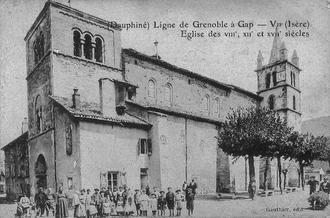
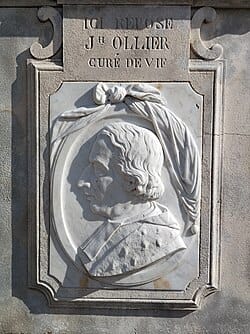
The curé during nearly the whole of Rochas’ life in Vif was Joseph Ollier, who served from 1850 to 1874 — from the time Rochas was seven until after he had left for the New World. Ollier was an honorary canon of Saint-Louis de Grenoble. After lightning struck the apse in 1857, when Rochas was fourteen, Ollier oversaw major repairs and commissioned the painter Alexandre Debelle to paint the apse and choir with standing evangelists, medallion symbols, a sky of azure scattered with golden stars, and the inscription Gloria in excelsis Deos on the arch. He was Rochas’ priest for his entire adult life in Vif.
In the north aisle of the church stands an altar dedicated to Saint Joseph — the patron saint of carpenters, the saint whose novena the Sisters of Loretto would later pray to when they needed someone to build their staircase. Rochas grew up praying in a church with a Saint Joseph altar. Here I simply note it without overloading the observation.
Embedded in the wall of the church clocher is the repurposed tombstone of a Vif blacksmith, dating from the 15th century, bearing a horseshoe, pincers, a hammer, and a sword grip in the form of a trefoil cross. A blacksmith memorialized in the church wall of his childhood; and later a blacksmith named Acuña would rule on the manner of Rochas’ death 60 years later. Not a connection, but a coincidence, noted with a light hand.
The bells
The church bells marked the canonical hours — matins, lauds, vespers — structuring every day for the entire community. In a 19th century French Catholic village, the bell was the auditory skeleton of daily life. Every significant moment — birth, death, marriage, the elevation of the Host at Mass — was announced by bells.
Two bells are specifically documented during Rochas' lifetime. A bell dated 1666 was ringing when he was born and throughout his childhood. And Curé Ollier purchased a great new bell in 1863: Eugénie-Marie-Pauline, cast by the Burdin Aîné foundry in Lyon, giving an E note, diameter 1.21 metres, weight 1,300 kilograms. Its inscription reads De coelo in coelum vocat — From heaven to heaven it calls.
This was the bell of his adolescence and young adulthood. From age ten to age 29, from 1853 until he left in 1873, he heard it every day. Dog Canyon had no bells. When he occasionally made his 65-mile journey to Las Cruces — to Rouault’s store, to Lassaigne’s church at St. Genevieve’s — the sound of church bells in a desert town would have arrived with the specific force of something long absent. Not nostalgia exactly. Something more bodily than that. The sound that had structured every day of his first thirty years, suddenly present again. He would have heard it in Las Cruces. He would have heard it in Santa Fe. In Dog Canyon, never.
The dialect
The language Rochas spoke at home was not specifically French. It was the patois of the Gresse valley — Dauphinois du Nord, a dialect of the Francoprovençal language family, which is not a dialect of French, but a separate Romance language related to both French and Occitan. He would have thought of it simply as le patois — the local tongue. Standard French was the language of the school, the notary, the written letter, and the formal church service.
The patois was his first language. French was his second. Spanish was his third, acquired in the working community of Las Cruces and the Tularosa Basin. English was his fourth, and he never mastered it.
When he cursed his killers “in fluent French and broken English,” he was working through his language hierarchy in reverse order — most fluent at the deepest level, least fluent at the most recently acquired. The deepest language, the one he would have reached for had he had time to think, was the Gresse valley patois. That nobody present would have understood a word of it is either a final joke or a final solitude, depending on how you read it.
The wind at Vif
The Gresse valley had its own named winds. The Bise — a cold dry wind from the northeast, channelled between the Jura mountains and the Alps — blew through the Grenoble region throughout the year. It has been specifically associated, in the meteorological and medical literature, with headaches. The Foehn came off the Vercors — warm, sudden, dry. The Mistral’s influence reached east from the Rhône valley during high-pressure events.
Vif was windy in the way that enclosed alpine valleys are windy: episodically, dramatically, with named winds that arrived with force and then left. Between visits, the valley was still. The wind in the Gresse valley was a visitor. It came and went. This matters for what was coming. Rochas knew wind. He had not known wind like Dog Canyon.
The fog — a personal note
I know the enclosed world that Vif describes. In Treviso, in the Veneto plain below the Alps where I lived for many years before New Mexico, the winter fog can settle for weeks at a time — not days, but weeks — without a single hour of sun. It lies on the plain like a held breath. The sky absent. The horizon erased. A world reduced to a few metres in every direction.
Rochas grew up in a version of this world. I lived in another version of it. We both left it for New Mexico, where the sky is never absent, and the horizon is never erased, and where the light arrives every morning like a verdict.
The mother
Anne Victoire Chaulon, cultivatrice, died on 27 August 1878 in Vif, aged 61 years, witnessed in death by her husband François Charles. Her son François-Jean was in New Mexico. Whether he knew promptly or learned later or incorporated it into his understanding of why return was impossible, we cannot say. But the date is there. August 27, 1878. In Vif. His mother died and he was in the desert.
The Quality of Everything
Before we follow him onto the ship, it is worth pausing to consider what he was leaving behind — not emotionally, which is beyond recovery, but sensorially, which is not. Because the contrast between the world Rochas grew up in and the world he ended up in is one of the most extreme available on Earth without leaving the temperate zones.
Light
The Gresse valley receives approximately 2,065 sunshine hours per year. This sounds adequate until you understand what the remainder looks like. The Vercors escarpment closes the western horizon, intercepting the afternoon sun for much of the year. The frequent cloud cover means overcast days are common, and on overcast days the light is diffuse and grey-green, arriving from all directions simultaneously rather than from a single source. It is a soft, mediated, European light.
Dog Canyon in the Tularosa Basin of New Mexico receives roughly 80 percent more sunshine hours per year than the Gresse valley. The sky at 4,400 feet (1,341.12 m) of elevation in the Chihuahuan Desert, with its thin dry air and minimal water vapour, is a different sky. It is a deep-saturated blue at the zenith, almost violet. The shadows are absolute. The sunlit rock is white or pale gold. There is no gradation between them.
I lived in Alamogordo, a nearby town, in the early 1980s. I know this light. It is not the light of the Gresse valley. It lands on you like a physical force. Edward Abbey described arriving in the Tularosa Basin “with a kind of force and clarity that seemed not natural but supernatural.” That is exactly right.
In the clear desert air at this altitude, UV radiation is approximately 50 percent higher than at sea level. At 12 degrees of latitude closer to the equator, with the clear atmosphere of a desert almost devoid of humidity, ground reflection from limestone walls, and the white gypsum of White Sands to the west, the aggregate UV exposure at Dog Canyon was probably 2–3 times what Rochas had experienced in a lifetime in Vif. He had no sunscreen. The concept did not exist. The wind masked the burning sensation constantly. The consequence, accumulated over a decade of outdoor manual labour, was a face and hands that looked considerably older. He was 51 when he died, described as “an ailing, aging foreigner.”
Sound
The Gresse valley in full summer was acoustically dense. The river provided a constant baseline. Above that, church bells at the canonical hours, cowbells, and sheep bells on the upper slopes in summer, the full European dawn chorus of blackbirds, thrushes, finches, and the cuckoo — that most recognizable sound of European spring, the sound that Keats and Wordsworth both reached for when they wanted to say this is home. And human sounds: carts on stone streets, voices, the rhythmic sounds of the wine press in harvest season, the cement works at Genevrey-de-Vif after 1857, and the ambient noise of over 2,000 people living in proximity.
I remember the sounds of Dog Canyon differently. Wind. Mostly wind.
Some say the wind howls, or it shrieks, that it is mournful, but my experience in Dog Canyon and the surrounding area is that the wind is a sustained breath, close to the sound of a seashell pressed against the ear. It is a constant, and varies only when it encounters or goes around an obstacle in its path. The wind is immense, operating on a different timescale; where our breath is measured in seconds or minutes, the breath of that wind, in that place, is measured in seasons and decades.
Rochas had known wind in France, but its presence in Dog Canyon would have had a very different aura. In France, the wind was a frequent visitor, but never a constant companion. This Apache wind — because it is truly from their creator, as we shall come to — has a different quality altogether.
To digress slightly into the more grounded scientific research: there is credible medical, epidemiological, and psychoacoustic literature that directly links constant desert winds to both physiological and psychological distress. In 2022, paleo-anthropologist Alex D. Velez published a peer-reviewed study in Historical Archaeology titled “The Wind Cries Mary: The Effect of Soundscape on the Prairie-Madness Phenomenon.” His research showed that the unrelenting, low-frequency sound of wind across open plains and high deserts can trigger acute hyperacusis — extreme sensitivity to environmental sounds. In isolated settings, where there are no urban noises to mask it, the constant acoustic friction can manifest clinically as severe insomnia, chronic irritability, depression, and, in historical cases of isolated settlers, violent mental breakdowns. Prairie madness was real, and the wind was part of its mechanism.
Some clinical research into meteoropathy suggests that sustained high-velocity winds may chemically alter the air. Strong winds create an excess of positive ions in the atmosphere by frictionally charging dust particles. Some medical literature indicates that inhaling air heavily laden with positive ions may trigger an overproduction of serotonin in the human brain, leading paradoxically to anxiety, migraines, nausea, and relentless physical tension. This remains an area of ongoing research rather than settled clinical consensus. What is rather more settled is that persistent wind lifts fine caliche dust, crystalline silica, and desert allergens into the air, triggering systemic inflammation and respiratory distress in those who live in it over time.
All very scientific and rational. Rochas would very likely have experienced some version of these effects. He mentions it himself, in his own words, written three days before he died: “this miserable catarrh in the head and also in the stomach.” The science, for once, simply confirms what he already knew.
And there is one thing more to say about the wind — something that requires a small digression into theology, and another into indigenous cosmology, and which arrives at the same place by completely different routes.
In Roman Catholic tradition, the connection between wind and the divine is etymologically fundamental. The word for the Holy Spirit in Hebrew is ruah. Its primary meaning is breath, air, wind. In Greek, it is pneuma — also meaning wind, breath, spirit. The Catholic Catechism states explicitly: “The term ‘Spirit’ translates the Hebrew word ruah, which in its primary sense means breath, air, wind.” The Holy Spirit, in the tradition Rochas was baptized into, is the wind. The word is the same. On the Day of Pentecost, the Spirit came as a rushing wind. In Genesis, the Spirit moved over the face of the waters as a mighty wind. In John’s Gospel, Jesus says: “The wind blows where it wills, and you hear the sound of it, but you do not know whence it comes or whither it goes; so it is with every one who is born of the Spirit.” Two uses of the same word in the same sentence.
The Mescalero Apache, who had known Dog Canyon longest, understood the wind differently but not entirely so. In their traditional belief, the Creator manifests throughout the natural world — in thunder, in rivers, in mountains, and in wind. Wind is a continuous expression of sacred presence in the physical world. The Mescalero maintain their spiritual traditions actively and protect their oral knowledge deliberately; this monograph will not go further than the public record permits. But the public record permits this much: in the canyon where Rochas lived alone for a decade, the wind that was his constant companion was understood by the people who had known it longest as a form of the sacred.
Two traditions, arriving from entirely different directions, finding the same presence in the same canyon wind. Neither of them named it the same thing. Both of them recognized it as something beyond the merely meteorological.
Smell
I remember almost no smell in Alamogordo, a nearby town in which I lived. The reason is physical: volatile organic compounds require humidity to stay suspended in air long enough to reach our receptors. In very dry air the desert is not scentless so much as intermittently scented. I remember the petrichor when it rained — that extraordinary smell of water hitting bone-dry soil, arriving with overwhelming force after weeks of absence.
The Gresse valley was entirely different. Vif had a continuous olfactory ground: the limestone river, the vineyard through its seasons, the cellar, the alluvial soil in rain. On the slopes above in summer: wildflowers, pine resin, the faint vanilla of orchids in the alpine meadow. And in September, across the whole valley: the yeasty, alcoholic, fruity, daily-changing smell of the harvest.
He was born in September. The fermentation smell was natal to him.
Dog Canyon had the olive oil instead. Two bottles of it, in a stone cabin where nothing else in the landscape produced that scent. Whether he ever opened a bottle and held it to his nose and found the Gresse valley briefly in his hands, we cannot know. But the olive oil was there. It survived him, catalogued by his neighbour.
The Night Sky
In 1894, there was almost no significant light pollution anywhere on Earth. Both Rochas’ French sky and his New Mexico sky were pristine by modern standards — both showed the otherworldly Milky Way as a river of dense light. But they were not identical skies. The Gresse valley is enclosed — the sky a slot between the Vercors and the alpine ridgeline, not a full hemisphere. Dog Canyon at its mouth opens to the west across the full Tularosa Basin, 50 miles (ca. 80 km) to the Organ Mountains. On a clear night, which at Dog Canyon happened about 300 times a year, the Milky Way arched over that open western sky, over the faint luminescence of White Sands, over a basin with no human light source anywhere.
And here is the thing: the stars were the same stars. Orion rises in the same place over New Mexico that it rises over the Isère. Whatever else Dog Canyon took from him, it gave him that sky, 300 nights a year. The one constant in a life of radical discontinuity.
Altitude
Vif sits at approximately 300 metres — essentially sea level by the standards of the American Southwest. Dog Canyon at its mouth is at 4,400 feet (1,340 metres). I remember vague altitude headaches in Alamogordo. The body registers the change even when the change is not dramatic.
The popular tradition — not confirmed in any primary source and treated here with appropriate skepticism — holds that Rochas complained of headaches and stomach pains that contributed to his decision to leave France. If there is any truth in this, the comedy of his situation is quietly devastating: a man who may have left France partly because of headaches, who then went to live at altitude in one of the sunniest and driest climates in North America, where the altitude would have caused headaches on arrival and never entirely stopped. He mentions the catarrh himself. Three days before he died.
The Journey
He left on his birthday.
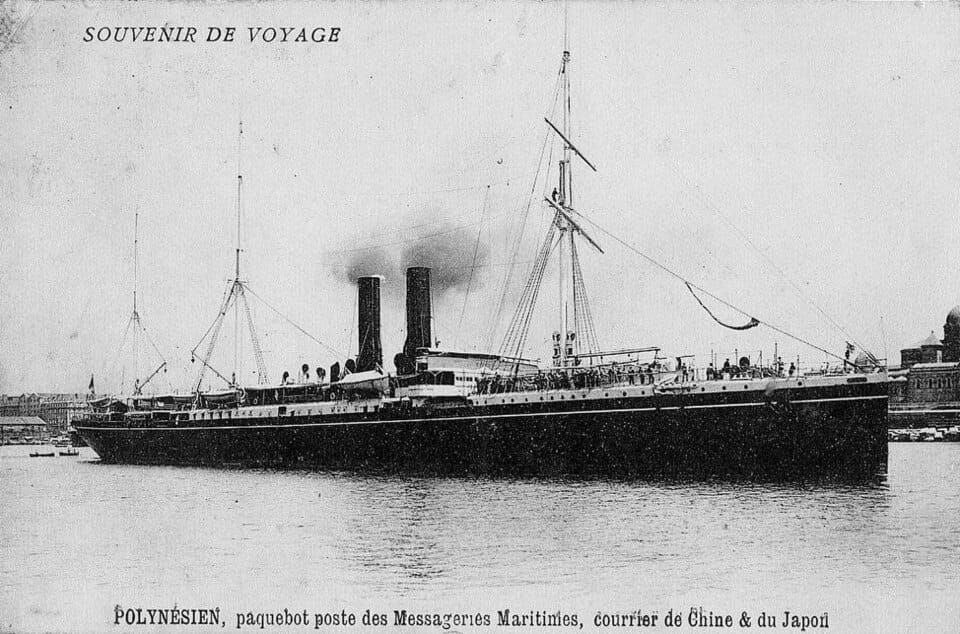
The SS Polynésien of the Allan Line departed Liverpool on 18 September 1873 — the thirtieth birthday of one François-Jean Rochas, listed on the manifest as “Francis Rochas,” male, 30, labourer. He arrived in Quebec on 29 September 1873. The crossing took eleven days.
How might he have travelled from Vif to Liverpool?
Vif is 16 kilometres south of Grenoble, with no railway serving it — too small, the valley too enclosed. He would have reached Grenoble by road: on foot, by cart, or by horse. From Grenoble, he joined the PLM — the Paris-Lyon-Méditerranée railway — for the seven to ten-hour journey north through Lyon to the Gare de Lyon in Paris.
Then, across Paris on foot or by horse-drawn cab, from the Gare de Lyon on the south side to the Gare du Nord on the north, approximately four kilometres. In 1873, there was no Métro, no bus system of consequence — just the horse-drawn omnibus or the fiacre for a man with luggage. This crossing of the capital would have been remarkable to a man from a valley town of 2,500 people, possibly never having been further than Grenoble. Paris was not enclosed. Paris had no single horizon.
From the Gare du Nord, the Chemin de Fer du Nord to Calais — his first experience of open horizontal landscape, the sky enormous, the land almost featureless. Then the Channel crossing, 90 minutes by steam packet. Then Dover to London, two hours. Then London to Liverpool, four to five hours.
The Allan Line’s standard practice on the Liverpool-Quebec route was to call at Moville, County Donegal — the deep-water anchorage for Londonderry — to pick up Irish emigrants. If the SS Polynésien followed this standard pattern, Rochas would have seen the Irish coast before the open Atlantic. Whether he boarded at Liverpool or joined at Moville cannot be confirmed from the manifest, which records Liverpool as the originating port. But the intermediate stop was routine and almost certainly occurred. He may have watched the green hills of Donegal disappear behind him as the ship turned west.
He would never have seen anything as large as the SS Polynésien. When he walked up the gangplank at Liverpool on 18 September 1873, his thirtieth birthday, she was probably the largest man-made object he had ever been near.
I want to picture him, leaning on the ship’s railing. What I can’t picture is whether he looked back towards Europe, toward a home he likely knew he would never see again, or whether he resolutely stared out toward the New World. Was he leaning forward with excitement and nervous anticipation? This would have been the biggest step of his life.
Quebec — the arrival
The SS Polynésien arrived at Quebec on 29 September 1873. Late September on the St. Lawrence is the height of the autumn colour season — maple, birch, and ash in full turn, the forested riverbanks blazing in red, orange, and gold. For a man arriving from Liverpool’s grey docks after eleven days at sea, the first sight of North America would have been this: the wide cold river, the limestone cliff of Cap Diamant above the lower town, and the forests on both banks in full autumn fire.
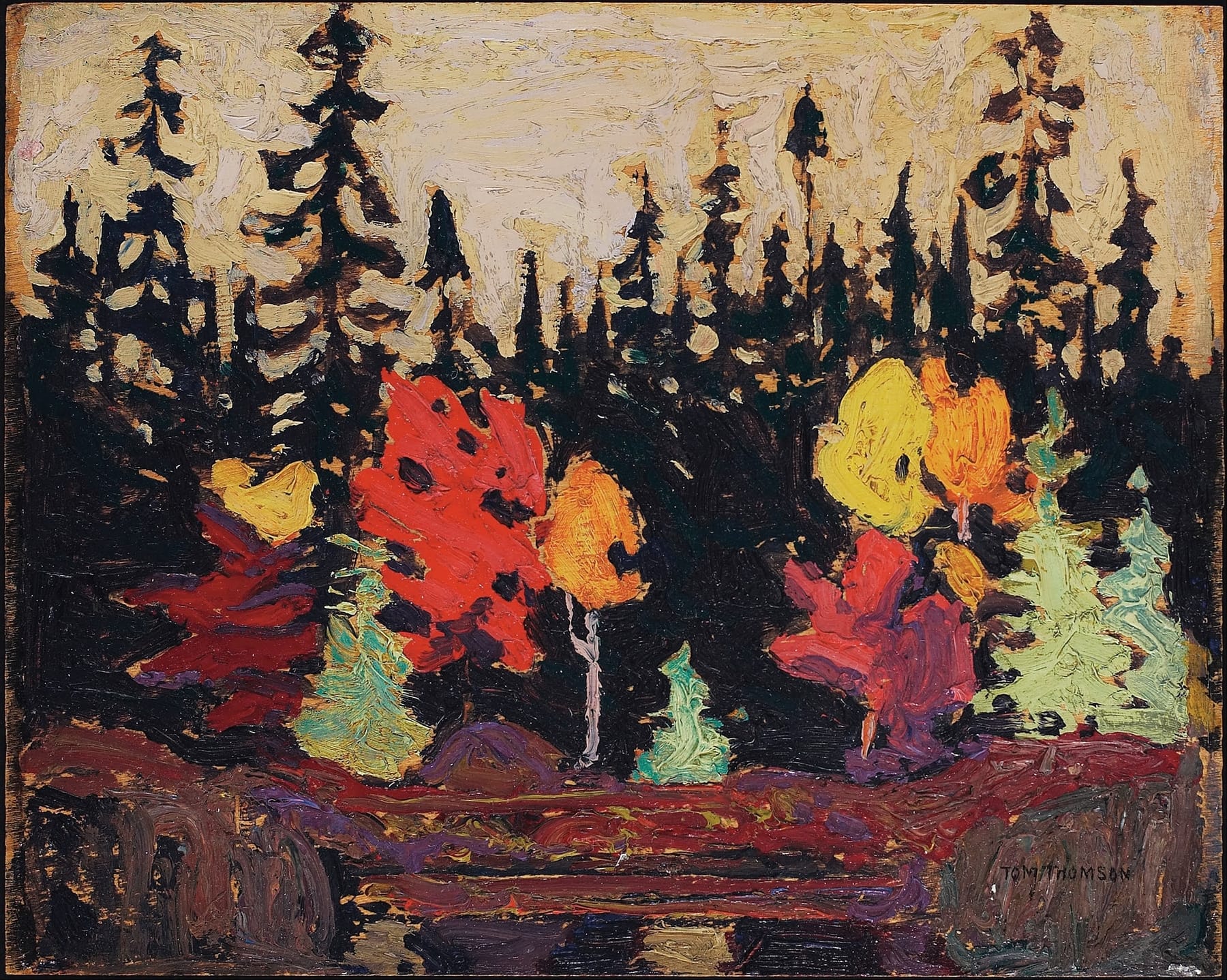
No European landscape prepares you for North American autumn colour. The maples particularly — Acer saccharum, the sugar maple, which has no European native equivalent — would have been a revelation. A craftsman’s eye, trained to notice the quality of wood and grain and surface, would have registered that colour with particular force. He arrived in autumn fire.
Quebec in 1873 was a predominantly French-speaking Catholic city — in many ways the most European city in North America, with its walled upper town, its Catholic institutional presence, its French language. For a man from the Isère it would have been the least foreign place available in the New World. And yet he did not stay.
Why? The honest answer is that we do not know. We know he arrived in Quebec on 29 September 1873, and we know he was at the Exchange Hotel in Santa Fe in March 1878 — a gap of four and a half years in which his movements are entirely undocumented.
But the questions are worth asking.
Was the carpenter’s market in Quebec already saturated? The city had been building for two centuries and had an established artisan class. A man with Rochas’ skills may have found more opportunity in a place that was actively building from scratch.
Was Quebec under the English not to his liking? The British colonial administration, the political tension of post-Confederation Canada — a French immigrant from metropolitan France might have found the French Canadians familiar in language but not entirely in culture.
Did he hear about New Mexico in Quebec? The French Catholic networks in North America were extensive. Quebec’s Catholic hierarchy had contact with the American missionary church — with Lamy’s Santa Fe. A conversation in a Quebec City parish, a chance encounter with a traveller heading south, might have been all it took.
Had he read about it? Jules Verne was already writing about the American West to enormous French readership in the 1860s and 1870s.
Was his Compagnons du Devoir network — if he was part of it, and the evidence suggests he was — buzzing about the opportunities in New Mexico, where a French archbishop was building a cathedral and needed master craftsmen?
This is all unknowable. The manifest tells us where he arrived. The newspaper tells us where he eventually surfaced. Everything in between is the open Atlantic of his biography.
The cottonwood that he may have planted at Dog Canyon turns yellow in October — a small echo of the St. Lawrence, a single tree doing what the whole Quebec riverbank had done the month he arrived in the New World.
PART TWO: SANTA FE
Lamy's French Quarter
Jean-Baptiste Lamy was born in 1814 in Lempdes, a village in the Puy-de-Dôme department of Auvergne, approximately 12 km from Clermont-Ferrand. He came to the United States in 1839, and in 1851 was appointed the first Bishop of the newly created Diocese of Santa Fe.
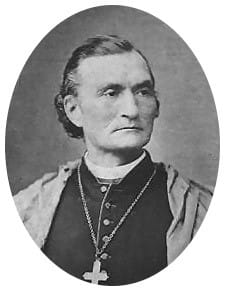
What Lamy proceeded to do, over the next four decades, was to build. He built a cathedral inspired by the Romanesque churches of his native Auvergne. He built schools, chapels, hospitals. And to build them, he reached back to France.
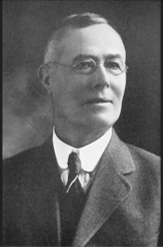
Quintus Monier, born 1853 in Clermont-Ferrand, 12 km from Lamy’s birthplace, came to New Mexico specifically to build for Lamy. Étienne Lacassagne came from Marseille, recruited by Lamy, working on the cathedral, the Loretto Chapel, the schools, and the Palace of the Governors. His brick company, Étienne Lacassagne & Co., supplied machine-made bricks across Santa Fe. The 1880 census records him living at the Loretto Academy construction site, occupied as a plasterer — the same construction site where Rochas was building the staircase. They were working on the same building at the same time. Lacassagne was plastering the walls while Rochas built the helix inside them.
Father Pierre Lassaigne, Lamy’s recruit, came from France in 1864, posted first to Tularosa and then to Las Cruces. Theodore Rouault came from Combourg in Brittany — the hometown of Chateaubriand, who wrote his memoirs under the title Memoirs from Beyond the Grave. Numa Reymond came from La Chaux-de-Fonds in Switzerland — the watchmaking capital of the world.
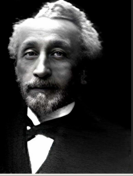
The French community that gathered around Lamy in Santa Fe was a deliberate act of cultural transplantation — men from Auvergne, the Isère, Marseille, Brittany, and Switzerland, finding each other in the desert because they were European, not because they were from the same place. Rochas was part of this world. He knew Monier, knew Lacassagne, knew Lassaigne, knew Reymond, knew Rouault. He referred to Archbishop Lamy by his first name in his last letter, as a man known personally rather than a figure of institutional authority.
He was not alone. He had simply chosen to live alone, 65 miles (ca. 105 km) from the community that would have kept him.
The Exchange Hotel, March 1878
On 2 March 1878, the Weekly New Mexican listed among the guests at the Exchange Hotel in Santa Fe: Frank Rochas.
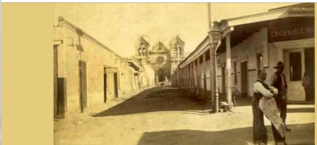
The Exchange Hotel occupied the southeast corner of the Plaza, at what is now the site of La Fonda Hotel. In 1878, it was a single-storey flat-roofed Territorial adobe, an inn of some sort since approximately 1610. Its guest list read like a history of the American West: Frémont, Kit Carson, Ulysses Grant, Rutherford Hayes, William Sherman, Lew Wallace. Its history included at least one bar shooting, one lynching, and a billiards room killing. It had a gaming salon, a bar, a dining room, and a central placita with flowers and vines and caged birds.
The same week that Rochas was listed as a guest, the paper noted the presence of a Niblo’s company. Niblo’s Garden was one of the most famous theatrical venues in 19th century America, a large playhouse on Broadway at Prince Street in New York, the venue of the original 1866 production of The Black Crook — considered by many theatre historians the first American musical.
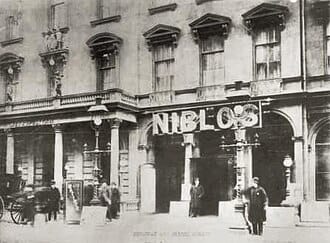
Although this may seem a deep digression, I believe it is worth going into some detail about this musical company. Rochas would have seen them perform. What might his impressions have been? Amusement? Roman Catholic disapproval? It’s impossible to say, but he would have been there with them, shoulder to shoulder in the hotel, impossible to ignore.
The company included Washington (“Wash”) Antonio — Harlequin and acrobat; Annie Antonio — singer and dancer; Lottie Antonio — performer; and Dan J. Sprague — stage manager. The Antonios were a performing dynasty, the children of Signor Antonio, a circus clown and pantomimist who had died of consumption in April 1877. The death notice in the New York Mercury records the mourners: his wife, Wash, Tillie, Marie, May, Lottie, Maggie (Mrs. Nichols), Martha, and others. Thirteen children, many of them performers.
We can trace their movements with some precision. In September 1877, they were in Galveston, Texas, at the Grand Central — Wash listed as acrobat, Annie and Lottie as performers, Sprague as stage manager. By March 1878, they were at the Exchange Hotel in Santa Fe, and then Denver. By May 1879, Wash Antonio was organizing his own company toward the silver mining camps of Colorado when the stage went over the bank on the road between Cañon City and Leadville at two o’clock in the morning. Three women had arms broken. Wash Antonio was badly bruised about the head and shoulders, with fears that sight had been completely destroyed in one eye. That is the last confirmed record of him.
The irony, which I feel obliged to note, is that the Antonio family had been performing since at least 1865 in a pantomime called The Great Pantomime of the Mountain Outlaws, or The Brigand’s Doom — documented in the Detroit Free Press of 18 August that year, with Wash and Lottie and their father Signor Antonio performing together. On the same frontier, thirteen years later, the mountain man in question was not playing a role. He was building stone walls and growing salads in Dog Canyon, and his doom was already being arranged.
What did Rochas make of the Niblo’s company? What did they make of him? The Exchange Hotel was not so large that guests did not notice each other. Perhaps nothing passed between them. Perhaps a French carpenter and a family of acrobats and dancers had more in common in 1878 Santa Fe than the distance between their professions suggests — all displaced persons, all working with their bodies, all far from anything they had started from. We cannot know. The records give us proximity, not conversation.
The Miraculous Staircase
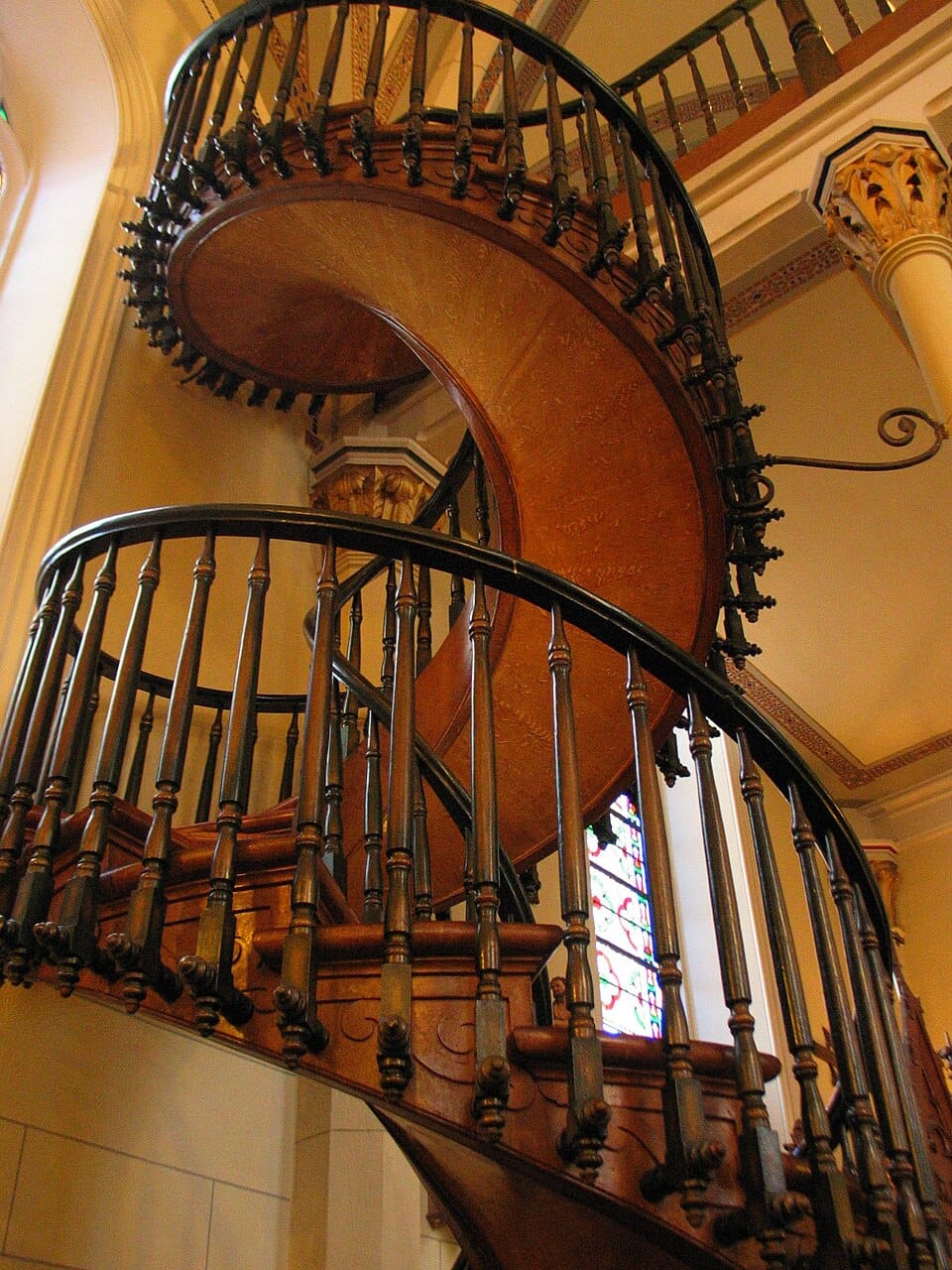
The Loretto Chapel — formally Our Lady of Light Chapel, on the campus of the Loretto Academy for Girls — was begun in 1873 under the direction of Archbishop Lamy. Its architect was Projectus Mouly, son of the Parisian master builder Antoine Mouly. Projectus designed a Gothic Revival chapel inspired by Sainte-Chapelle in Paris — pointed arches, French stained-glass, an interior of considerable delicacy and vertical ambition. He died in 1879 before the building was complete.
His death created a problem. The choir loft had been built but not connected to the nave below. Multiple builders were consulted. None could offer a solution. The Sisters of Loretto prayed a nine-day novena to Saint Joseph, the patron of carpenters. On the ninth day, a humble workman appeared with a burro laden with tools. He worked alone, requiring only a couple of tubs of water for soaking the wood. When he was finished, he was gone. No bill for materials was found. No one knew his name.
“Surely,” said the devout, “it was Saint Joseph himself.”
The legend improved, as Sonnichsen says of another story in the same landscape, “like good wine.” By the time it reached television in 1998 — CBS broadcast The Staircase, starring Barbara Hershey and William Petersen — the staircase had 33 steps (the age of Christ), the wood was “unknown to science,” and the carpenter had vanished overnight.
The staircase itself is genuinely extraordinary. It is a continuous winder in helix form, rising 20 feet (ca. 6 m) to the choir loft in two complete 360-degree turns, built largely from spruce wood. The inner stringer consists of seven wooden segments joined by wooden pegs; the outer stringer has nine segments. No nails: wooden pegs throughout. Handrails were added in 1887 by Phillip August Hesch, a Canadian-born master builder from Preston, Ontario, who had settled in Santa Fe in 1876 and built, among other things, the original St. Vincent Sanatorium in 1882. Without the handrails, the staircase was so frightening to descend that some nuns and their students came down on their hands and knees.
The women who commissioned this work deserve their own moment. Mother Magdalen Hayden — born Joanna Hayden in 1813 in Rathclogh, County Kilkenny, Ireland — had led four Sisters of Loretto to Santa Fe in September 1852 at Archbishop Lamy’s request. The journey was nearly fatal: the original mother superior, Matilda Mills, aged 33, died of cholera on the Missouri River. Magdalen herself contracted the disease. Lamy nursed the survivors into town and, when Magdalen recovered enough to travel, appointed her mother superior on the spot. She and three companions — Sisters Roberta Brown, Rosanna Dant, and Catherine Mahoney — arrived in Santa Fe on 25 September 1852, 1,723 miles (ca. 2,773 km) and nearly three months from Kentucky.
This woman, who had buried a companion on the trail, who had survived cholera, who had built an educational institution from nothing, oversaw the construction of the Loretto Chapel and its staircase. She paid Rochas $150 in 1881. She died on 17 October 1894 — ten weeks before Rochas was killed at Dog Canyon. The Spanish newspaper Revista Católica said of her: “With the death of the Reverend Mother Magdalen disappears from the scene of this world a figure notable and radiant, and with her a whole epoch of the Catholic Church of this Territory.”
She is immortalized in bronze on the door of St. Francis Cathedral in Santa Fe.
In the early 2000s, local historian Mary Jean Straw Cook identified the probable builder of the staircase. Cook found, in the Sisters’ logbook, an entry for 1881: payment of $150 to “Mr. Rochas.” She found the 1895 death notice in the Santa Fe New Mexican describing the murdered French rancher as someone who “was favourably known in Santa Fe as an expert worker in wood” and who “built the handsome staircase in the Loretto chapel and at St. Vincent sanitarium.” She found, in the probate inventory, the carpentry toolkit: five saws, nine planes, 19 moulding planes, two squares, five gauges, six chisels, two gouges, a draw knife, a brace, three augers, ten auger bits, a reamer, two clamps, and a pair of trammel points for drawing large circles.
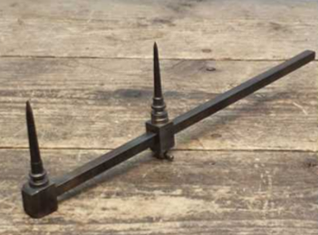
The trammel points are the detail that matters most to me. Trammel points are used for ascribing large arcs — for the geometry of curves at a scale beyond what a standard compass can achieve. You would need trammel points to lay out the geometry of a double helix staircase.
Cook’s identification has not gone unchallenged. John Clark, writing in the National Catholic Register, argues that the logbook entry refers to construction work at a nearby school rather than the staircase. The honest position is this: Cook’s identification is highly probable but not proven beyond all doubt.
What this work can add that neither Cook nor Clark could offer is the full biography. Even if the logbook entry refers to school construction — even in that case — Rochas was working in and around the Loretto Academy in 1881, was part of the French craftsman network that built Lamy’s Santa Fe, and was described at his death as the staircase’s builder by people in the city who had known him. The case is not closed. But the man is real, and the staircase is real, and the hands that built it were capable of exactly this.
A note on the Compagnons du Devoir: this ancient fraternity of journeyman craftsmen required bachelorhood during the Tour de France — the period of travel and work through which apprentices demonstrated mastery. Members typically produced a miniature masterpiece to prove their admission: for carpenters, this was often a model staircase demonstrating mastery of helical geometry and joinery. Cook suggests Rochas was a Compagnon. No membership record has been found to confirm it. The Musée du Compagnonnage in Tours maintains a searchable database — an open research question worth pursuing.
Over at Loretto Chapel, now a privately owned museum and wedding venue, hundreds of thousands of visitors a year stand at the base of that helix and feel something. John Clark, the skeptic, stood there and — his words — saw faith. He saw a young couple who had made a pilgrimage. He saw a woman doing the Stations of the Cross. He saw the real human experience of people bringing their genuine spiritual need to a beautiful object and finding it met.
This work does not argue against that. Faith and biography are not incompatible. The miracle, if there is one, is in the hands that made it and the life that surrounded those hands.
His name was François-Jean Rochas.
PART THREE: DOG CANYON
The Canyon
Dog Canyon
The name arrives already carrying its story. In Spanish it is Cañón del Perro — Canyon of the Dog — named for an incident in the 1850s or 1860s when US Army soldiers pursuing Apache raiders found a stray dog at an abandoned ranchero near the canyon mouth. The dog led them to water.
The Mescalero Apache name is older and more precise: T’iis ntsaadz-í ‘úú’á — something along the lines of “where the large cottonwoods stand,” a water marker, an ecological statement. The cottonwoods that grow along a desert watercourse are visible from miles away, their tall pale canopies rising above the scrub. They mean water.
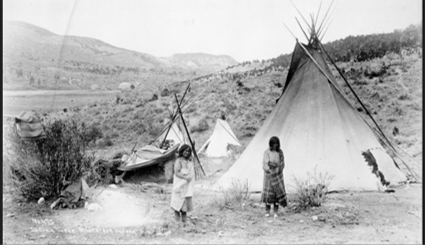
Three languages, three centuries, one canyon, one truth: there is water here. In the Tularosa Basin, in the Chihuahuan Desert, that is not a minor truth. It is the only truth that matters.
Alamogordo — the nearest significant town — takes its name from the same ecological reality. Álamo gordo: fat cottonwood. The water marker is the settlement. In 1598, when Juan de Oñate led his expedition north through the Jornada del Muerto, his scouts followed a stray dog whose muddy paw prints led them to a hidden spring. They named the place Los Charcos del Perrillo — the Pools of the Little Dog. A dog leading soldiers to water in the desert, three centuries before the canyon was named in English for the same story.
The canyon cuts through the west wall of the Sacramento Mountains, slicing through solid limestone from the valley floor to the summit. It turns and twists between tremendous coloured cliffs, rising to two thousand feet above the floor in places. Partway up, where the cliffs are most extreme, the trail launches out along an almost vertical precipice.
The Eyebrow Trail
The name earns its existence. A ledge so narrow it was named for the ridge above an eye — a thread of pathway clinging to the cliff, with nothing below it but several hundred feet of canyon. The Mescalero Apache knew this trail as well as they knew their own breathing. When soldiers pursued them up the canyon, they scrambled above the Eyebrow and waited, and when the soldiers reached the narrow ledge, they rolled boulders down.
In April 1880, Captain Henry Carroll led detachments of two companies of the Ninth Cavalry — the Buffalo Soldiers — up Dog Canyon in pursuit of Apache raiders. On the Eyebrow Trail, the boulders came down. Many of his men were lost. Two or three years later, François-Jean Rochas set up his first camp at the mouth of the canyon and began building his one-room stone house.
The geology of Dog Canyon is late Cretaceous limestone — the San Andrés formation, laid down in a warm shallow sea 65-70 million years ago. It is the same limestone that forms the Vercors escarpment above the Gresse valley, deposited in the same Cretaceous sea. Rochas, without knowing it, spent his working life building in and against stone that was geologically congruent with the stone of his childhood.
La Luz
The nearest settlement to Dog Canyon was La Luz — Nuestra Señora de la Luz, Our Lady of the Light — founded in 1705, the oldest settlement in the Tularosa Basin. Named for candles in windows signalling safety to returning husbands, or for a signal fire, or for its formal dedication to Our Lady of the Light. Light as guidance. The opposite of the dark in which he died.
It was a small but established Hispanic community. The Baca family were among the original settlers; Antonio Baca ran the stage stop in the family house during the 1880s, serving the White Oaks to Las Cruces stagecoach, and the first post office in La Luz was located in the Baca house. John Thomas Fortson — born in Elbert County, Georgia in 1821, first postmaster of La Luz — operated from that counter. Through Fortson’s hands passed every letter Rochas sent to France, and every letter France sent back to Dog Canyon. He died in La Luz on 4 January 1899 and was buried at Our Lady of the Light Cemetery, the same ground where Rochas lay.
When I lived in Alamogordo in the early 1980s, I worked alongside a Baca, likely of that same La Luz family, whose roots in the area went back to the earlier settlement. He was not, to me, a particularly memorable individual. But he had a better and deeper connection to that place than I did. The Baca family had been there since 1705. I was passing through. So, in the longer view of things, was Rochas.
Perry B. Kearney — born in Wisconsin in 1858 — made the cash homestead entry for La Luz land in 1882, the same approximate year Rochas was settling at Dog Canyon, and owned what became the Sutherland House until 1890. This is likely the same Sutherland family who sent the man to list inventory at Rochas’ cabin.
John Good arrived in the early 1880s, bought 500 acres, and built a ten-room house in La Luz in 1886. The La Luz Townsite Multiple Resource Area document is explicit: Good “was the first of the Texas cattlemen to arrive in the area. The coming of this group greatly affected life in the Tularosa Basin and La Luz.”
Good’s arrival brought with him, at least for a period, one of the more remarkable figures on the New Mexico frontier. Susie Warfield — born in Wales (or New South Wales Australia – there is considerable debate on the subject) in 1854, known eventually as Bronco Sue Yonkers (or sometimes “Yankers”) — had made her way through Nevada mining camps, Colorado stage lines, and a series of violent encounters to the Tularosa area, where she and Good became involved. When Good’s wife and children arrived, Sue pivoted and became involved with a rancher named Charley Dawson. Good’s jealousy led him to challenge Dawson to a duel at La Luz on 8 December 1884. Good shot Dawson dead and was acquitted. Sue was then arrested on a separate murder charge, tried in 1886, and defended by Colonel Albert Fountain — the same lawyer who would disappear with his son in 1896 and whose disappearance would trigger the Pinkerton investigation that eventually named Rochas’ killers. She was acquitted and left for Arizona the following day, never to be heard from again.
The Tularosa Basin in Rochas’ years was this kind of place. The same people kept appearing in the same violent network. Good, Lee, Fountain, Miller, Rochas: the same desert, the same conflicts, the same unresolved endings.
There was no completed church in La Luz during Rochas’ lifetime — the Nuestra Señora de La Luz church was begun in the 1890s but not completed until 1916. When Rochas was buried in December 1894, the funeral Mass was almost certainly said by Father Lassaigne, who would have ridden from Las Cruces to La Luz to bury his friend. It is the kind of thing Lassaigne would have done.
The Squatter
He had no legal right to the land.
To claim land under the Homestead Act, the land first had to be surveyed. Dog Canyon in the early 1880s was almost certainly unsurveyed. Without a survey, no claim could be filed. His 23 December 1894 letter to Monier — asking for help approaching the Surveyor General, explaining that a young stammering surveyor had left him a plat which he had subsequently lost — was the formal first step toward finally securing what he had occupied for over a decade.
He died three days after writing it.
What he built in the meantime was considerable. The stone walls — long stretches of them, built without mortar, fitted by eye and hand — still partially stand. The cabin itself: one room, stone, his own construction. Corrals for his growing herd. The garden. The orchard: apple, peach, pear, and cherry, planted and tended through the drought years of the early 1890s when every other rancher’s cattle were dying of thirst.
Food and daily sustenance
He ate what the canyon and the desert offered, and he ate what he cultivated, and he ate what he brought on his 65-mile supply runs to Las Cruces.
From the canyon and the basin: mule deer, which the reliable water at the canyon mouth drew regularly; wild turkey, roosting in the cottonwood and oak; jackrabbit and cottontail, the most reliable daily protein; Gambel’s quail gathered around the water’s edge. On the basin floor, during his supply runs: pronghorn antelope, abundant in the 1880s on the open Tularosa plain. Higher up the Sacramento escarpment: black bear, hunted for predator control and for the fat, valuable as a cooking and preserving medium. Mountain lion was a constant threat to his cattle and dogs. Javelina — the collared peccary — moved through the canyon-desert transition zone. Rattlesnakes were a hazard throughout.
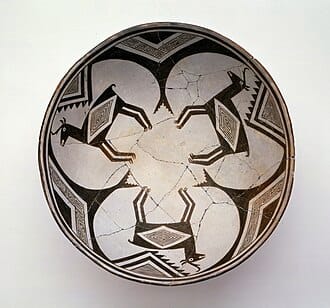
From the canyon itself, wild: yucca fruit and flowers, edible raw or cooked, a Mescalero staple he would have learned to use; prickly pear, both the fruit and the pads; chokecherry along the watercourse in late summer; wild grape, which a man who grew up in a viticultural family would have noticed immediately; piñon nuts from the higher slopes in autumn; wild onion near the water; watercress where the stream ran above ground; juniper berries as a flavouring.
From his cultivated garden: the orchard — apple, peach, pear, cherry, written about with mild pride in his last letter home; and salad greens — Sonnichsen calls him “undoubtedly the first man north of El Paso to raise his own salads,” which is a dry joke but carries biographical weight. A man who grows salads is not merely feeding himself. He is eating in a particular way, the way a French countryman eats. Onions, garlic, beans were almost certainly in the garden. Herbs are possible, given the olive oil.
From Rouault’s store in Las Cruces: flour, coffee, dried beans, salt, sugar. Possibly canned goods by the late 1880s, when tinned food was becoming available in frontier stores. The tin can with a bullet hole that I found near the cabin ruins in the early 1980s was, most likely, just that — a modern tin can, used for target practice. But tin cans existed back then in Dog Canyon.
The cooking: the cabin had a stove — the stovepipe chimney is mentioned in the Morrison shooting account, the wisp of smoke visible at dawn as he made his morning coffee. He had heat. He had olive oil. He cooked with both. A man who keeps olive oil and grows salads, cooking game and vegetables in a stone cabin in the Chihuahuan Desert, is cooking — in a stubborn, impractical, magnificent way — like a Frenchman. He may have eaten javelina and jackrabbit and prickly pear because the canyon offered them, but he dressed them with olive oil from Aix-en-Provence and served them alongside salad greens he had grown himself.
That is a very specific kind of stubbornness.
By 1888, he had six horses and400 head of cattle carrying his Scoop R brand. By the early 1890s, 500 head. When he eventually sold his entire herd to John Henry Riley — who had come through the Lincoln County War on the Murphy-Dolan side — for $3,400, he lost the economic weight that had made him a figure of consequence in the canyon country.
He was, in Sonnichsen’s word — exactly right, I think — scrappy. After roundups, when the herds were mixed and sorted by brand, he would appear and go through the cattle looking for his Scoop R mark, and his dogs would be with him — described as “as cross-grained as their master and just as fearless” — and his neighbours did not appreciate either the dogs or the scrutiny. “You are stealing my cows,” he told a Texan rancher who objected. “If I catch you, I have you arrested.”
On the question of Morrison
The ranch hand he suspected of theft, whom he had arrested and who then shot him in a pre-dawn ambush in July 1886, was named Morrison — an Anglo name, Irish or Scots-Irish in origin, consistent with the Anglo-Texan cattle culture moving into the basin.
The Hispanic community of the Tularosa Basin had been there for generations — La Luz founded in 1705, the Baca and Gutierrez and Acuña families with roots going back a century and a half. They had water rights, land grants, family obligations, and a social fabric that a French immigrant with broken English had no easy entry into. The Anglo-Texan cattlemen, by contrast, were themselves newcomers — arriving in the 1880s, as recent to the basin as Rochas himself. There was also a perception, accurate or not, that the Anglos had more experience with cattle, while the Mexican community was more oriented toward agriculture.
Rochas may have found it easier to orient toward the Anglo world, even as that world was simultaneously his greatest threat. Morrison shot him. Oliver Lee was his water adversary. Dan Fitchett, who reported his death, was in Lee’s network. The English-speaking world Rochas found easier to navigate was the world that killed him.
The Morrison shooting, 1 July 1886
The Las Cruces Sun-News of 3 July 1886 gives the full account. Rochas had been losing property from his cabin and stock from his range, and suspected Morrison who had been working for him. He went to La Luz and had him arrested for stealing a horse. Morrison was released and immediately set out for Dog Canyon seeking revenge.
Before dawn, he hid behind a strategically placed rock and waited. Dawn filtered across the top of the mountain wall. A wisp of smoke rose from Rochas’ stovepipe chimney as he made his morning coffee. He came out, unsuspecting, climbed the slope, went to work on his latest wall. Morrison waited until he stooped to pick up a heavy stone — then shot him with a Winchester.
The ball took effect in his body but did not disable him. He started to run to his cabin, was hit again in the arm, still made it. He barred the door. He got his revolver. He lay down on his bed to wait.
Nothing happened until ten o’clock that night. Then Morrison broke open the door to finish up his bloody work. Rochas was lying on the bed, quiet and steady. As the door caved in, he fired, wounding Morrison, who escaped. In the morning a party went on his trail and followed him some miles by the blood he spilt. Rochas recovered from his wounds.
Eight years later, three men would come to his door, but he would not have time to bar it.
His People
He was not entirely alone in the world, though he chose his company carefully and kept it few.
Father Pierre Lassaigne — Padre Pedro, as his largely Hispanic congregation knew him — had been recruited from France by Lamy in 1864 and posted first to Tularosa, then reassigned to St. Genevieve Catholic Church in Las Cruces in 1881, where he remained for twenty-eight years until his death in 1909. He was Rochas’ friend. He was also, by the evidence of the historical record, one of the more entertaining clergymen on the New Mexico frontier.
During his Tularosa posting, Lassaigne had taken the side of his Hispanic parishioners in the Tularosa Ditch War of 1873 — a conflict over water rights, specifically over dams built by Anglo settlers that disrupted the water supply to the Hispanic community’s crops. The Ditch War then metastasized into the Horrell War, in which five brothers from Texas went on a shooting spree killing every Hispanic person they encountered. Lassaigne, according to official dispatches reported in the Records of the American Catholic Historical Society of Philadelphia, told his congregation to set fire to the Horrell ranch and kill them as they fled.
The ecclesiastical authorities were not altogether delighted. He was reassigned to Las Cruces.
Two French outsiders in the desert, then: one who built his stone cabin and guarded his water and told cattle thieves he would have them arrested; one who told his congregation to burn the ranch. No wonder they were friends. They understood each other’s relationship to authority, which was: respectful in principle, selective in practice.
Numa Reymond — born in La Chaux-de-Fonds, Switzerland in January 1847, the watchmaking capital of the world — was a different kind of friend. He came to Las Cruces and built a substantial fortune through mercantile interests, operated the stage line between Santa Fe and Mesilla before the railroads arrived, served as one of the first regents of what is now New Mexico State University, and was deeply involved in the Aztec Masonic Lodge. He retired around 1907, spent his last decade mostly in Switzerland, returned in 1917, and died in El Paso in October 1917. He outlived Rochas by 23 years.
Theodore Rouault — born in Combourg, Brittany in 1850 — kept a store in Las Cruces where Rochas traded, loading up his old buggy and striking out across the San Agustin Pass and the grim Tularosa desert toward his cabin sixty-five miles away. Rouault administered Rochas’ estate after his death, filed the administrator’s report in April 1900. He died in Las Cruces in April 1940, aged 89 years — still alive when Sonnichsen was beginning his research in the 1940s, an unreached witness.
In his last letter, Rochas asked after Lacassagne twice. This was Étienne Lacassagne, who had plastered the walls while Rochas built the staircase, who had stayed in Santa Fe and built a dynasty — brick company, family, approximately 100 descendants. He stayed. He became Santa Fe. Rochas went to the canyon.
In the letter, he wrote: “Send me news also of Mr. Baptiste Lamy.” Archbishop Lamy had died in 1888, six years before. Perhaps he did not know. The isolation of Dog Canyon could obscure even major news from the world he had left behind.
The Texans
The Texans came with their herds and their range code and their lust for grass and water. John Good, the first of them to arrive in the La Luz area in the early 1880s, acquired 500 acres and built himself a ten-room house whose opening was reported in the Las Cruces newspaper. The accumulation of pressure on Rochas in his last years forms a pattern recognizable in retrospect as a man being slowly squeezed. He had senior water rights, but no legal title. He had a reputation for checking other men’s herds at roundups and accusing them of theft. He had received warnings to leave. He snarled back and said things in French which, as Sonnichsen notes, it was just as well nobody could understand.
Oliver Lee arrived in Dog Canyon in 1893. He was 28 years old, born in Buffalo Gap, Texas. He built a ranch south of the canyon mouth and wanted Rochas’ water.
Oliver Lee’s biography will not be detailed here. That ground has been thoroughly worked — by Sonnichsen, by Recko’s Murder on the White Sands, by the literature on the Fountain murders, and by the Oliver Lee Memorial State Park itself. What the record gives him in this monograph is exactly what the record gives him: the named suspect in the only testimony that comes close to identifying Rochas’ killers, and the last irony — that the state park named after the probable murderer stands on the land where the victim lived and died.
Rochas was 51, describing himself as “just the same, except for a few gray hairs,” and making, at last, his first formal move toward a land survey. He sat down on 23 December 1894, and wrote three letters. He would be dead in three days.
PART FOUR: THE DEATH
23 December 1894
He wrote to his brother and sister in France first — about his health, his garden, his desire to live without bad blood. He spoke of the trees he had planted — apple, peach, pear, and cherry — boasting mildly. He was 51 years old and had not seen his family since he left Vif in 1873.
Then he wrote to Monier. The letter survives because it was found on his table after his death and deposited in the probate file. It is the only document in Rochas’ own words that is publicly available. It is given here in full, because it is not the letter of a man planning to die.
Dear Friend,
You will certainly be surprised when you receive this letter to see that I am thinking of you. However I assure you that I think of you sometimes. I have had news of you and of Mr. Baptiste Lamy through Mr. Reymond. I have had none from Lacassagne and I should like to have some. I am writing you also because I have a little need of you. I do not write English and my handwriting is bad. I should like to correspond with the Surveyor General, whose station is at Santa Fe. The land on which I live is not surveyed and I should like to know how to act to get it surveyed and I have been thinking that you would be able to get me the necessary information. I think he will need to know in what township and section I am situated. Surveyors have passed by here several times. The last one left me a plat of my place with the number of the township and the number of the quarter-section. But I can not find it and I must certainly have lost it. The name of the surveyor I cannot give you but it will be easy for you to find it. He lives in Santa Fe as does his father, who is also a surveyor. The young man stammers a good deal. He must have it on his books, I am certain. The name of the place is Dog Canyon. I hope that this will not give you too much trouble. I think you will not be too busy at this time. Here it is still warm. It has frozen a little but hardly enough for one to see. Almost all the trees still have their leaves. I hope you have continued in good health and that you have had plenty of work; the same for Lacassagne, of whom I hope you can give me news. As for me, it is always the same thing. I am just the same, except for a few gray hairs. I feel well except for this miserable catarrh in the head and also in the stomach. Well, some day one will die, and that will relieve us of all these maladies. Send me news also of Mr. Baptiste Lamy. I think perhaps you may know these people — I mean the surveyors. That will make the business easier. Since we are at the end of the year, I conclude by wishing you a happy New Year and remain always
your friend,
Frank Rochas
He signed himself Frank. He always did. Not François, not Jean, not even Frenchy — Frank. The Americanization of the name compressed into five letters, used even in letters to a French friend, in a letter written in French. He had been Frank for long enough that it was simply who he was.
The letter is the voice of a man who is arthritic and tired but not despairing. The “some day one will die” — written three days before they came — is sardonic rather than premonitory, the kind of thing a man with chronic illness says when making a mild joke about his own condition. The trees still have their leaves. He is wishing Monier a happy New Year.
The letters lay on his table through Christmas.
On 26 December, three men rode up to his cabin.
26 December 1894
He came to the door with his rifle in hand.
He looked at them. He knew what they had come for, and he was not afraid. He cursed them in fluent French and broken English — the two languages he had, the one of his childhood and the one adopted, both of them inadequate to the situation, both of them available — until one of them reached quickly for his gun and fired three rapid shots.
Only one bullet took effect. It entered his chest.
While the three horsemen rode away, he lay down on his bed to die.
The canyon walls, which are limestone and reflect sound rather than absorbing it, would have bounced the shots from surface to surface. A single shot in Dog Canyon sounds like several, arriving from different directions with a slight delay before each echo. The contemporary newspaper accounts differ on these details — some say shot through the heart, Winchester in hand, pistol under the pillow; others say shot came from outside the window. In a limestone canyon, the acoustics of a shooting are genuinely confusing.
Two days later, on 28 December 1894, a rancher named Dan Fitchett — associated with Oliver Lee — rode to La Luz and reported that somebody had killed the old Frenchman. Whether he discovered the body independently or was sent to make the report as part of a managed notification is unknown — this tale will not claim more than the record permits.
Faustino Dominguez Acuña — the Justice of the Peace, born in Juárez, Chihuahua, in February 1846, blacksmith by trade in the 1885 census — assembled a coroner’s jury, rode out to Dog Canyon, made his observations, and ruled that Frank Rochas had died of a gunshot wound in the breast. No human agency was mentioned.
This was the same Faustino Acuña who had been Rochas’ blacksmith for nearly a decade. The man who had shod his horses and repaired his tools, now ruling on how he died.
Acuña sent David Sutherland — Rochas’ neighbour, stockman, born in Ohio in April 1843, just one year younger than Rochas — to take charge of the property. Sutherland made his inventory: 1 lamp. 2 ropes. 2 bottles olive oil. 4 glasses (drinking). 1 pants (worn). And the tools.
The funeral was held at La Luz — almost certainly with Lassaigne riding the 65 miles from Las Cruces to say the Mass — and the incident was closed.
For a few days people talked about it casually: “The old Frenchman got killed — did you hear about it? Wonder who will get his money?” There was no mourning and no thought of going after the killers.
His family in France was notified. They employed New York lawyers who worked with Reymond and Rouault to make proper disposition of $4,000 in money and property. His brothers and sisters received $2,457.77. The lawyers took most of the rest, though they expended $13.80 for the coffin and the plot in the La Luz cemetery.
He was buried at Our Lady of the Light, in La Luz, New Mexico. Named for candles in windows, or for a signal fire, or for its formal dedication to Our Lady of the Light. Light as guidance. The opposite of the dark in which he died.
John Thomas Fortson, the postmaster through whose hands Rochas’ letters had passed for years, was buried in the same ground four years later.
The Reckoning That Wasn't
In 1896, Colonel Albert Jennings Fountain — the lawyer who had prosecuted Eli “Slick” Miller for cattle rustling, and had defended Bronco Sue Yonkers in her murder trial — disappeared in the Tularosa Basin with his young son Henry. They had been returning from Lincoln, where Fountain had secured indictments against Oliver Lee and others for cattle theft. They were never found.
In April 1896, a Pinkerton detective named William B. Sayers — born in Ireland in April 1853, arrived in the United States in 1880, resident in 1900 of Denver, Colorado, where he lived with his wife Florence and their children — went to the Territorial Prison at Santa Fe to interview Eli “Slick” Miller. Miller was born in Colfax County, New Mexico, in 1871. He was 23 at the time of Rochas’ death. He was in prison and hoping for a pardon.
Miller did not directly implicate Oliver Lee in the Fountain disappearance. But he did claim that Lee was one of the three men who rode up to Frenchy’s door on 26 December 1894.
This is hearsay. It is the testimony of a convicted criminal with a personal motive for cooperation. Although it is the only testimony in the record that names a specific person as one of Rochas’ killers, it cannot be verified.
What the record establishes: Slick Miller told Pinkerton operative Sayers that Oliver Lee was at Dog Canyon on 26 December 1894. Miller was a prisoner seeking a pardon. His testimony was recorded in the Sayers report to Governor Thornton. The governor filed the papers. No prosecution followed. This work offers Miller’s testimony as testimony, not as proof.
The men who killed Rochas were never charged. Oliver Lee went on to become a New Mexico state senator. The state park at the mouth of Dog Canyon is named the Oliver Lee Memorial State Park.
The man who lived and laboured and died at that site for over a decade has no park named for him. He has a grave that was lost for decades, found by accident in 1978 when a VFW cemetery cleanup crew turned over a wooden board that had fallen face-down: Frank Rocha or Roch / Frenchie.
In John Ford’s 1962 western The Man Who Shot Liberty Valance, a cynical newspaper editor is told the true story behind a legend he has been printing for years. “When the legend becomes fact,” he says, “print the legend.”
Ford did not endorse this advice. The senator who benefited from the legend spends the entire film haunted by it. This work takes the opposing position: when the legend has a name, and the name has a life, and the life deserves to be known — print the life.
PART FIVE: ERASURE AND RECOVERY
An Endling
As outlined in the introduction, the word endling was coined in 1996, in a letter to the journal Nature, to describe the last known individual of a species or subspecies. I have written about endlings before — Doll and Ruby Easson, and Emalyn Smith Burney. François-Jean Rochas was an endling in the extended sense: the last of his immediate line in the New World, unmarried, childless, and the last of a particular human type in a particular place. The solitary French settler at Dog Canyon — an ecological and human niche that closed the moment he died.
What makes Rochas different from my other endlings is the quality of his chosen endling-hood. Doll and Ruby and Emalyn were overtaken by circumstance. Rochas took his stance deliberately and defended it with his life. He was told to leave. He stayed. He was shot at, warned, threatened. He stayed. He wrote letters home about his apple trees three days before they killed him.
He stayed until staying killed him.
And then the damnatio memoriae began. Not formal, no Senate decree. The accumulated effect of: a coroner’s ruling that named no human agency; a Pinkerton report filed and forgotten; a legend that erased the craftsman from what was later called a miraculous staircase; decades of silence in the canyon country where people who had known him gradually died; a grave that lost its marker and then lost its location.
Cook herself, the historian who identified Rochas as the staircase’s probable builder, puts it plainly: “There were those who knew his name but who did not wish to betray the legend. The staircase builder’s identity was of little interest to the public until his accomplishment reached legendary proportions sometime during the early decades of the 20th century. By then, those who had known or worked with Rochas were dead.”
It was partly chosen.
The last physical trace of him to surface was the wooden board found face-down in the Our Lady of the Light Cemetery in La Luz in September 1978, when a VFW cleanup crew turned it over and read: Frank Rocha or Roch / Frenchie. Juan Gutierrez — author of The La Luz I Remember, aged 89 that day — visited the cemetery and saw it.
The stone walls he built still partially remain. And by the pool at the mouth of the canyon, possibly planted by his hands in the early 1880s, stands — or stood — a cottonwood tree.
Fremont cottonwoods live between 100–150 years under optimal conditions. A tree planted at Dog Canyon in ca. 1882 would reach the outer limit of its natural lifespan somewhere in the 2030s. Sonnichsen, visiting in the late 1940s, described it as “the last of his planting which survives.” If it still stands — protected in what is now a state park, with the reliable water that sustained it — it is somewhere between 100 and 145 years old.
It may still be alive now. Perhaps one should ask Oliver Lee Memorial State Park.
It was there when Rochas was alive. It was there when he was killed. It has outlasted everyone who knew Rochas, everyone who killed him, everyone who investigated his death, everyone who wrote about him.
It may be the last living witness.
The Legend and the Carpenter
Mary Jean Straw Cook edited two books simultaneously in 2002: the revised edition of Loretto: The Sisters and Their Santa Fe Chapel, in which she identified Rochas as the staircase’s probable builder, and Immortal Summer, a collection of 1897 Southwest letters by Amelia Hollenback. Cook had both on her desk at once: the dead Frenchman and the Victorian traveller, both in the same desert.
The 1984 Bulletin des Amis de la Vallée de la Gresse et des Environs — a local history journal published in Vif, the town of Rochas’ birth — is the most important source in this work that most readers will never see. Issue No. 14, Christmas 1984, pages 26 to 40, contains the most detailed French-language account of Rochas’ life. It is not available online. It exists in Vif, which is where it belongs, and where I hope one day to read it.
The process of recovery has been slow. Cook identified him in the early 2000s. Sonnichsen wrote about him in 1960, acknowledging that “at this moment there is probably not one person in the whole Tularosa country who can remember his name.”
The legend of the miraculous staircase, in the meantime, has generated a television film, a young adult novel, multiple documentary episodes, and hundreds of thousands of visitors a year to a chapel that does not officially acknowledge that it knows who built the staircase.
This is not a conspiracy. It is the ordinary human preference for a good story over a complicated truth. Saint Joseph appearing with a burro is a better story than a French carpenter from the Isère with broken English and a chronic catarrh and nineteen moulding planes.
But the carpenter existed. And his name was Frank Rochas. He signed his letters that way, even to French friends, in French: your friend, Frank Rochas. Five letters. The length of a name that fit the landscape he had chosen.
EPILOGUE: WITNESS
I was very pregnant when I visited Dog Canyon.
This seems worth stating plainly, because it is the central fact of the visit — more central, even, than the canyon, the cabin, the rusted tin can with the bullet hole that I found up near the ruins. I was enormous with beginning, and the place I was visiting was the site of an ending, and I clambered up the dry riverbed with my husband and our German Shepherd Chow Chow mix named Simon, and none of us found this incongruous.
Simon drank from the water at the canyon mouth. The same water Rochas’ dogs drank from — the dogs described as cross-grained and fearless. Dog Canyon. A dog in Dog Canyon. We had not planned this.
I kept the rusty tin can with the bullet hole. It was never a museum quality artifact worthy of a velvet cushion set behind temperature-controlled glass. Likely it was merely a modern tin can, used for target practice by some local man. Still, I kept it for years. Over the course of several household moves since the 1980s to the present day, the rusty can was lost, thrown out, or misplaced. In some ways, I wish I had kept it; it would have been far more meaningful than a brochure or some hand-out from the local chamber of commerce. But then again, without this monograph, were the tin can to be found in a drawer by my children after my demise, they likely would have wondered: “Was mother, you know… okay? Why do you suppose she had this piece of junk stashed away?” Now, having written this, the question would have been answered. But regrettably, the tin can is no more.
This work is the answer to the question of keeping a rusty tin can.
I had arrived in Alamogordo having spent the previous ten years in Treviso and Venice — in the Veneto, in the landscape of water and mist and the density of European history pressing in from all directions. Prior to that, the milky-white sky, bluish like breast milk, of northeastern Italy. And then: the Tularosa Basin. Looking like the contents of an ashtray upturned on the shag carpet, as I wrote in another essay. The almost painful blue sky. The wind. The seashell sound of the canyon. The roadrunner, oddly small, nothing like the cartoon.
The stars above Dog Canyon on a clear night — which is almost every night — are the same stars Rochas watched. Orion rises in the same place. The otherworldly Milky Way takes the same course. I used to travel the roads from Alamogordo to El Paso at night and turn off my headlights and drive by starlight. The stars were bright enough. This is not a metaphor. This is what the sky is like there, without significant electric light.
He had that sky every clear night for decades. Whatever else the desert took from him — the river sound, the bell of Eugénie-Marie-Pauline calling from heaven to heaven, the smell of fermentation in September, the enclosed warmth of a valley that pressed in on all sides and held him — it gave him that sky, about 300 nights a year, over White Sands, over a basin with no light source for 50 miles.
Sonnichsen ends his chapter on Rochas with: “In that forgotten grave rests what is left of Frank Rochas, the valiant Frenchman.”
The grave is no longer forgotten. The grave is in the Our Lady of the Light Cemetery in La Luz, Otero County, New Mexico. The stone walls he built still partially stand. The cottonwood may still stand. The staircase still stands — spring-like, queenly, frightening without the handrails, turning twice in the dim air of a Gothic chapel in Santa Fe while tourists photograph it and wonder who made it.
His name was François-Jean Rochas. He was born on 22 September 1843 in Vif, in the Isère department of France, which is a limestone valley enclosed by the Vercors Massif, where the Gresse river runs cold and fast and the vineyard smells of fermentation in September and the bell Eugénie-Marie-Pauline calls from heaven to heaven and the sky is often grey and soft and full of cloud.
He died on 26 December 1894, cursing in French and broken English, at the door of a stone cabin in Dog Canyon, New Mexico, where the sky is almost painfully blue, the shadows are absolute, and the wind is the only sound that never stops.
He is not forgotten.
APPENDIX A: NOTES ON SOURCES, FACTS, AND SPECULATION
Established fact covers everything documented in primary sources: birth and death records, immigration manifests, census records, newspaper accounts, the Sonnichsen footnotes and the probate file entries they reference, the Manion article on the Haydens, the church records from the Église Saint-Jean-Baptiste de Vif, the Geneanet family tree records drawn from the Archives départementales de l'Isère, and the documents directly quoted or cited throughout.
Probable inference covers conclusions that follow logically from the evidence but are not directly stated in any primary source: that Rochas knew Lacassagne personally through the Loretto construction; that the olive oil was sourced through French supply networks in the Southwest; that Lassaigne said the funeral Mass at La Luz.
Speculation, however grounded covers: the Compagnons du Devoir membership; the precise nature of any contact between Rochas and Mescalero individuals; the Quebec interlude; the inner emotional life of any person in this narrative; the fate of the cottonwood.
Where I have speculated, I have tried to say so.
APPENDIX B: SOURCES CONSULTED
Documents
Birth record: Archives départementales de l'Isère (AD38), 9NUM1/5E548/9, Vif. naissances, vue 199. Birth of François-Jean Rochas, 22 September 1843.
Marriage record (parents): AD38, 9NUM/5E548/12, Vif. mariages, vue 100. Marriage of François Charles Rochas and Anne Victoire Chaulon, 23 November 1842.
Death record (mother): AD38, 9NUM/5E548/16, Vif. naissances, mariages, décès, vue 450. Death of Anne Victoire Chaulon, 27 August 1878.
Immigration manifest: Library and Archives Canada, RG 76-C, Roll C-4528. SS Polynésien, Allan Line, departed Liverpool 18 September 1873, arrived Quebec 29 September 1873.
New Mexico Territorial Census, 1885: "Frank Roches," age 42, stockman, Precinct 14, Doña Ana County, Enumeration District 9, p.21.
Frank Rochas Probate File: Doña Ana County Court House, Las Cruces, New Mexico. Contains: letters to brother and sister in France; letter to Quintus Monier (full text in Sonnichsen); Report of Coroner Faustino Acuña; Report of T. Rouault, administrator, filed 4 April 1900; Declaration of H. Clay Phillips, U.S. Consul at Grenoble; property inventory.
Sisters of Loretto Day Book, 1881: Entry recording payment to "Mr. Rochas," $150. Original held at Loretto Motherhouse Archives, Nerinx, Kentucky.
Pinkerton Report: W. B. Sayers to Governor W. T. Thornton, 17 April 1896. Cited in Sonnichsen, fn.7.
Geneanet, Stéphane Desreumaux family tree. Records for Anne Victoire Chaulon and François Charles Rochas, drawn from AD38 primary documents.
Newspapers
Weekly New Mexican, 2 March 1878, p.2.
Las Cruces Sun-News, 3 July 1886, p.3. "Another Shooting Affray Near La Luz."
Santa Fe Daily New Mexican, 5 January 1895, p.4. Chronicling America: https://chroniclingamerica.loc.gov/lccn/sn84020631/1895-01-05/ed-1/seq-4/
El Independiente (Las Vegas, NM), 12 January 1895, p.2.
Rio Grande Republican, reprinted White Oaks Eagle, 17 January 1895, p.2. Newspapers.com: https://www.newspapers.com/newspage/901882926/
Las Cruces Republican, reprinted New Mexican Review, 17 January 1895, p.1.
Rio Grande Republican, 3 and 10 July 1886. Cited Sonnichsen fn.5.
New-York Mercury, 29 September 1877, p.2; 17 November 1877, p.4; 14 April 1877, p.5; 1 June 1878, p.7.
Kansas City Times, 10 August 1879, p.14.
Star Tribune (Minneapolis), 22 May 1879, p.2.
Detroit Free Press, 18 August 1865, p.3.
Alamogordo Daily News, 21 September 1978, p.22.
Las Cruces Sun-News, 4 September 1966, p.12.
Albuquerque Journal, 28 February 1988, p.72.
Bulletins (French)
Bulletin des Amis de la Vallée de la Gresse et des Environs, No.14, Noël 1984, pp.26–40. ISSN 0223-9485. Not online. Contact municipality of Vif, Isère.
Books
Sonnichsen, C. L. Tularosa: Last of the Frontier West. University of New Mexico Press, 1960; revised 1980. ISBN 978-0826305619.
Cook, Mary Jean Straw. Loretto: The Sisters and Their Santa Fe Chapel. Museum of New Mexico Press, 2002. ISBN 0890133980.
Cook, Mary Jean Straw (ed.). Immortal Summer: A Victorian Woman's Travels in the Southwest. Museum of New Mexico Press, 2002. ISBN 9780890134023.
Keleher, William A. The Fabulous Frontier. University of New Mexico Press, 1962.
Recko, Corey. Murder on the White Sands. University of North Texas Press, 2007. ISBN 978-1574412222.
Patorni, François-Marie. The French in New Mexico: Four Centuries of Exploration, Adventure, and Influence. French in America Press, 2020. Kindle Edition.
Horgan, Paul. Lamy of Santa Fe. Farrar, Straus and Giroux, 1975.
Bullock, Alice. Loretto and the Miraculous Staircase. Sunstone Press, Santa Fe, 1978.
Bellmore, Audra. Old Santa Fe Today, 5th edition. Historic Santa Fe Foundation.
MacKell, Jan. Red Light Women of the Rocky Mountains. University of New Mexico Press, 2011.
DeVoto, Bernard. Across the Wide Missouri. Houghton Mifflin, 1947. The Year of Decision: 1846. Little, Brown, 1943. The Course of Empire. Houghton Mifflin, 1952.
Note: The passage attributed to DeVoto regarding the frontier as a world of "loneliness, hardship, and social deterioration" is recalled by the author but has not been located in a specific text. The sentiment is consistent throughout DeVoto's frontier writings. The attribution is noted as a recalled paraphrase rather than a direct quotation.
Armand, Yves, and Jean-Claude Michel. Histoire de Vif. Mairie de Vif. ISBN 978-2-9528111-0-1.
Reports and Articles
McLemore, Virginia T. "Oliver Lee Memorial State Park." New Mexico Geology, February 1996, v.18, n.1, pp.14–17.
Nickell, Joe. "Helix to Heaven: The Staircase Stands but the Myth Falls." Skeptical Inquirer, November/December 1998.
Spalding, Thomas W. "Sin and Grace on the Cattlemen's Frontier." Records of the American Catholic Historical Society of Philadelphia, Vol.107, No.3/4 (Fall-Winter 1996), pp.65–75. https://www.jstor.org/stable/44210211
Manion, Patricia Jean. "The Haydens of Caherlesk in North America." Old Kilkenny Review, 1998, pp.24–42.
Velez, Alex D. "'The Wind Cries Mary': The Effect of Soundscape on the Prairie-Madness Phenomenon." Historical Archaeology 56, no. 2 (2022): 262–273. https://doi.org/10.1007/s41636-022-00335-6
Threinen, Ellen. "La Luz Townsite Multiple Resource Area." National Register of Historic Places Inventory/Nomination Form, 23 May 1980. National Park Service.
Gunter, David. "There Is No Mystery to Santa Fe's Famous Spiral Staircase." 27 January 2022. https://www.davidgunter.com/2022/01/27/there-is-no-mystery-to-santa-fes-famous-spiral-staircase/
Alexander, Kathy. "Bronco Sue Yonkers — Wild Woman of the West." Legends of America, updated May 2025. https://www.legendsofamerica.com/bronco-sue/
Wikipedia (French). "Église Saint-Jean-Baptiste de Vif." https://fr.wikipedia.org/wiki/%C3%89glise_Saint-Jean-Baptiste_de_Vif
Author's Archive
Visit to Dog Canyon, early 1980s, while heavily pregnant. With husband and German Shepherd Chow Chow mix named Simon. Clambered up the dry riverbed to the cabin ruins. Found a rusted tin can with a bullet hole; kept for years; subsequently lost during household moves. Worked alongside a Baca, likely of the La Luz family, in Alamogordo. Arrived in New Mexico having spent eleven years in Treviso and Venice, Italy.
Residence in Alamogordo, early 1980s. Personal observations on light, sound, smell, altitude, roadrunners, tumbleweeds, night sky, petrichor. Published in part as "Desert," loucheleaves.com, 14 April 2024, https://loucheleaves.com/desert/.
 Denise Choppin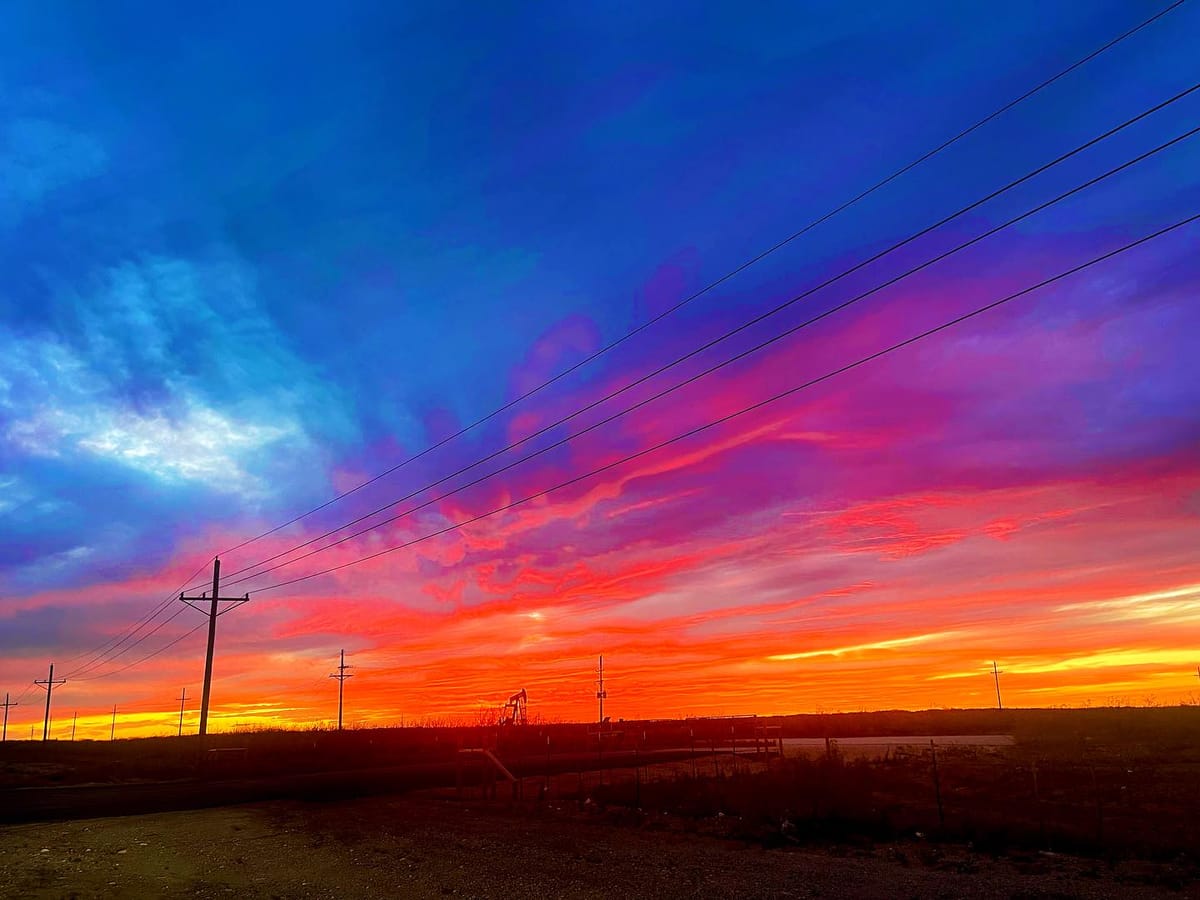
APPENDIX C: PEOPLE WHO CROSSED HIS PATH
The Rochas Family (France): Pierre Rochas (grandfather, died 1842); Marie Anne Murian (grandmother); François Charles Rochas (father, born La Merlière 4 November 1814); Anne Victoire Chaulon (mother, born 3 November 1816, died Vif 27 August 1878); Victoire Joséphine Henriette Rochas (sister, born 1846, married Laurent Célestin Griat 1884); Joseph Charles Henri Rochas (brother, born 1849, married 1882); Pierre Auguste Rochas (brother, born 1852); Léon Charles Eugène Rochas (brother, born 1855); Marie Pauline Rochas (sister, born 1858); Emile Joseph Célestin Griat (nephew, born Vif 22 December 1886); François Ribaud (possible French descendant, visited New Mexico).
Vif: Curé Joseph Ollier (curé of Vif 1850–1874, Rochas' priest); the bell Eugénie-Marie-Pauline (cast 1863, Burdin Aîné, Lyon, E note, 1,300kg).
The French Network, New Mexico: Archbishop Jean-Baptiste Lamy (1814–1888); Quintus Monier (1853–1923, Clermont-Ferrand); Étienne Lacassagne (1842–1903, Marseille); Father Pierre Lassaigne (died 1909, Las Cruces); Numa Reymond (1847–1917, La Chaux-de-Fonds); Theodore Rouault (1850–1940, Combourg, Brittany).
The Sisters of Loretto: Mother Magdalen Hayden (Joanna Hayden, 1813–1894, County Kilkenny); Matilda Mills (died on the Santa Fe Trail, 1852); Sisters Roberta Brown, Rosanna Dant, Catherine Mahoney; Phillip August Hesch (1828–1914, Preston, Ontario, added handrails 1887); Projectus Mouly (architect, died 1879).
La Luz Community: Faustino Dominguez Acuña (1846–1929, Juárez, blacksmith 1885, Justice of the Peace 1894); David M. Sutherland (1843–1932, Ohio, stockman, neighbour, made the inventory); John Thomas Fortson (1821–1899, Elbert County Georgia, first postmaster, buried same cemetery as Rochas); Perry B. Kearney (1858–1930, Wisconsin, homesteader 1882); Baca family (original settlers, stage stop); Gutierrez family (prominent settlers; Juan José Gutierrez, author of The La Luz I Remember); Robert Baca (worked with Denise in Alamogordo, likely of the La Luz family).
The Death and Investigation: Oliver Lee (1865–1941, Buffalo Gap Texas, named by Miller as one of the three men); Dan Fitchett (rancher, associated with Lee, reported the death); Eli "Slick" Miller (1871–1901, Colfax County, cattle rustler, Pinkerton informant); William B. Sayers (1853–after 1900, Ireland, Pinkerton detective, Denver); Governor W.T. Thornton; the three men at the door (one named by Miller as Lee; two unnamed).
Financial: John Henry Riley (1850–?, Valentia Island County Kerry Ireland, bought the Rochas herd); Theodore Rouault (estate administrator); H. Clay Phillips (U.S. Consul at Grenoble, filed declaration in probate file).
The Tularosa Basin World: Bronco Sue Yonkers (born Susie Warfield, Wales, 1854; connected to John Good; defended by Fountain; vanished to Arizona 1886); John Good (first Texas cattleman in La Luz area); Colonel Albert Jennings Fountain (prosecuted Miller, defended Bronco Sue, disappeared 1896); Bill McCall (1874–1966, Radium Springs, Sonnichsen's 1948 informant).
The Niblo's Company, Exchange Hotel, March 1878: Washington ("Wash") Antonio (Harlequin, acrobat, son of Signor, injured 1879); Annie Antonio (singer and dancer); Lottie Antonio (performer); Signor Antonio (father, died April 1877); Dan J. Sprague (stage manager).
The Recovery: C. L. Sonnichsen (1901–1995); Mary Jean Straw Cook (identified Rochas as staircase builder, early 2000s).
The Author: Denise Choppin, visited Dog Canyon early 1980s while heavily pregnant, accompanied by husband and German Shepherd Chow Chow mix Simon, formerly resident of Treviso and Venice Italy, writing this monograph from southern Ontario.
APPENDIX D: MONIER LETTER
Transcribed in Sonnichsen, Tularosa, from the original in the Frank Rochas Probate File, Doña Ana County Court House, Las Cruces, New Mexico. Written in French; this is Sonnichsen's English translation.
[Full text reproduced above.]
APPENDIX E: FURTHER RESEARCH — OPEN QUESTIONS
The Compagnons du Devoir: The Musée du Compagnonnage in Tours (museecompagnonnage.fr) maintains a searchable database. A search for "Rochas" has not been conducted.
The full probate inventory: Sonnichsen quotes selectively. The complete document is in the Frank Rochas Probate File at the Doña Ana County Court House, Las Cruces.
The carpentry tools: The probate file may contain disposition records showing to whom the tools were sold and for how much. Never published.
H. Clay Phillips, U.S. Consul at Grenoble: His declaration in the probate file may contain biographical details about Rochas' French origins not available elsewhere.
The 1984 Bulletin: A copy of Bulletin des Amis de la Vallée de la Gresse et des Environs, No.14, Noël 1984, should be sought through the municipality of Vif. Also: Bulletin No.90 contains the curé list. Histoire de Vif by Yves Armand and Jean-Claude Michel should be obtained directly from the Mairie de Vif.
The stammering surveyor: Identifiable through Santa Fe surveying records of the period.
The cottonwood: Oliver Lee Memorial State Park should be asked whether the cottonwood at the pool at the canyon mouth still stands.
The Rio Grande Republican, 10 July 1886: Sonnichsen's second citation on the Morrison shooting. Not yet retrieved. May report whether Morrison was caught.
─── ❖ ── ✦ ── ❖ ───
A Frenchman in Dog Canyon:
The Recovery of François-Jean Rochas, Known as Frenchy
© Denise J. Choppin. All rights reserved.
─── ❖ ── ✦ ── ❖ ───
Here are links to a couple of other "endling" biographies I have written:
 Denise Choppin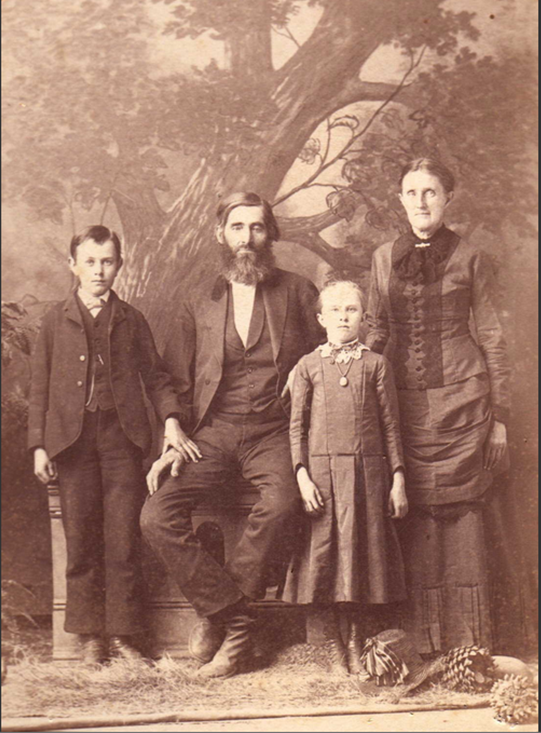
 mjb
mjb